How to Cast a Fishing Rod: The Overhead Cast, Step by Step
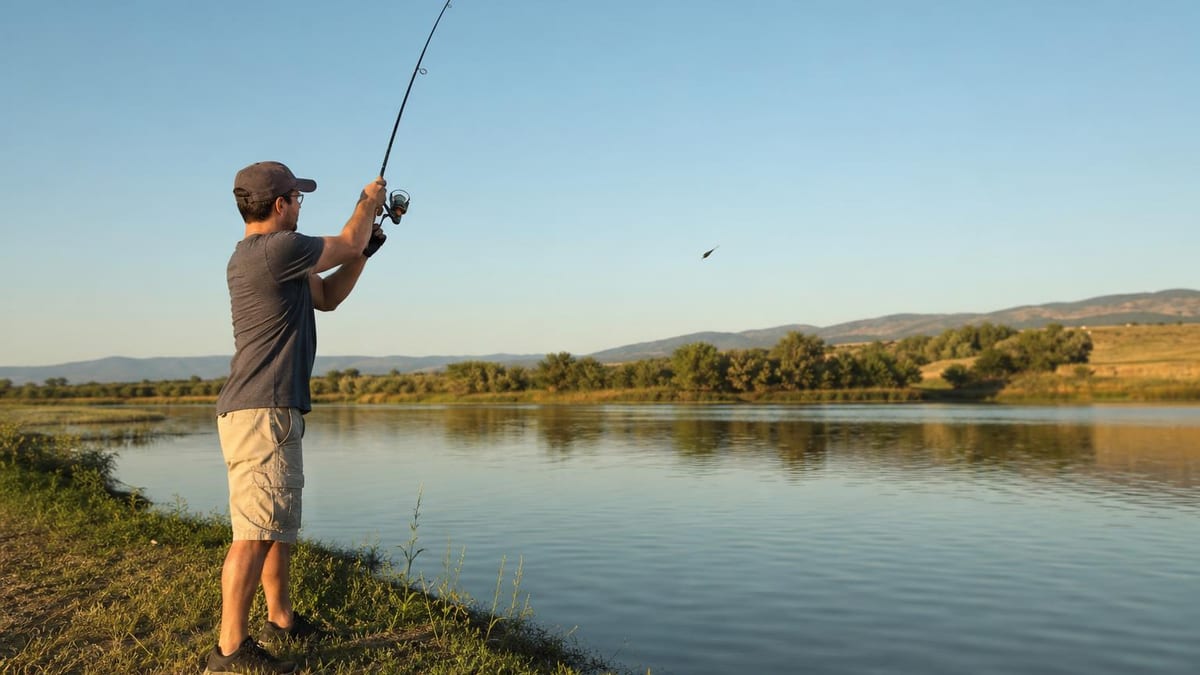
Face the target a quarter-turn off, rod tip at eye level. Hold the line — thumb button on a spincast reel, index finger on a spinning reel. Bend at the elbow until the rod is almost vertical and loads under the lure's weight, then move the forearm forward and release when the rod returns to eye level. Texas Parks and Wildlife teaches these exact steps.
Key takeaways
- Minnesota's DNR states that the weight of the lure and the drag on the line determine casting distance, not how much power you use.
- The same agency's instruction is that accuracy is more important than distance — the target is cover, not the horizon.
- Texas Parks and Wildlife gives the same release point for both reel types: when the rod comes back down to eye level.
- A cast that lands at your feet was released too late; one that goes straight up was released too soon. Both agencies give that identical diagnosis.
- Every agency casting lesson leads with the same safety step: look overhead and behind you before the rod moves.
The sentence that fixes most casts
Before any of the steps, one correction does more work than the rest combined. Minnesota’s Department of Natural Resources states it in its casting lesson:
The weight of the lure and drag on the line determine the distance of the cast, not how much power you use. Remember that, in casting, accuracy is more important than distance.
Almost every beginner casts by throwing harder. The rod is a spring, and the lure is what loads it. Power applied outside that timing goes into noise, tangles and the overhead branches.
The second half of the quote matters just as much. The agency’s practice targets sit about twenty feet away, and it tells students to think of them as habitat — sunfish live close to shore under docks and near plants and fallen logs. Twenty accurate feet beats sixty random ones.
Before the rod moves
Every agency casting lesson opens the same way, and it is not boilerplate. A hook on the end of a loaded rod travels fast.
Minnesota’s DNR puts the check inside the casting procedure itself: look over your shoulder to make sure no one is standing behind you, and look overhead and behind you for any obstructions — power lines, tree branches, bushes, pets — before you cast. Its scoring rubric rewards a student who always looks to the side, front and back before casting, and who carries the rod and reel in a vertical position.
Two more from the same agency’s take-along guide:
- when fishing from shore, stay a pole’s length away from your neighbour
- when fishing off a pier, do not bother casting — drop your line straight down
And one that surprises people: do not cut line with your teeth. The agency notes that people can chip teeth or swallow a loose piece of line, and recommends nippers or nail clippers instead.
The overhead cast, by reel type
Both casts are the same arm motion. Only the release differs — a thumb button on a spincast reel, an index finger on a spinning reel. These steps are Texas Parks and Wildlife’s, from its beginning-angler guide.
| Step | Spincast (push-button) | Spinning (open-bail) |
|---|---|---|
| Grip | Hold the pistol grip, push the thumb button down and hold it in | Reel stem between your middle fingers, forefinger extended to the spool cover, bail opened with the other hand |
| Stance | Face the target a quarter turn off, rod tip aimed at it about level with your eyes | Same, with the rod arm closest to the target |
| Load | Bend the arm at the elbow, raising the rod until it almost reaches eye level; the rod bends back under the plug’s weight | The same single swift, smooth motion |
| Drive | As the rod bends, move the forearm forward with a slight wrist movement | Identical |
| Release | When the rod reaches eye level, release the thumb button | When the rod reaches eye level, straighten your forefinger to let the line go |
Minnesota’s DNR teaches the same cast with a different landmark, which some people find easier to feel than to see: the rod tip travels back to about ten o’clock and forward to about two o’clock. If you are unsure which rig you are holding, our guide to choosing a fishing rod and the comparison of spinning and baitcasting gear cover the differences.
Diagnosing a bad cast in one glance
The useful thing about the overhead cast is that the failure tells you what went wrong. Both agencies give the same reading, independently.
| What happened | What it means | Fix |
|---|---|---|
| The lure landed close in front of you | Released too late | Let go earlier — as the rod comes down to eye level, not after |
| The lure went more or less straight up | Released too soon | Hold a fraction longer; let the rod come forward first |
| The line tangled around the rod | The fault was in the back cast | Go slowly and smoothly on the way back |
Minnesota’s DNR names the first two the Grounder and the Lob, and the third the Winder. Texas Parks and Wildlife gives the identical first two diagnoses for both reel types. When two agencies that never coordinated describe the same three errors, you are looking at the actual failure modes of the motion rather than one instructor’s opinion.
Which reel to learn on
Minnesota’s DNR is direct about this, and its reasoning is about tangles rather than performance.
Closed-face (push-button, spin-cast): the reel sits on top of the rod behind a cover, the rod is about five feet long with small guides, and the agency calls it the simplest type to learn to use because the line is less likely to tangle. Affordable, and typically used for panfish.
Open-face (spinning): the reel hangs below a longer rod with larger-diameter guides that release line more quickly, which lets you cast further and suits lightweight lures. The agency describes it as somewhat more complicated to learn and more prone to tangling, and recommends light line — about 4 to 10 pound test — because heavy monofilament springs off the open spool and tangles easily. Our fishing line types guide covers what that means in practice.
Baitcasting: not recommended for novice anglers who are learning to fish, in the agency’s words, because the line tangles easily without familiarity.
Fly casting is a different skill entirely — the line, not the lure, carries the weight — and our how to fly cast guide covers it separately.
Practising without water
You do not need a lake to get good at this, and agencies assume you will not use one. Practice is done with a casting plug — a hookless weight — and the take-along guide points out you can buy one or make your own from a piece of wood and an eye screw.
Minnesota’s DNR sets up practice as a lane: targets about twenty feet away, three casts per turn, aiming at objects that stand in for cover. Cast outside with the wind rather than against it while you are learning. Tie the plug on with an improved clinch knot — the same knot the lesson pairs with its casting session.
When you do get to water, aim where the agency aims: under docks, beside plants, against fallen logs. Our guide to reading water covers finding those targets, and shore fishing basics covers working them from the bank.
Before you go
Fishing licences, permitted gear and access rules are set by your state agency, and some waters and parks restrict where you may cast from. Our licences and regulations guide explains where to look them up.
Frequently asked questions
How do you cast a spinning reel?
Texas Parks and Wildlife gives five steps. Grasp the rod's handle with the reel stem between your middle fingers and extend your forefinger to touch the spool cover, then open the bail with your other hand. Face the target a quarter turn off, with the rod arm closest to the target, and aim the rod tip at the target about eye level. In one swift, smooth motion bend your casting arm at the elbow and raise your forearm until your hand is almost at eye level. When the rod is almost straight up and down it will bend under the weight of the plug — as it bends, move your forearm forward with a slight wrist movement. When the rod reaches eye level, straighten your forefinger to release the line.
How do you cast a push-button reel?
The same motion, with a simpler release. Texas Parks and Wildlife describes grasping the pistol grip with one hand, pushing the thumb button down and holding it in, then facing the target a quarter turn off with the rod tip aimed at it about level with your eyes. Bend the arm at the elbow swiftly and smoothly, raising the rod until it almost reaches eye level; as the rod bends back under the plug's weight, move the forearm forward with a slight wrist movement. When the rod reaches eye level, release the thumb button. Minnesota's DNR teaches the identical cast and adds a useful marker: the rod tip travels back to about ten o'clock and forward to about two o'clock.
Why does my cast land at my feet?
You released too late. Both agencies give the same diagnosis: Texas Parks and Wildlife writes that if the plug landed close in front of you, you released too late, and Minnesota's DNR calls the same fault the Grounder — the tackle goes straight down because the button came up just a bit too late. The opposite fault is the Lob: if the plug goes more or less straight up, the release was too soon. There is a third, the Winder, where the tackle tangles around the rod; Minnesota's DNR attributes that to the back cast and prescribes going slowly and smoothly on the way back.
How far should I be able to cast?
Less far than you think, and more accurately. Minnesota's DNR is explicit that the weight of the lure and the drag on the line determine the distance of the cast, not how much power you use, and that in casting, accuracy is more important than distance. Its practice layout puts the targets about twenty feet away, and it frames them as fish habitat: sunfish live close to shore under docks and near plants and fallen logs, so those are what you aim at. Distance rarely decides a day of fishing. Putting a bait beside a log does.
What is the first thing to check before casting?
What is behind you. Minnesota's DNR puts it in the procedure itself: look over your shoulder to make sure no one is standing behind you, and look overhead and behind for any obstructions such as power lines, tree branches, bushes and pets before you cast. Its assessment rubric scores this — the top mark is always looking to the side, front and back before casting, and carrying the rod and reel in a vertical position. The agency's take-along guide adds two more: stay a pole's length away from your neighbour when fishing from shore, and when fishing off a pier, do not bother casting at all — drop your line straight down.
Which reel is easier to learn on?
The closed-face one, by the agency's own account. Minnesota's DNR describes closed-face reels — also called push-button or spin-cast — as the simplest type to learn to use, because the line is less likely to tangle than with an open-face reel. Open-face spinning reels release line more quickly through larger guides, which lets you cast further and suits lightweight lures, but the agency notes they are somewhat more complicated to learn and more prone to tangling, and recommends light line of about 4 to 10 pound test because heavy monofilament springs off the open spool. Baitcasting reels are explicitly not recommended for novices.
Sources
- Fish Texas: A Basic Guide for the Beginning Angler — Casting Tips — Texas Parks and Wildlife Department. Accessed September 22, 2026.
- Fishing: Get in the Habitat! Lesson 5:2 — Casting a Closed-face Rod and Reel Combo — Minnesota Department of Natural Resources (MinnAqua) / USFWS Sport Fish Restoration. Accessed September 22, 2026.
- Fishing: Get in the Habitat! Lesson 5:1 — Freshwater Rods and Reels — Minnesota Department of Natural Resources (MinnAqua) / USFWS Sport Fish Restoration. Accessed September 22, 2026.
- Pier Notes: Casting, Finding, Landing, and Fish Senses — Minnesota Department of Natural Resources (MinnAqua). Accessed September 22, 2026.
- Casting an Open-bail Spinning Reel — U.S. Fish and Wildlife Service. Accessed September 22, 2026.
How we choose sources: sources policy.
More in this series
Know when it's worth going.
Fishing Club AI turns live weather, pressure and moon data into a simple bite forecast for your spot — so the skills you practise get used on the right day.
Get the App