Largemouth Bass
Micropterus salmoides
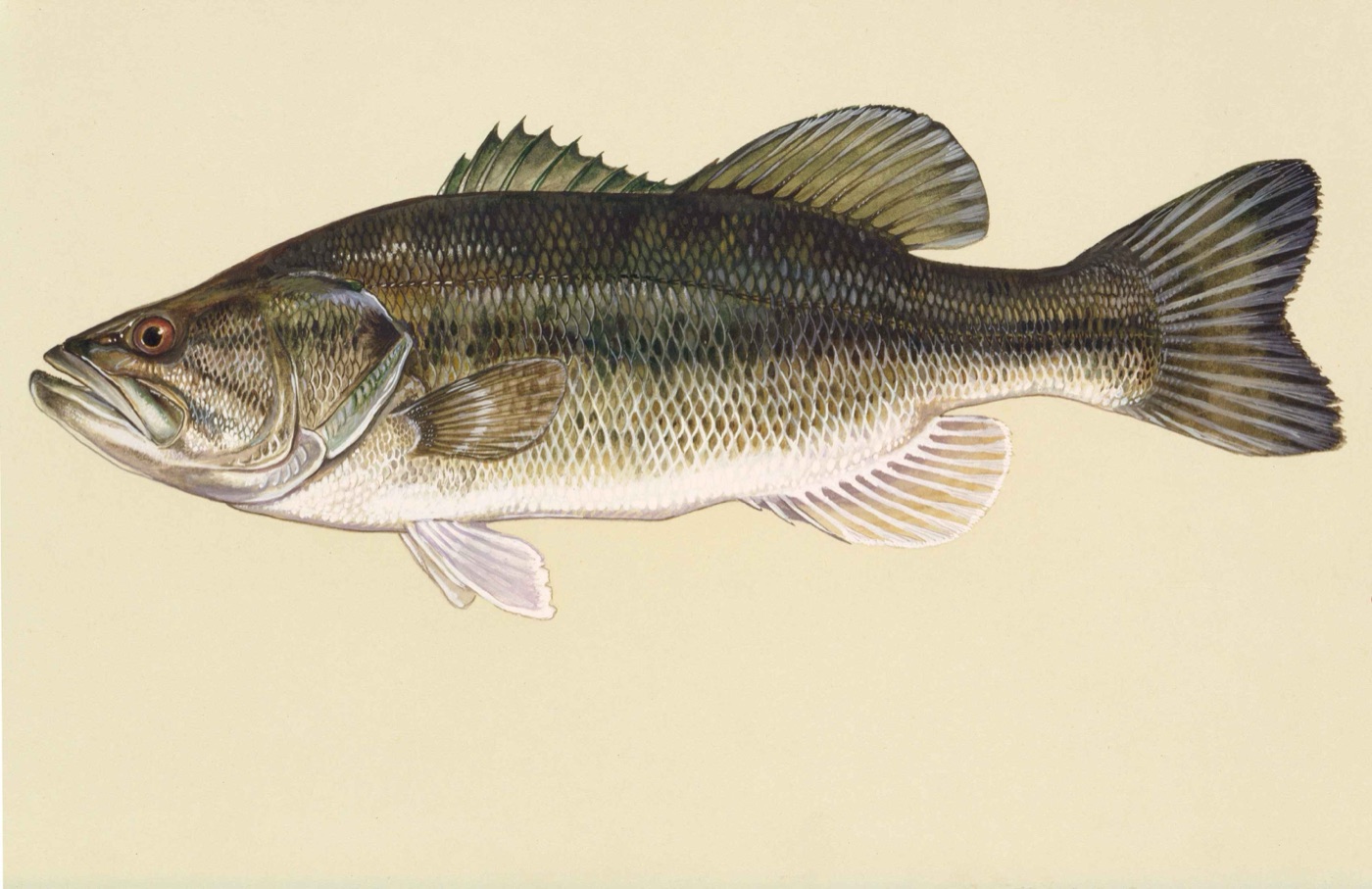
Largemouth bass is a large freshwater predatory fish of the sunfish family, distinguished by an upper jaw that extends past the rear edge of the eye.
MoreFull Species Details
- Species Name
- Micropterus salmoides
- Family
- Centrarchidae
- Order
- Centrarchiformes
- Also Known As
- Bucketmouth, Green bass, Bigmouth bass, Black bass
Largemouth Bass (Micropterus salmoides) Fish Description
Largemouth bass is a large freshwater predatory fish of the sunfish family, distinguished by an upper jaw that extends past the rear edge of the eye.
The body is olive-green to dark green on the back, fading to a pale, off-white belly, with a broken horizontal band of dark blotches running the length of each flank. The dorsal fin is nearly divided into two parts, spiny in front and soft behind. A largemouth's mouth is its defining trait: the jaw hinge sits behind the eye, unlike the smaller-mouthed smallmouth and spotted bass. Adults are stout and deep-bodied, built for short, explosive ambush strikes rather than sustained pursuit. Coloration darkens in clear water and lightens in murky or stained water, helping the fish blend with its surroundings.
Largemouth bass is native to the eastern and central United States and northern Mexico. Anglers and agencies have since introduced the species across all of the lower 48 states and to more than fifty countries, making it one of the most widely stocked freshwater gamefish on earth. It thrives in warm, weedy lakes, slow rivers, and farm ponds. Anglers pursue largemouth for the violence of the strike and the fish's willingness to attack a huge range of lures, from surface frogs to deep plastic worms.
Interesting Facts About Largemouth Bass
- The world record largemouth bass weighed 22 pounds 4 ounces, tied between Georgia (1932) and Japan (2009).
- Largemouth bass can live up to 16 years in the wild.
- The species can detect vibrations through a lateral line running along each side of its body.
- Largemouth spawn when water temperatures reach roughly 60 to 75 degrees Fahrenheit.
- Males build and guard the nest, fanning out a shallow bed in gravel or sand.
Show more facts
- A large female can carry more than 100,000 eggs in a single season.
- Largemouth bass strike prey by engulfing it in a rapid suction of water.
- The species tolerates water temperatures from near freezing to about 90 degrees Fahrenheit.
- Largemouth are ambush predators that rarely chase prey over long distances.
- Trophy fish over 10 pounds are almost always females.
- Largemouth bass is the official state fish of Georgia, Mississippi, Alabama, and Florida.
- The species can go months without feeding during cold winter periods.
Average Speed & Size
Largemouth bass is a burst-swimming ambush predator that typically reaches 12 to 20 inches and 1 to 5 pounds. Trophy fish exceed 24 inches and 10 pounds, with the largest approaching 22 pounds. The species relies on a sudden, powerful lunge rather than sustained speed, accelerating from cover to engulf prey within a fraction of a second. Between strikes, largemouth hold nearly motionless beside structure, conserving energy until an opportunity passes within range.
Where to Find Them
Largemouth bass is found in warm, still or slow-moving freshwater across most of North America. The species concentrates around cover: submerged weed beds, fallen timber, docks, and drop-offs that offer shade and ambush points. Largemouth favor water between 65 and 80 degrees Fahrenheit and hold shallow in spring and fall, moving deeper during summer heat and winter cold. Clear lakes, murky ponds, and vegetated river backwaters all hold fish. Largemouth are largely absent from cold, fast trout streams and high mountain waters, which stay too cold for spawning.
Largemouth Bass Fishing Tips
Largemouth bass fishing is beginner-friendly yet endlessly deep, which is why it is the most popular freshwater target in the United States. Success comes down to fishing near cover and matching your lure to the season and water clarity.
Equipment
Use a 7-foot medium-heavy baitcasting or spinning rod paired with a reel spooled with 12- to 17-pound fluorocarbon or 30-pound braid. This setup handles everything from weightless worms to heavy jigs pulled out of thick cover. A fast-action tip aids hook sets, while a strong backbone drives the hook home and turns fish away from snags.
Chumming
Chumming is neither necessary nor legal for bass in most waters, so anglers instead draw strikes through lure presentation. Work a spot from multiple angles, vary retrieve speed, and cast repeatedly to visible cover. Reaction baits like spinnerbaits and lipless crankbaits provoke strikes from bass that are not actively feeding.
Bait
Live shiners and nightcrawlers are the most dependable natural baits. Among lures, soft plastic worms rigged Texas-style, skirted jigs, and topwater frogs consistently produce, matched to water clarity and season.
Patience
Largemouth hold tight to cover and often ignore a lure until it passes within inches, so work each spot thoroughly before moving. Slow presentations tempt wary, pressured fish.
Conditions that change the bite
- What Barometric Pressure Is Best for Fishing? No research supports a single best barometric pressure for fishing. What pressure really does, how big a weather swing is, and what to watch instead.
- Best Time of Day to Fish: What Evidence Shows Dawn and dusk are measurably better — and the edge is smaller than the folklore says. The 13-year dataset, the light mechanism, and what matters more.
- Dissolved Oxygen: The Condition Anglers Can't See Fish live or die by oxygen you can't see. How temperature, depth, dawn and turnover move it, which species need more, and how to fish around the invisible map.
Guides for fishing this species
- Bass Fishing for Beginners: Largemouth 101 Where largemouth bass hold, how the seasons move them, and the lure categories that catch them — a beginner's guide built on state agency sources.
- Catch and Release: Doing It So the Fish Survives Wet hands, under a minute of air, cut deep hooks, revive facing the current. NOAA and state agency best practices for releases that actually survive.
- Fishing Licenses: How the System Works and Where the Money Goes License sales plus excise taxes fund fisheries through a user-pays system dating to 1950. How the Sport Fish Restoration program works and why licenses matter.
- Fishing Line Types: Braid vs Mono vs Fluorocarbon Monofilament, fluorocarbon and braided line compared — stretch, visibility, sink rate and durability, what agencies actually say, and which to spool when.
- Fishing Soft Plastics How to rig soft plastics, what research shows happens when a fish swallows one, and why bass colour vision makes most tackle-aisle shades irrelevant.
- Fishing Tackle for Beginners: What You Actually Need, per the Agencies That Teach It Three agency beginner tackle lists overlap almost exactly. Here is the overlap — ten items — and the agencies' own reason for each one.
Related Species
Know when they'll bite.
BiteScore forecasts when largemouth bass will feed at your spot — from live weather, pressure, and moon data.
Get the App