Albacore Tuna
Thunnus alalunga
Albacore tuna is a medium-sized, warm-blooded species of the mackerel family, prized worldwide as the only tuna that may be labeled canned white meat.
MoreFull Species Details
- Species Name
- Thunnus alalunga
- Family
- Scombridae
- Order
- Scombriformes
- Also Known As
- Longfin tuna, Germon, Pigfish, Chicken of the sea
Albacore Tuna (Thunnus alalunga) Fish Description
Albacore tuna is a medium-sized, warm-blooded species of the mackerel family, prized worldwide as the only tuna that may be labeled canned white meat.
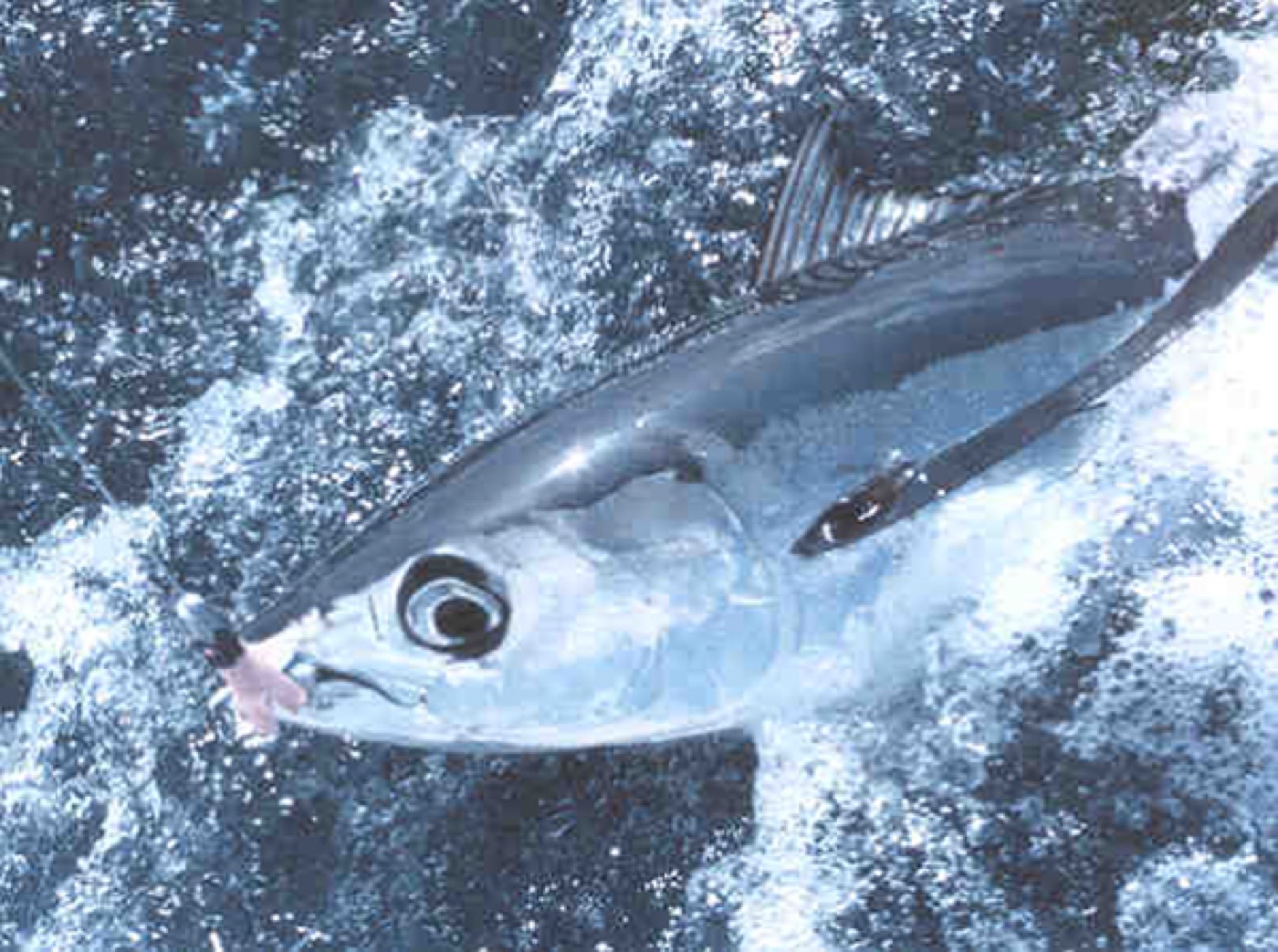
Its most distinctive feature is a pair of exceptionally long pectoral fins that reach well past the anal fin, giving the species its "longfin" name. The body is metallic dark blue across the back and shades to silvery white along the belly. A slender, torpedo-shaped profile and a series of small finlets running to the tail mark it clearly as a fast pelagic predator. The first dorsal fin is deep yellow, while the second dorsal and anal fins are pale. Mature fish carry a faint iridescent band along each flank, and the trailing edge of the tail shows a thin white margin.
Albacore inhabits temperate and tropical waters across every major ocean. The species migrates in large schools between feeding grounds and spawning areas, crossing entire ocean basins within a single year. In the eastern Pacific, young albacore appear off the US West Coast from summer into autumn, drawing a dedicated troll and live-bait fishery. Anglers seek albacore for two reasons: the fish fights with relentless, drag-burning runs, and its pale, mild flesh ranks among the most valuable table fare of any tuna.
Interesting Facts About Albacore Tuna
- Albacore is the only tuna species legally sold as canned "white" meat in the United States.
- The species can raise its body temperature far above the surrounding water using a countercurrent heat exchanger.
- Albacore reach sexual maturity at about 5 to 6 years of age.
- A single female can release 2 to 3 million eggs during one spawning season.
- The all-tackle world record albacore weighed 88 pounds 2 ounces, caught off the Canary Islands in 1977.
Show more facts
- Albacore can swim in sustained bursts approaching 50 miles per hour.
- The species has a lifespan of roughly 11 to 12 years in the wild.
- Albacore pectoral fins can exceed 30 percent of the fish's total body length.
- Schools often travel more than 600 miles per month during seasonal migration.
- Albacore must swim continuously to force oxygen-rich water over their gills.
- The North Atlantic albacore stock was declared rebuilt to sustainable levels in 2020.
- Commercial albacore troll and pole-and-line fisheries are among the most selective tuna fisheries worldwide.
Average Speed & Size
Albacore tuna is a fast-moving, highly migratory swimmer that typically reaches 16 to 40 inches and 9 to 40 pounds in recreational catches. Larger individuals exceed 50 inches and 80 pounds, though such fish are rare. The species relies on continuous high-speed swimming, cruising steadily for hours and accelerating in short bursts to run down bait. Its streamlined body and rigid tail make it one of the most efficient long-distance swimmers in the open ocean.
Where to Find Them
Albacore tuna is found in temperate and subtropical open ocean waters, generally where surface temperatures range from 60 to 66 degrees Fahrenheit. The species concentrates along temperature breaks, current edges, and offshore zones far from the coast, often 20 to 100 miles out. In the eastern Pacific, albacore run off Oregon, Washington, and California from July through October. Productive water is typically clear, deep blue, and warmer than the surrounding sea. Albacore are largely absent from cold polar seas and from shallow inshore bays, which lack the temperature and depth the species requires.
Albacore Tuna Fishing Tips
Albacore fishing is moderately difficult and rewards anglers who cover water and read ocean conditions. Success depends on locating the right temperature break far offshore, then presenting bait or lures at trolling speed.
Equipment
Use a 30- to 50-pound-class conventional rod paired with a fast, high-capacity lever-drag reel spooled with 40- to 50-pound monofilament or braided line. Rig fluorocarbon leaders of 30 to 40 pounds to counter the albacore's sharp eyesight. A stout, parabolic rod absorbs the species' hard, repeated runs without pulling hooks.
Chumming
Chumming with live anchovies or sardines is the most effective way to hold a moving school beside the boat. Once a trolled lure raises fish, deploy handfuls of live bait steadily to trigger a feeding frenzy. Frozen chum and a slow drip of chunked bait extend the bite when live bait runs short.
Bait
Live anchovies and sardines are the top bait choices, fished on a lightly weighted hook or free-lined into the chum line. Trolled feathers, cedar plugs, and skirted lures raise fish before the live-bait phase begins.
Patience
Albacore are wary of engine noise and leader shadow, so drift quietly once fish gather and let baits sink naturally. Steady, unhurried presentation outperforms aggressive casting.
Conditions that change the bite
- What Barometric Pressure Is Best for Fishing? No research supports a single best barometric pressure for fishing. What pressure really does, how big a weather swing is, and what to watch instead.
- Best Time of Day to Fish: What Evidence Shows Dawn and dusk are measurably better — and the edge is smaller than the folklore says. The 13-year dataset, the light mechanism, and what matters more.
- Dissolved Oxygen: The Condition Anglers Can't See Fish live or die by oxygen you can't see. How temperature, depth, dawn and turnover move it, which species need more, and how to fish around the invisible map.
Guides for fishing this species
- Fishing Line Types: Braid vs Mono vs Fluorocarbon Monofilament, fluorocarbon and braided line compared — stretch, visibility, sink rate and durability, what agencies actually say, and which to spool when.
Related Species
Know when they'll bite.
BiteScore forecasts when albacore tuna will feed at your spot — from live weather, pressure, and moon data.
Get the App