Yellowfin Tuna
Thunnus albacares
Yellowfin tuna is a fast-growing open-ocean predator of the mackerel family, recognised by the greatly elongated second dorsal and anal fins that trail back along its flanks.
MoreFull Species Details
- Species Name
- Thunnus albacares
- Family
- Scombridae
- Order
- Scombriformes
- Also Known As
- Ahi, Albacora, Rabil, Thon jaune
Yellowfin Tuna (Thunnus albacares) Fish Description
Yellowfin tuna is a fast-growing open-ocean predator of the mackerel family, recognised by the greatly elongated second dorsal and anal fins that trail back along its flanks.
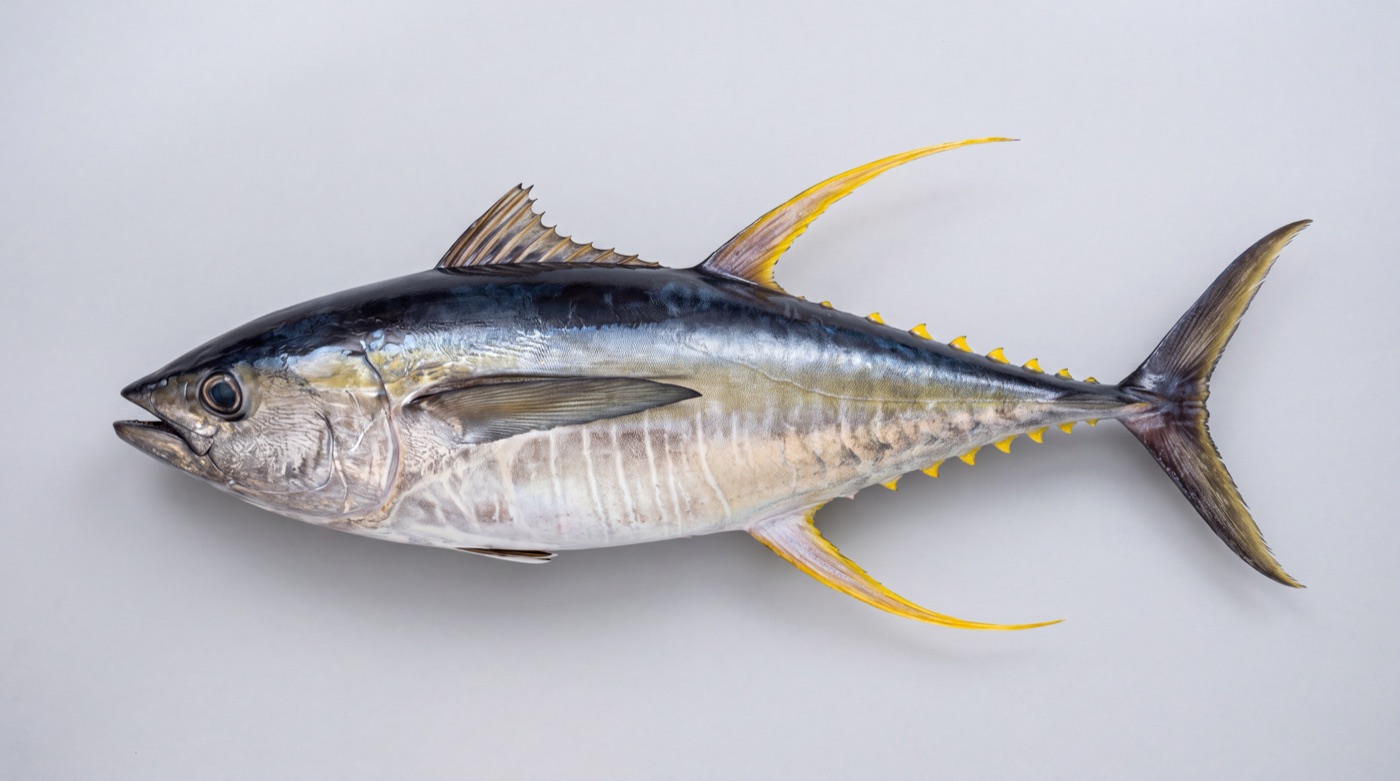
The body is the classic tuna shape — deep-blue above, silver below, built as a solid muscular spindle. What separates yellowfin from its relatives are the fins. In adults the second dorsal fin is very long, as is the anal fin directly beneath it; Florida's wildlife agency puts their length at roughly a fifth of the whole fish. Seven to ten finlets run along the top and bottom edges toward the tail, bright yellow and each bordered by a narrow band of black. NOAA describes the fish as marked by a long bright yellow dorsal fin and a yellow stripe down the side.
Yellowfin live in tropical and subtropical oceans between roughly 40°N and 35°S, and are absent from the Mediterranean. They are epipelagic fish that spend most of their lives in the top layer of open water but range far deeper on occasion. They gather around drifting flotsam, fish aggregating devices, anchored buoys and large marine animals — and in the eastern Pacific they famously school beneath dolphins, an association strong enough that protecting dolphin stocks became a policy priority in the purse seine fishery there. For a fish that reaches several hundred pounds, the yellowfin's life is remarkably short.
Interesting Facts About Yellowfin Tuna
- They live only about six to seven years — extraordinary for a fish that can exceed 300 pounds.
- Growth is explosive: roughly 7.5 pounds at 18 months and about 140 pounds by age four.
- Females spawn almost daily during the season, releasing millions of eggs each time.
- Most yellowfin can reproduce by age two.
- The second dorsal and anal fins are very long in adults — about a fifth of the total length.
Show more facts
- The bright yellow finlets are each edged with a narrow black border.
- In the eastern Pacific, larger yellowfin school in association with spotted, spinner and common dolphins.
- That tuna-dolphin association is why dolphin protection became a priority in the eastern Pacific purse seine fishery.
- One tagged fish reached a maximum depth of 1,014 metres.
- Despite that, they spend 94% of their time in the surface layer above 100 metres.
- The depth pattern is strongly daily: shallow at night, deeper by day, with deep dives often at sunrise.
- They actively modulate heat transfer, which prevents overheating during hard swimming and slows heat loss on a descent into cold water.
Average Speed & Size
Yellowfin grow faster than almost any fish of comparable size and then die young. Florida's wildlife agency gives a common length of 60 inches, while the species maximum reported is 110 inches and 880 pounds, and NOAA describes fish up to six feet and 400 pounds. The Florida Museum reports the all-tackle rod-and-reel record as 388 pounds 8 ounces. The body is a stiff muscular spindle built for sustained speed, and a hooked yellowfin runs long and then fights in deep, punishing circles beneath the boat. We have not found a measured swimming speed for the species from a source we can verify, so we do not quote one.
Where to Find Them
Yellowfin are open-ocean fish that stay high in the water column. The Florida Museum places them generally in the upper 330 feet, and tagging work found 94% of time spent above 100 metres despite one recorded dive to 1,014 metres. NOAA gives a temperature preference of 64 to 88 °F. Look for them around floating objects — flotsam, fish aggregating devices, anchored buoys — and around large marine animals including dolphins, which concentrate them reliably. They live both above and below the thermocline, with older fish often found deeper. Depth changes through the day: shallow at night, deeper during daylight, with the deepest dives frequently at sunrise.
Yellowfin Tuna Fishing Tips
Yellowfin fishing is offshore fishing, and the hard part is finding them rather than making them bite. Structure in open water — anything floating, and any concentration of life — is what turns thousands of square miles into a place worth stopping.
Equipment
Heavy offshore tackle is not optional. A stand-up rod with a high-capacity lever-drag reel and several hundred yards of heavy line is the baseline, because a big yellowfin will take a long first run and then fight vertically for a long time. Circle hooks reduce deep hooking, which matters when you may release a fish.
Chumming
Chunking — a steady stream of cut baitfish drifting back from a stopped boat — is the standard way to hold a school once you find one. Because these fish feed competitively in the surface layer, a consistent chum line often brings them close enough to sight-cast to.
Bait
Live baitfish are hard to beat when the fish are feeding selectively. Trolled lures and rigged natural baits cover water while you search, and vertical jigs work well on fish holding deeper in daylight.
Patience
Time of day does real work here. The daily depth pattern means surface presentations tend to be more productive around dawn, dusk and at night, while daytime fish may be well below the surface and need a bait taken down to them.
Conditions that change the bite
- What Barometric Pressure Is Best for Fishing? No research supports a single best barometric pressure for fishing. What pressure really does, how big a weather swing is, and what to watch instead.
- Fishing After Rain: What Runoff Actually Changes Rain rewrites four things at once: clarity, flow, temperature and oxygen. What runoff actually does to the water, which fish it favors, and when to go back.
- Reading River Levels: Fishing by the Gauge More than 13,500 USGS streamgages report stage and flow in near real time. How to read gauge height, cfs and the hydrograph before you drive to the river.
Guides for fishing this species
- Fishing Line Types: Braid vs Mono vs Fluorocarbon Monofilament, fluorocarbon and braided line compared — stretch, visibility, sink rate and durability, what agencies actually say, and which to spool when.
Related Species
Know when they'll bite.
BiteScore forecasts when yellowfin tuna will feed at your spot — from live weather, pressure, and moon data.
Get the App