Striped Bass
Morone saxatilis
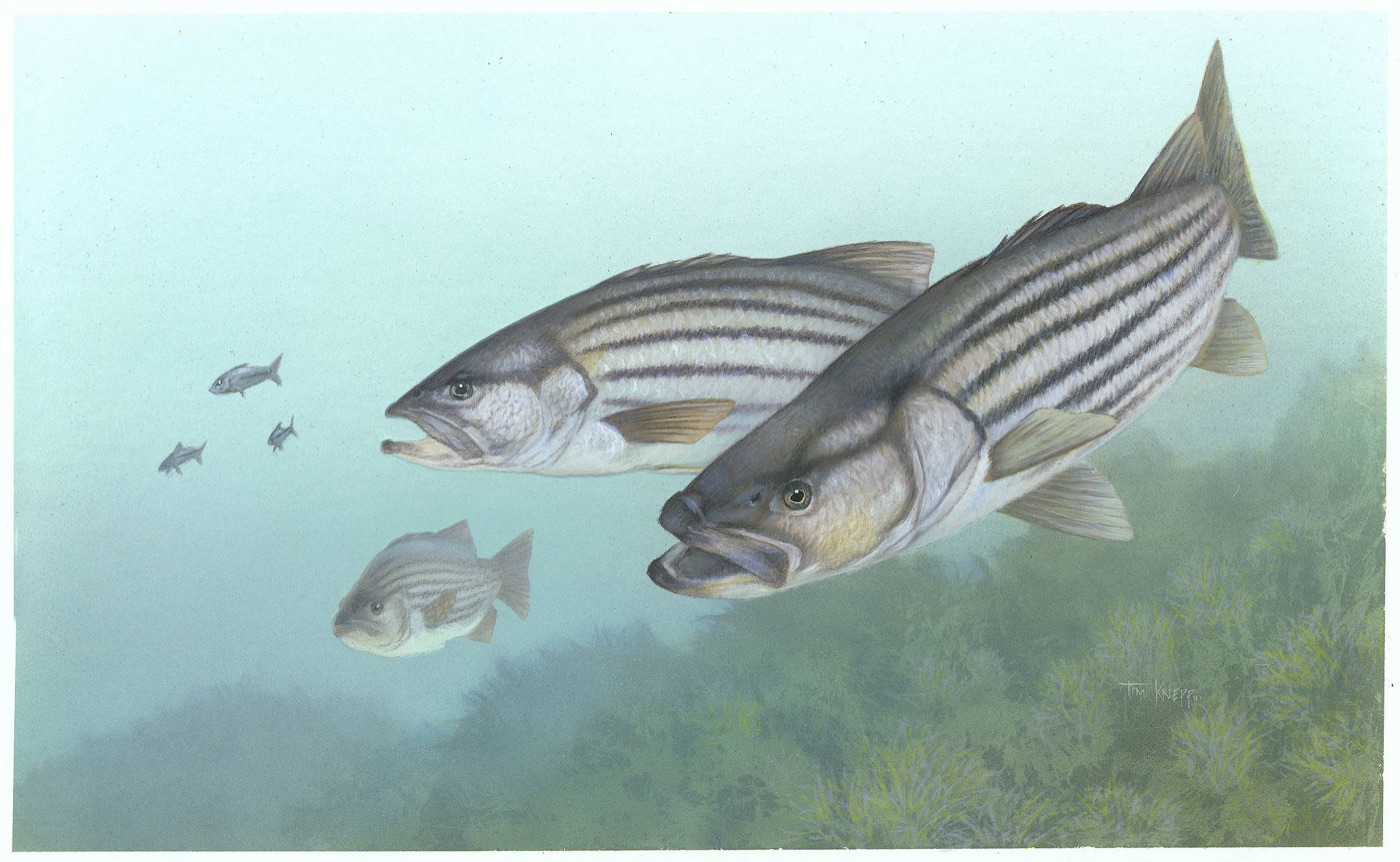
Striped bass is a large migratory fish of the temperate bass family, named for the seven or eight dark horizontal stripes running along its silvery sides.
MoreFull Species Details
- Species Name
- Morone saxatilis
- Family
- Moronidae
- Order
- Perciformes
- Also Known As
- Striper, Rockfish, Linesider, Atlantic striped bass
Striped Bass (Morone saxatilis) Fish Description
Striped bass is a large migratory fish of the temperate bass family, named for the seven or eight dark horizontal stripes running along its silvery sides.
The body is streamlined and moderately deep, dark olive to steel-blue across the back and bright silver along the flanks, with distinct unbroken stripes from the gills to the tail. Two separate dorsal fins, the first spiny and the second soft-rayed, sit clearly apart on the back. The head is pointed and the mouth large, set with a projecting lower jaw. Striped bass grow far larger than most inshore gamefish, and older females develop a deep, heavy-shouldered profile. The stripes are sharpest on healthy adults and can fade on fish from murky or brackish water.
Striped bass is native to the Atlantic coast of North America, from the St. Lawrence River to northern Florida and along the Gulf coast. The species runs from salt water into freshwater rivers to spawn, and landlocked populations now thrive in reservoirs across the country after decades of stocking. Anglers prize striped bass for their size, dogged fights, and the drama of a coastal run, when large schools chase bait through the surf within casting range of the beach.
Interesting Facts About Striped Bass
- The world record striped bass weighed 81 pounds 14 ounces, caught off Connecticut in 2011.
- Striped bass can live more than 30 years in the wild.
- A single large female can release up to 3 million eggs in one spawning season.
- The species must return to fresh or brackish water to spawn successfully.
- Striped bass migrate hundreds of miles along the Atlantic coast each year.
Show more facts
- Fish over 30 pounds are almost always females, known to anglers as cows.
- Striped bass were introduced to the US Pacific coast in 1879 and 1882.
- The species can tolerate a wide range of salinity, from fresh water to full seawater.
- Striped bass feed most actively at dawn, dusk, and through the night.
- Young striped bass often travel in large schools for protection and feeding.
- The striped bass is the official state fish of Maryland, Rhode Island, and South Carolina.
- Commercial and recreational striped bass fishing is tightly regulated to protect the stock.
Average Speed & Size
Striped bass is a powerful, sustained swimmer that typically reaches 20 to 40 inches and 5 to 30 pounds. Trophy fish exceed 50 inches and 50 pounds, with the largest surpassing 80 pounds. The species cruises steadily along coastlines and through currents, then accelerates in strong bursts to run down schools of baitfish. Its muscular body and broad tail make it one of the hardest-pulling inshore gamefish, capable of long, line-peeling runs once hooked.
Where to Find Them
Striped bass is found along the Atlantic coast, in coastal rivers and estuaries, and in many inland reservoirs. The species holds near structure that concentrates bait: rock piles, jetties, bridge pilings, drop-offs, and current rips. Striped bass follow migrating baitfish into the surf zone and up tidal rivers, feeding hardest on moving water around dawn and dusk. Coastal fish move north in spring and south in autumn as water temperatures shift. Striped bass are absent from tropical reefs and warm offshore waters, which lie outside their preferred temperate range.
Striped Bass Fishing Tips
Striped bass fishing ranges from beginner-simple to highly technical, depending on the water. Success depends on locating bait and fishing moving tide or current, when stripers feed most aggressively.
Equipment
Use a 7- to 9-foot medium-heavy rod paired with a high-capacity spinning or conventional reel spooled with 20- to 40-pound braid and a 30-pound fluorocarbon leader. Surf anglers favor longer rods for distance, while boat anglers use shorter, stouter setups for casting and jigging. Strong terminal tackle is essential to turn large fish away from rocks and pilings.
Chumming
Chumming with cut menhaden, clams, or grass shrimp is a proven way to draw striped bass into range from an anchored boat. Establish a steady scent trail up-current and drift baited hooks back through the slick. On moving tide, the chum disperses naturally and pulls feeding fish toward the boat.
Bait
Live eels, menhaden, and bunker are the top live baits, while clams and bloodworms excel from the surf. Effective lures include swimming plugs, bucktail jigs, and soft-plastic paddletails.
Patience
Striped bass often feed in short, tide-driven windows, so timing matters more than constant casting. Fish the moving water and wait out the slack, when the bite typically slows.
Conditions that change the bite
- What Barometric Pressure Is Best for Fishing? No research supports a single best barometric pressure for fishing. What pressure really does, how big a weather swing is, and what to watch instead.
- Best Time of Day to Fish: What Evidence Shows Dawn and dusk are measurably better — and the edge is smaller than the folklore says. The 13-year dataset, the light mechanism, and what matters more.
- Dissolved Oxygen: The Condition Anglers Can't See Fish live or die by oxygen you can't see. How temperature, depth, dawn and turnover move it, which species need more, and how to fish around the invisible map.
Guides for fishing this species
- Best Conditions for Surf Fishing: Reading Tide, Wind and Swell Together How to read surf fishing conditions as a system — tide, wind and swell together — using official NOAA and NWS data, plus safety guidance for the beach.
- Fishing Line Types: Braid vs Mono vs Fluorocarbon Monofilament, fluorocarbon and braided line compared — stretch, visibility, sink rate and durability, what agencies actually say, and which to spool when.
- How to Snell a Hook: The Snell Knot The traditional snell knot in five diagrammed steps — why wrapping the shank instead of the eye changes hooksets, and where snelling shines.
- How to Tie a Double Uni Knot The double uni knot in five diagrammed steps — the standard way to join braid to leader or any two lines, with the wrap counts that make it work.
- How to Tie a Uni Knot The uni knot in five diagrammed steps — one tying motion that handles hooks, lures, line joins and the reel spool, and why it earns the name 'uni'.
- The Fish Finder Rig: Sliding Sinker Bottom Fishing How to build the fish finder rig — sliding sinker, bead, swivel, leader — why fish never feel the weight, and how to pair it with circle hooks.
Related Species
Know when they'll bite.
BiteScore forecasts when striped bass will feed at your spot — from live weather, pressure, and moon data.
Get the App