How to Read Water
Reading water means recognising the sequence a river repeats — riffle, run, pool, glide — and knowing that fish hold in slow water immediately beside fast water, where food arrives without the cost of swimming in the current. State and federal biologists separate those units by measured depth and velocity, and the same thresholds tell you where to cast.
Key takeaways
- Rivers repeat the same four units, and biologists separate them by measured depth and velocity thresholds.
- In one Wyoming study, 95% of brook trout observed sat where the current was under 15 cm per second.
- Holding behind a rock stops paying off in fast water — above about 50 cm per second the energy saved is lost attacking prey.
- A riffle can reaerate roughly thirty times faster than the pool beside it at low flow.
- In hot weather, pools stratify, and surface water can run 3 to 9 °C warmer than the bottom.
The sequence every river repeats
A river is not a uniform channel but a repeating set of four units, and once you can name them the water stops looking random. Agencies that survey stream habitat separate them by two measurements — depth and velocity — and the thresholds are worth carrying in your head because they are exactly what your eye is already estimating.
Pennsylvania’s Fish and Boat Commission draws the lines at 18 inches of depth and about one foot per second of current. A pool is slow water at least 18 inches deep. A glide is slow water shallower than that. A run is fast water at least 18 inches deep. A riffle is fast water no more than 18 inches deep. Deep and slow, shallow and slow, deep and fast, shallow and fast — that is the whole classification.
They form through the interaction of flow and sediment with whatever the channel is made of. Oregon’s Department of Fish and Wildlife describes habitat units as formed by discharge and sediment load acting against channel roughness — bedrock, boulders and large wood. That is why pools sit below obstructions and against banks the current is pushing into, and why the same features recur down a river rather than appearing at random.
The units also sort the bottom. Fine particles settle in slow water, so riffles and runs in good condition are largely free of them while pools and glides collect them. If you can see clean gravel, you are looking at fast water even when the surface does not show it.
Why fish sit beside fast water, not in it
Fish position themselves to be fed by current they are not swimming in, and the research on this is specific enough to fish by. Work on stream salmonids describes how velocity gradients created by channel roughness and flow obstructions matter especially to fish feeding on drifting invertebrates, because holding a focal point in slow water next to fast water lets a fish scan a large volume for prey while keeping swimming costs low.
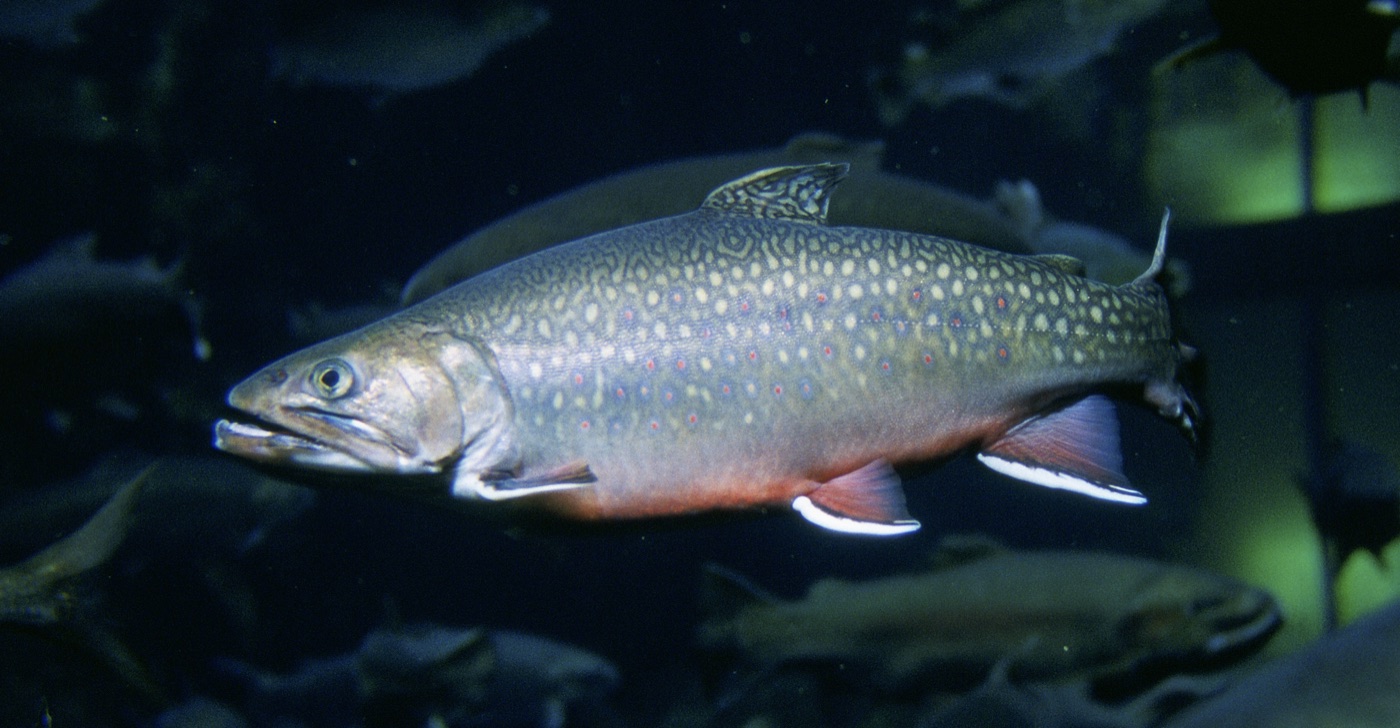
The numbers are striking. In a Wyoming study cited by the US Fish and Wildlife Service, 95% of all brook trout observed were associated with point velocities of less than 15 centimetres per second — about half a foot per second, which is barely moving. Those same fish are feeding on food travelling far faster, a metre away.
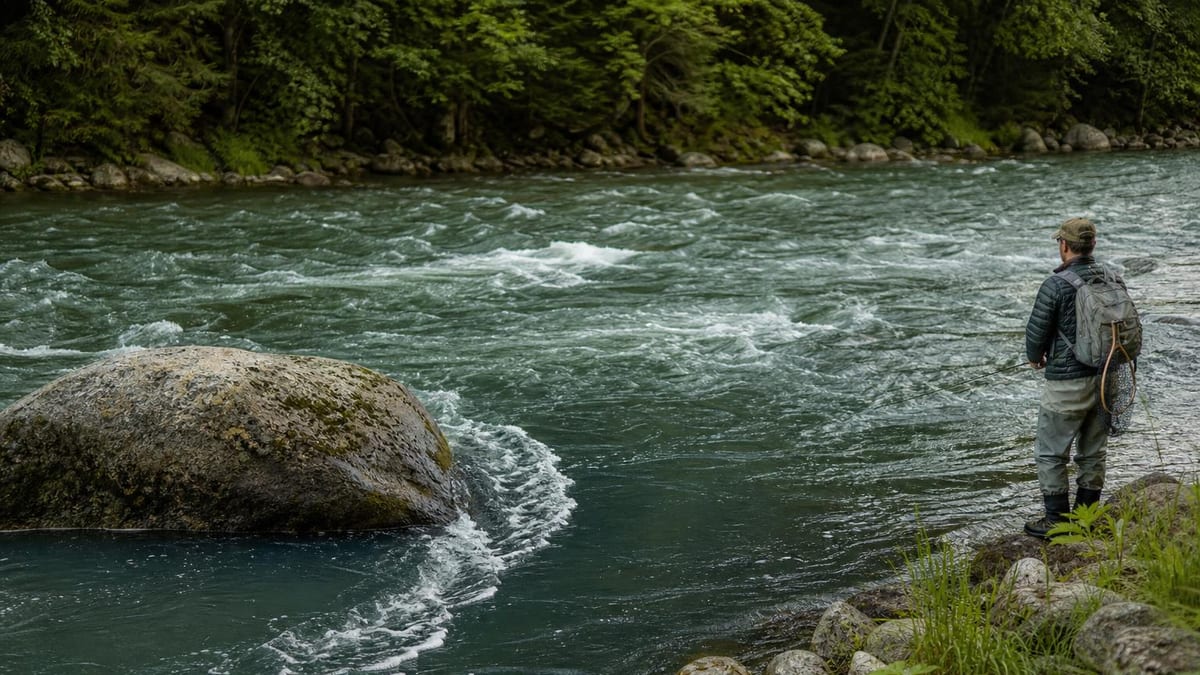
This is why the boundary is the target rather than either side of it. Cast into the fast water and your bait sweeps past below the fish; cast into the dead water and it never gets seen. The productive line is the seam itself, and it is usually visible as a difference in surface texture — broken water beside smooth, or a line of foam and bubbles marking where two speeds meet.
The same logic scales up. A whole pool is a low-velocity area beside the run that feeds it, which is why the head of a pool, where fast water arrives, is so often the best part of it.
The rock is not always a good place
Sheltering behind an obstruction pays off only up to a point, and above that it costs the fish more than it saves. This is worth knowing because it contradicts the usual advice to fish every boulder in the river.
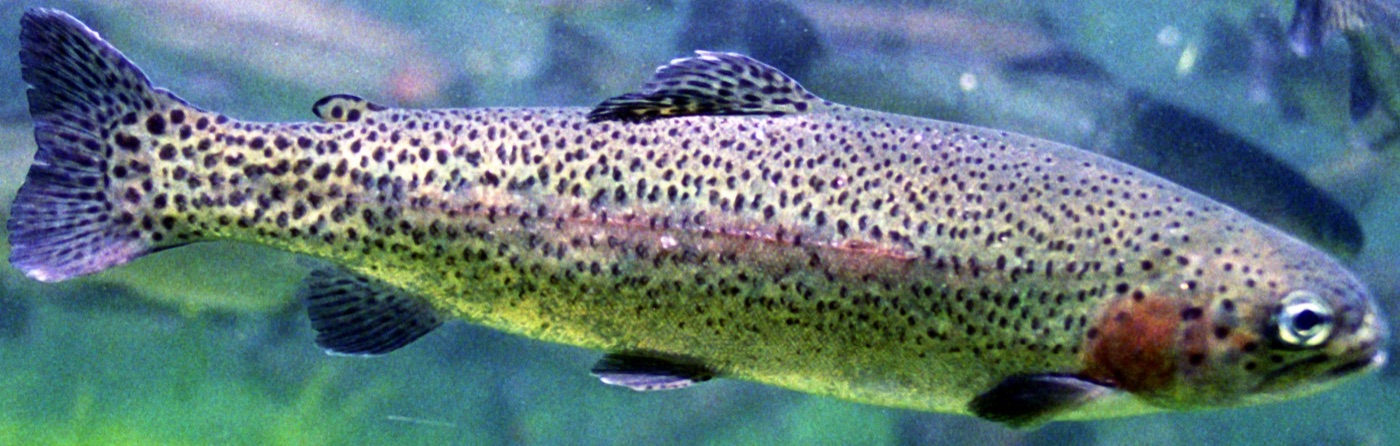
Research measuring the oxygen consumption of drift-feeding rainbow trout found the expected benefit at moderate speeds: sheltering fish did not increase their oxygen use until they were swimming faster than 68 centimetres per second, while fish holding in open flow used significantly more energy at every incremental speed. Below about 50 centimetres per second, the study calculated, foraging trout could acquire around 1.4 times their daily energy requirement.
Above that speed the advantage reverses. The researchers found that in high flow the benefit of sheltering disappears entirely, because the fish suffers a roughly 65% increase in the cost of attacking prey and a 40% reduction in attack success. The reason is the velocity gradient itself: darting out of slack water into a fast current and back is expensive, and the steeper that jump, the more it costs and the more often the fish misses.
The practical translation is that boulders in moderate current are worth fishing carefully, and boulders in a torrent often are not. In high water, look for places where the whole flow is slower — the inside of bends, deeper pools, the margins — rather than for individual obstructions in the main force of the river.
What riffles are actually doing
Riffles are the engine room even though the fish are usually elsewhere, and they do two jobs that matter downstream. Understanding them changes how you read the rest of the river.
The first is oxygen. A US Geological Survey study of stream aeration measured a section of the Kansas River at low water and found the riffle reaerating at a coefficient of 4.1 per day against 0.13 for the pool — roughly thirty times faster. The report notes that the contrast between riffles and pools is especially marked at low water, and that at bankfull flow these features are effectively drowned out. In other words, the riffle matters most exactly when oxygen is scarcest.
The second is food. Federal habitat reports state plainly that invertebrate fauna is much more abundant and diverse in riffles than in pools, and that riffle production falls once fine sediment exceeds about a tenth of the substrate. Recent work confirms significantly higher macroinvertebrate density and taxonomic richness on riffle stones than in pool sediments.
Put those together and a riffle is a food conveyor. The drift a fish is eating in the run or pool below was produced upstream in broken water, which is why the water immediately below a riffle is so consistently worth fishing.
Cover, and what counts as it
Cover is more specific than “something to hide under”, and agencies define it in measurements. That precision is useful, because it tells you which of the features on a bank are actually worth a cast.
The US Fish and Wildlife Service describes trout cover as areas of low bottom visibility combined with water deeper than 15 centimetres and current slower than 15 centimetres per second, provided by overhanging vegetation, submerged vegetation, undercut banks, instream objects such as stumps, logs, roots and large rocks, rocky substrate, depth, or surface turbulence. Note that depth and turbulence count on their own — a fish does not need a roof if the water is deep enough or broken enough.
For an undercut, researchers working in Wyoming used a working definition: the water under the overhang at least 15 centimetres deep and the overhang at least 9 centimetres wide. Oregon’s survey manual sets a comparable field threshold of at least a metre long with an average of 15 horizontal centimetres of overhanging ceiling. A shallow scoop in a bank is not cover; a foot of dark water under a lip is.
Wood is the strongest signal of all. A study of three Appalachian streams found trout always present in habitat units with large amounts of large woody debris, but present in only 70 to 90% of the many units with little or none — and the stream with abundant wood supported higher trout density and biomass. Wood also builds the habitat around it: adding large wood to a stream created enough new pool habitat to trap an estimated 27 kilograms more detritus over 250 metres, a 25% increase in the food base.
Pools in summer
In hot weather a pool is not one temperature, and the difference decides where fish are. This is the most useful seasonal adjustment in reading water.
A study of northern California rivers found that pools stratify when cold inflow is strong enough or currents weak enough to prevent mixing, with surface temperatures commonly 3 to 9 °C higher than at the bottom. The cold water came from tributaries, from flow through gravel bars, and from streamside subsurface sources — so the cold spot is often at a specific end of the pool rather than simply at its deepest point.
The response is dramatic. In one study reach, 65% of juvenile steelhead moved into stratified pools when ambient stream temperatures reached 23 to 28 °C. Federal guidance defines cold-water refuge as water at least 2 °C colder than the surrounding flow, and notes that fish detect temperature differences smaller than 0.1 °C and move to exploit them.
So in a summer heatwave, fish the pools — but fish them where cold water enters, at tributary mouths, along bedrock banks and in backwaters isolated behind gravel bars, rather than assuming the middle of the deepest hole is best.
Limitations and context
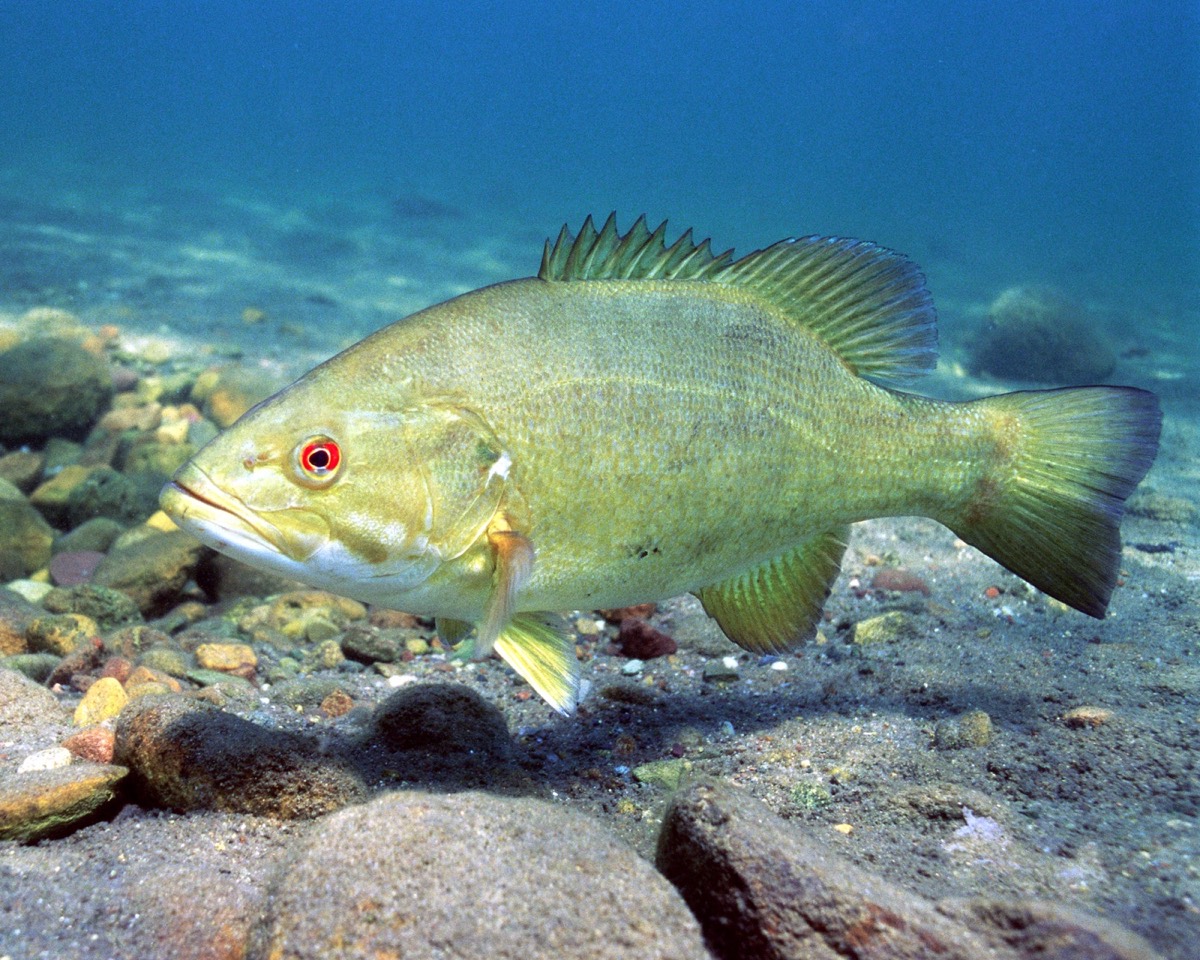
Most of the quantified research above concerns trout and salmon in cool streams. The physical principles — where velocity drops, where sediment sorts, where oxygen is generated — apply to any river, but the specific velocity and depth preferences do not transfer automatically to warmwater species.
The agency thresholds quoted here are habitat-assessment and management standards rather than fishing rules. Biologists use them to classify and score stream habitat; we are borrowing them because they happen to describe the same features an angler is reading, not because a fish observes them.
Conditions change what any of this means on a given day. Flow, water clarity and temperature all shift the picture, and at bankfull the riffle-pool structure is largely drowned out. Our guides to water temperature and wind cover the conditions side, and shore fishing basics applies the same structure-reading habit to still water.
Frequently asked questions
What is the difference between a riffle, a run, a pool and a glide?
Depth and speed, and agencies measure both. Pennsylvania's Fish and Boat Commission classifies a pool as slow water at least 18 inches deep with velocity no greater than about one foot per second; a glide as slow water shallower than 18 inches; a run as fast water at least 18 inches deep; and a riffle as fast water no more than 18 inches deep. In short: deep-and-slow, shallow-and-slow, deep-and-fast, shallow-and-fast.
Why do fish sit behind rocks?
To feed from fast water without swimming in it — but the advantage has limits. Research on drift-feeding rainbow trout found that sheltering fish did not increase oxygen consumption until they exceeded about 68 cm per second, while fish holding in open flow paid more at every speed. Above roughly 50 cm per second, though, the benefit disappears: darting out across a steep velocity gradient raised the cost of each attack by around 65% and cut attack success by about 40%.
Where should I cast in a river?
At the boundary between fast and slow water rather than into either one. Studies of stream salmonids describe fish holding focal points in low-velocity microhabitats adjacent to faster water, which lets them watch a large volume of drifting food while keeping swimming costs down. That boundary is the target — along current edges, at the tail and head of pools, and beside any obstruction.
Why are riffles important if fish do not sit in them?
They make the food and the oxygen. Federal habitat reports describe aquatic invertebrates as much more abundant and diverse in riffles than in pools, and a US Geological Survey study measured a riffle reaerating around thirty times faster than the adjacent pool at low water. The riffle supplies the drift that fish downstream are feeding on.
Where do fish go in a river in hot weather?
Into cold water, and it can be a very short distance away. A study of northern California rivers found pools stratifying so that surface water ran 3 to 9 °C warmer than the bottom, and 65% of juvenile steelhead in one study reach moved into those stratified pools when ambient stream temperatures reached 23 to 28 °C. Fish detect differences smaller than a tenth of a degree and move accordingly.
Sources
- Stream Habitat Visual Survey — Instructional Guide — Pennsylvania Fish & Boat Commission. Accessed August 5, 2026.
- Methods for Stream Habitat Surveys — Aquatic Inventories Program (2023) — Oregon Department of Fish & Wildlife (hosted by Oregon State University). Accessed August 5, 2026.
- CADDIS — Physical Habitat — US Environmental Protection Agency. Accessed August 5, 2026.
- Exploitation of Velocity Gradients by Sympatric Stream Salmonids — Naman et al., North American Journal of Fisheries Management 40(2). Accessed August 5, 2026.
- Oxygen Consumption of Drift-Feeding Rainbow Trout — Johansen, Akanyeti & Liao, Journal of Experimental Biology 223(12). Accessed August 5, 2026.
- Habitat Suitability Index Models: Brook Trout (FWS/OBS-82/10.24) — US Fish & Wildlife Service. Accessed August 5, 2026.
- Trout Use of Woody Debris and Habitat in Streams — Flebbe & Dolloff, USDA Forest Service Research. Accessed August 5, 2026.
- The Aeration Capacity of Streams (Circular 542) — US Geological Survey. Accessed August 5, 2026.
- Thermally Stratified Pools and Their Use by Steelhead — Nielsen, Lisle & Ozaki, USDA Forest Service Research. Accessed August 5, 2026.
How we choose sources: sources policy.
More in this series
Know when it's worth going.
Fishing Club AI turns live weather, pressure and moon data into a simple bite forecast for your spot — so the skills you practise get used on the right day.
Get the App