How Does Wind Affect Fishing?
Wind affects fishing by pushing surface water and the food it carries toward downwind shores, mixing oxygen into the water, stirring up sediment that reduces visibility, and making casting and boat control harder. Moderate wind often concentrates baitfish, and the fish hunting them, along windward banks, points and structure. Strong wind becomes mainly a safety problem.
Key takeaways
- Wind pushes surface water toward the shore it blows into, carrying plankton and baitfish with it.
- Wave action mixes air into the water, which can raise dissolved oxygen near the surface.
- Wind-driven waves stir sediment along shallow banks, reducing visibility and often making fish less cautious.
- The windward bank is usually the productive side, but it is also the harder and rougher side to fish.
- Above roughly 20 knots, wind is primarily a safety and boat-control issue rather than a fishing pattern.
What wind actually does to the water
Wind changes fishing conditions by moving water, not by moving fish directly. When wind blows across a lake, bay or reservoir, it drags on the surface and pushes the top layer of water ahead of it. That surface drift carries whatever floats in it — plankton, insects, and the small baitfish that feed on them — toward the shoreline the wind is blowing into.
The same wave action mixes air into the water. As Texas Parks & Wildlife explains, strong wind on a lake “can whip up high waves,” and that “mixes air into the water, helping increase dissolved oxygen levels.” On a hot, still summer day, a breeze that ruffles the surface is doing something useful to the upper water column.
Wind also works against the way lakes separate into layers. The U.S. Geological Survey describes wind as one of the “destabilizing forces” that counteract the density stratification holding warm surface water above colder deep water. Sustained wind, especially over a long stretch of open water, pushes mixing deeper than a calm day would.
Finally, wind stirs the bottom. Waves breaking along a shallow bank lift silt and sediment into the water, which clouds it. That reduced visibility is why anglers often find fish willing to move closer to shore, and closer to a lure, on a windy bank than on a glassy calm one.
Why wind concentrates fish
Wind concentrates fish because it concentrates their food. Surface drift delivers plankton against the windward shore; baitfish follow the plankton; predators follow the baitfish. This is why the bank taking the wind in the face is so often the productive one, even though it is the uncomfortable side to fish.
Wind also organizes the water surface itself. Research collected in the NOAA repository describes how wind and waves generate Langmuir circulation — pairs of counter-rotating rolls just under the surface that create alternating converging and diverging lanes. Floating material gathers in the converging lanes as visible streaks, often called windrows. On big water, those lines of foam and debris are worth a cast, because the same convergence that gathers foam gathers food.
Structure amplifies the effect. Points, rock piles, jetties, dock corners and weed edges that sit on the windward side collect drifting food and give predators a place to ambush it out of the strongest current. A point that is mediocre in calm conditions can be the best spot on the lake when it is taking a steady breeze.
Wind direction: what it tells you, and what it does not
Wind direction matters mainly through its local consequences, not through the compass heading itself. What actually changes your fishing is which shoreline the wind blows into, how far the wind has travelled over open water before it gets there, and whether the wind shift is part of a larger weather change.
That last point is where much of the folklore comes from. Traditional rhymes about wind from the west or the east are not supported by published science, and they travel poorly between regions: a wind that brings warm, settled weather in one place can bring the opposite somewhere else. Treat them as local memory rather than a rule.
Fetch — the distance wind travels over water — is the more useful idea. A short fetch produces little more than a ripple. The same wind speed across several miles of open water produces real waves, real current, and a far stronger concentrating effect on the downwind shore.
How much wind is too much?
There is no single number, because it depends on your water body, your boat and your skill. What does exist is an official safety framework. For coastal and Great Lakes waters, the National Weather Service issues a Small Craft Advisory for sustained winds in the range of roughly 20 to 33 knots, and a Gale Warning for 34 to 47 knots. Exact advisory thresholds are set regionally, so the local marine forecast is always the authority.
Those figures are marine advisory criteria, not fishing advice, but they are a useful reality check. Once conditions approach small-craft criteria, wind has stopped being a pattern you can exploit and has become the main thing you are managing.
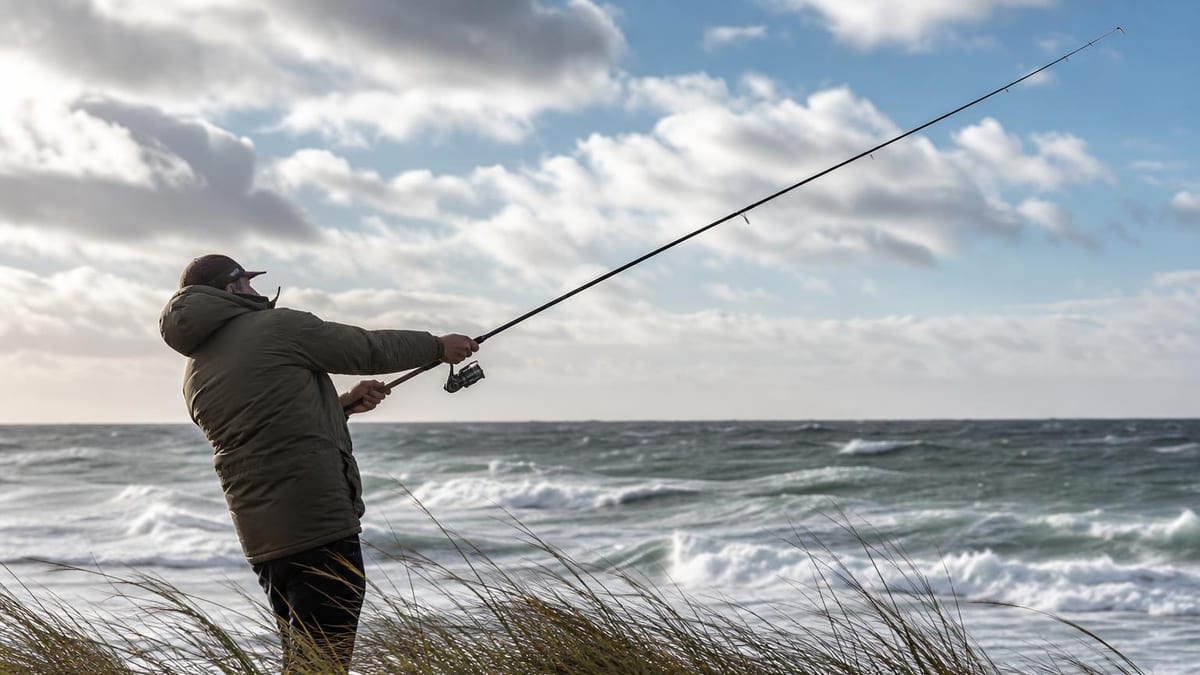
On inland water, judge it by what you can control: whether you can hold position, whether you can feel a bite, and whether waves are breaking where you intend to stand. Shore anglers can often keep fishing in wind that would end a small-boat trip, provided the bank is safe footing.
Practical tactics by wind strength
How you fish the wind depends on how hard it is blowing: calm water calls for stealth, a light breeze is close to ideal, moderate wind rewards fishing the windward bank, and strong wind shifts the priority to shelter and safety.
Dead calm. Fish tend to be spookier in clear, still water. Longer casts, lighter line, and subtler presentations help. Early morning and evening usually matter more on calm days than on breezy ones.
Light breeze (a ripple on the surface). Often ideal. There is enough surface texture to reduce visibility from below, and enough drift to move food, without making presentation difficult. Fish the windward side of structure.
Moderate wind (whitecaps forming). This is when the windward-bank pattern is strongest. Use heavier lures to keep contact and casting distance, and let the wind help you: drift along a bank rather than fighting to hold position. Expect the water there to be cloudier, which usually favours lures with more vibration or a bolder profile.
Strong wind. Priorities change to safety and control. Seek protected shorelines, coves and the lee side of islands, accepting that these are usually less productive, or fish from shore where footing is safe. If you are in a small boat and conditions are near advisory criteria, the right answer is often to go in.
Limitations and context
Wind is one variable among many, and its effect is not uniform. A steady breeze that fires up a shallow reservoir bank may do very little on a deep, clear lake with a rocky shoreline and no soft sediment to stir. Species matter too: fish that hunt by sight in clear water respond differently to clouded, wave-washed shallows than fish that hunt by vibration and scent.
Season and water temperature interact with all of this. Wind that mixes oxygen into warm summer water is doing something valuable; the same wind on a cold, well-mixed lake in spring changes far less. Local knowledge of the water you fish will always beat a general rule — including this one.
Frequently asked questions
Is it better to fish with the wind or against it?
Casting with the wind at your back is easier and gives you more distance, but the fish are often holding along the bank the wind is blowing into. Many anglers position themselves so the wind comes over one shoulder: it keeps casts manageable while still letting them work the windward side.
Do fish stop biting when it is windy?
Not usually. Moderate wind often improves fishing near windward shorelines and points, because it concentrates food and reduces visibility. Very strong wind mainly makes fishing harder for the angler by affecting casting, boat control and safety.
Which wind direction is best for fishing?
There is no reliable universal answer. Wind direction matters mostly through its local effects: which shoreline it blows into, how much open water it crosses, and whether it is bringing a weather change. Traditional sayings about wind direction are folklore, not verified science.
How much wind is too much to fish?
It depends on the water and your boat. For coastal and Great Lakes waters, the National Weather Service issues a Small Craft Advisory for sustained winds of roughly 20 to 33 knots, and a Gale Warning at 34 to 47 knots. Always check the current local marine forecast before going out.
Sources
- Marine Definitions — NOAA National Weather Service. Accessed August 2, 2026.
- Aquatic Science — Chapter 9: Lakes and Ponds — Texas Parks & Wildlife Department. Accessed August 2, 2026.
- Lake Number, a quantitative indicator of mixing used to estimate changes in dissolved oxygen — U.S. Geological Survey. Accessed August 2, 2026.
- Wind Fetch and Direction Effects on Langmuir Turbulence in a Coastal Ocean — NOAA Institutional Repository. Accessed August 2, 2026.
How we choose sources: sources policy.
More in this series
One condition rarely acts alone. BiteScore reads them together.
Fishing Club AI combines live weather, marine conditions and moon data into a simple bite forecast for your exact spot.
Get the App