Redfish
Sciaenops ocellatus
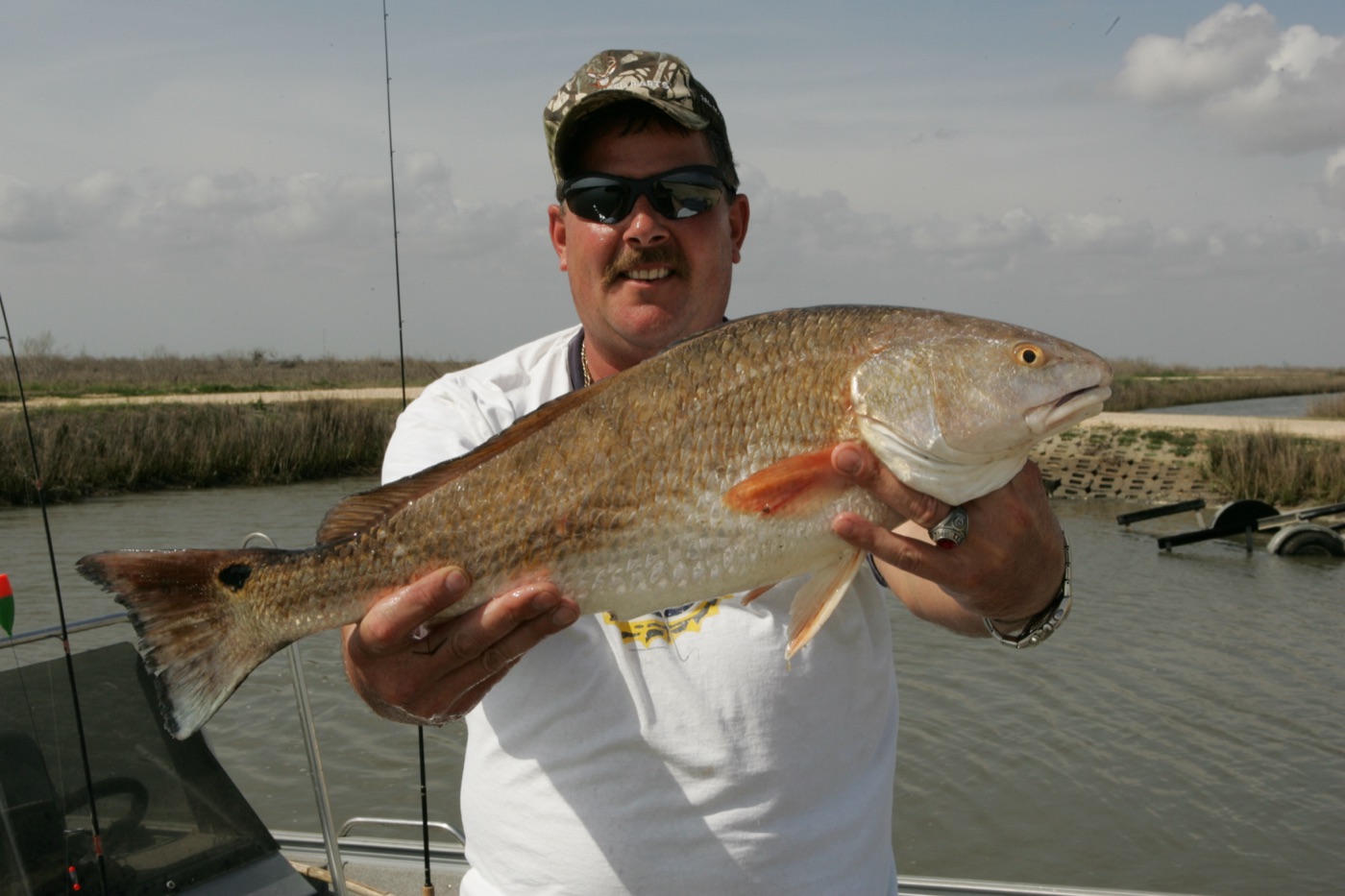
Redfish is a coastal gamefish of the drum family, easily identified by the copper-red body and one or more black spots at the base of the tail.
MoreFull Species Details
- Species Name
- Sciaenops ocellatus
- Family
- Sciaenidae
- Order
- Acanthuriformes
- Also Known As
- Red drum, Channel bass, Spottail bass, Puppy drum
Redfish (Sciaenops ocellatus) Fish Description
Redfish is a coastal gamefish of the drum family, easily identified by the copper-red body and one or more black spots at the base of the tail.
The body is deep and slightly elongated, bronze to reddish-copper on the back fading to a white belly, with the signature black eyespot near the tail. Some fish carry several spots or a full row along each flank. The mouth is set low and slightly downturned, suited to feeding on the bottom. The tail is squared rather than forked. Coloration deepens in clear coastal water and pales in murky estuaries. The false eyespot is thought to deceive predators into striking the tail rather than the head, aiding the fish's escape.
Redfish is native to the western Atlantic and the Gulf of Mexico, from Massachusetts to northern Mexico, and is most abundant along the Gulf and southeastern US coasts. The species spends its early years in shallow estuaries before mature adults move to deeper coastal waters to spawn. Redfish thrive on shallow grass flats, oyster bars, and marsh edges. Anglers prize the species for its powerful runs, its willingness to take flies and lures in skinny water, and its excellent table quality, which made blackened redfish a culinary phenomenon.
Interesting Facts About Redfish
- The world record redfish weighed 94 pounds 2 ounces, caught in North Carolina in 1984.
- Redfish can live more than 40 years in the wild.
- The black tail spot may trick predators into striking the tail instead of the head.
- Redfish spawn near passes and inlets in late summer and autumn.
- A large female can release over 2 million eggs during a single spawn.
Show more facts
- Young redfish spend their first years in shallow, protected estuaries.
- Redfish make an audible drumming sound using muscles against the swim bladder.
- The species feeds on the bottom, often tailing in water only inches deep.
- Blackened redfish popularity in the 1980s caused a sharp population decline.
- Redfish tolerate a wide salinity range, from fresh marshes to full seawater.
- The redfish is the official state saltwater fish of both Texas and North Carolina.
- Fish over 40 inches are known to anglers as bull reds and are usually released.
Average Speed & Size
Redfish is a strong, bottom-oriented swimmer that typically reaches 16 to 32 inches and 3 to 15 pounds. Bull reds exceed 40 inches and 30 pounds, with the largest surpassing 90 pounds. The species cruises the shallows at a steady pace, rooting along the bottom for prey, then accelerates in hard, sustained runs once hooked. Its broad tail and muscular body make redfish one of the most dogged inshore fighters, often pulling line in long, powerful surges.
Where to Find Them
Redfish is found in shallow coastal waters, estuaries, and grass flats along the Atlantic and Gulf coasts. The species holds near oyster bars, marsh edges, seagrass beds, and drop-offs, often feeding in water only a foot or two deep. Redfish favor warm coastal temperatures and follow the tide onto flats to root for crabs and shrimp, tailing visibly in the shallows. Larger fish gather near passes and inlets to spawn. Redfish are absent from cold northern seas and deep offshore waters, which lie outside the warm, shallow habitat the species prefers.
Redfish Fishing Tips
Redfish fishing is accessible and highly visual, especially sight-casting to tailing fish on shallow flats. Success comes from spotting fish in skinny water and presenting bait or a lure quietly ahead of them.
Equipment
Use a 7- to 7-foot-6 medium spinning or fly rod paired with a reel spooled with 15- to 30-pound braid and a 20- to 30-pound leader. This balance handles the redfish's strong runs while allowing accurate casts to fish in shallow water. Fly anglers favor an 8- or 9-weight rod for wind and for turning over larger flies on the flats.
Chumming
Chumming with cut crab, shrimp, or menhaden can draw redfish to a spot in deeper channels and around structure. A steady scent trail on moving tide pulls foraging fish within range of a baited hook. On shallow flats, however, sight-casting replaces chum, since fish are located and targeted individually.
Bait
Live or cut shrimp, crab, and mullet are the top natural baits, fished on the bottom or under a popping cork. Effective lures include gold spoons, soft-plastic jigs, and topwater plugs worked over the flats.
Patience
Redfish in shallow water spook at a heavy cast or the shadow of a boat, so a quiet approach and an accurate, well-led presentation matter most. Wait for tailing fish rather than blind-casting.
Conditions that change the bite
- What Barometric Pressure Is Best for Fishing? No research supports a single best barometric pressure for fishing. What pressure really does, how big a weather swing is, and what to watch instead.
- Best Time of Day to Fish: What Evidence Shows Dawn and dusk are measurably better — and the edge is smaller than the folklore says. The 13-year dataset, the light mechanism, and what matters more.
- Dissolved Oxygen: The Condition Anglers Can't See Fish live or die by oxygen you can't see. How temperature, depth, dawn and turnover move it, which species need more, and how to fish around the invisible map.
Guides for fishing this species
- Best Conditions for Surf Fishing: Reading Tide, Wind and Swell Together How to read surf fishing conditions as a system — tide, wind and swell together — using official NOAA and NWS data, plus safety guidance for the beach.
- Best Knots for Joining Braid to Fluorocarbon How to join braid to a fluorocarbon leader: which line-to-line knots to use, why braid slips, and how to keep the connection small enough to pass the guides.
- How to Choose Lure Colour Water absorbs red light first and blue last, so lure colour changes with depth and clarity. How to choose for visibility instead of guessing from folklore.
- How to Tie a Uni Knot The uni knot in five diagrammed steps — one tying motion that handles hooks, lures, line joins and the reel spool, and why it earns the name 'uni'.
- How to Tie an FG Knot The FG knot in five diagrammed steps — the slim braid-to-leader weave, why tension is everything, and when its extra effort actually pays.
- The Fish Finder Rig: Sliding Sinker Bottom Fishing How to build the fish finder rig — sliding sinker, bead, swivel, leader — why fish never feel the weight, and how to pair it with circle hooks.
Related Species
Know when they'll bite.
BiteScore forecasts when redfish will feed at your spot — from live weather, pressure, and moon data.
Get the App