Black Drum
Pogonias cromis
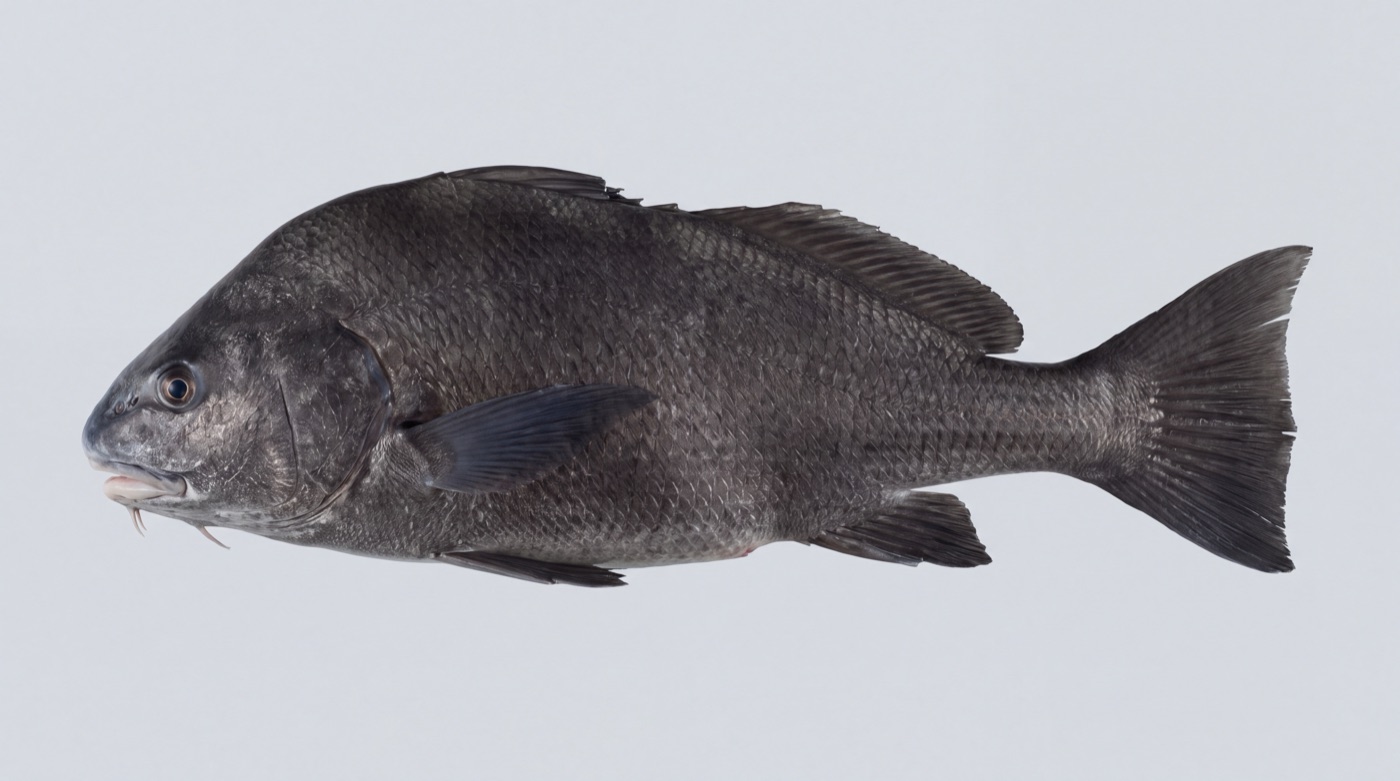
Black drum is a deep-bodied, high-backed member of the drum family, identified by the chin barbels it drags across the bottom to find buried shellfish.
MoreFull Species Details
- Species Name
- Pogonias cromis
- Family
- Sciaenidae
- Order
- Acanthuriformes
- Also Known As
- Bull drum
Black Drum (Pogonias cromis) Fish Description
Black drum is a deep-bodied, high-backed member of the drum family, identified by the chin barbels it drags across the bottom to find buried shellfish.
The body is deep and strongly arched behind the head, grey to blackish above and paler below, with heavy scales and a set of short barbels under the chin. Young fish carry four or five dark vertical bars along the flank that fade as they grow, so a small barred drum and a large plain one look like different species at a glance. The mouth sits low on the head, angled downward for feeding off the bottom. Behind the throat lie flat pharyngeal teeth — grinding plates rather than biting teeth — which crush oysters, clams and crabs whole. Louisiana's wildlife agency describes these as pharyngeal molars that let the fish crush and consume shellfish.
Black drum range along the Atlantic and Gulf coasts and are among the most adaptable inshore fish in their range; Texas Parks and Wildlife notes the species can adapt to a wider range of habitats than any other important Texas food fish. They hold over oyster reefs, around bridge and dock pilings, and in deeper channels, moving inshore and northward in spring and reversing in autumn. The species is long-lived and slow-moving, and it is best known for the sound that gives the family its name — a drumming produced by vibrating a muscle against the swim bladder, loud enough that it has been measured as the loudest bony fish yet recorded.
Interesting Facts About Black Drum
- The loudest bony fish ever measured, recorded at 183 decibels — the study sites were chosen because residents reported unexplained evening sounds inside their waterfront homes.
- Black drum can live around 60 years, making them one of the longest-lived inshore species.
- The drumming comes from a muscle vibrated rapidly against a gas-filled swim bladder, which is where the family name comes from.
- Sound production runs from October through April, peaks in February and March, and begins near dusk.
- Nightly drumming does not predict spawning — researchers found no correlation between sound and egg production night to night.
Show more facts
- Flat pharyngeal teeth behind the throat crush oysters, clams and crabs whole.
- The chin barbels are sensory equipment used to locate food on the bottom.
- Large feeding schools dredge the bottom and leave turbid plumes visible from the air.
- An average 13.4-pound female can release around 32 million eggs in a year.
- They move remarkably slowly over oyster reefs — 8 to 14 metres per minute, among the slowest rates ever recorded with an acoustic positioning system.
- Louisiana's oldest aged black drum was 45 years old; biologists have recorded 59-year-old fish on the east coast.
- The largest black drum on record weighed 146 pounds.
Average Speed & Size
Black drum grow steadily and live a long time, so size varies enormously with age. Texas Parks and Wildlife records about six inches in the first year, twelve by the second and sixteen by the third, after which growth settles to roughly two inches a year. Louisiana data puts a three-year-old at about 21 inches and a ten-year-old at about 28. Most large fish taken by anglers weigh 30 to 40 pounds, and the Atlantic States Marine Fisheries Commission reports fish over 46 inches and 120 pounds. This is not a fast fish: acoustic tracking over oyster reefs measured movement at 8 to 14 metres per minute. The fight is a heavy, grinding pull rather than a run.
Where to Find Them
Black drum hold on the bottom around hard structure — oyster reefs, wrecks, dock and bridge pilings — and in the deeper channels of bays and estuaries, with juveniles in shallower water. Habitat studies on Louisiana reefs found a clear preference for oyster reef, avoidance of soft sediment, and no particular selection for marsh edge. The species migrates inshore and northward in spring and southward in autumn, entering the lower Chesapeake around April and leaving in late autumn. Spawning aggregations gather nearshore from January to April in the Gulf, and from November through April in southern areas or April through June further north.
Black Drum Fishing Tips
Black drum are a bottom-feeding, structure-oriented target, and the fishing reflects that. Find shellfish bottom or hard structure, put a natural bait on it, and give the fish time to find it — this is not a species you chase with speed.
Equipment
A medium-heavy 7-foot rod with a reel holding 20- to 40-pound line covers most inshore fishing, with heavier tackle for bull drum around pilings. The fish do not run far, but a large one pulls hard and steadily, and bridge and reef structure will cut a light leader. An abrasion-resistant leader matters more here than casting distance.
Chumming
Crushed shellfish is the logical chum for a fish built to crush shellfish, and scent works better than sight for a species that hunts with barbels in murky bays. Chum drifting down-current from a reef gives a slow-moving fish a trail to follow. Allow more time than you would for an active predator.
Bait
Natural bait outfishes lures decisively. Fresh crab, shrimp and clam suit the species' shellfish diet, fished on or just above the bottom near structure.
Patience
This is a slow fish that finds food by scent and touch, so leave a bait in place rather than working it. Bites are often a subtle weight rather than a sharp take — reel down until the rod loads instead of striking early.
Conditions that change the bite
- What Barometric Pressure Is Best for Fishing? No research supports a single best barometric pressure for fishing. What pressure really does, how big a weather swing is, and what to watch instead.
- Best Time of Day to Fish: What Evidence Shows Dawn and dusk are measurably better — and the edge is smaller than the folklore says. The 13-year dataset, the light mechanism, and what matters more.
- Dissolved Oxygen: The Condition Anglers Can't See Fish live or die by oxygen you can't see. How temperature, depth, dawn and turnover move it, which species need more, and how to fish around the invisible map.
Guides for fishing this species
- Best Conditions for Surf Fishing: Reading Tide, Wind and Swell Together How to read surf fishing conditions as a system — tide, wind and swell together — using official NOAA and NWS data, plus safety guidance for the beach.
- The Fish Finder Rig: Sliding Sinker Bottom Fishing How to build the fish finder rig — sliding sinker, bead, swivel, leader — why fish never feel the weight, and how to pair it with circle hooks.
Related Species
Know when they'll bite.
BiteScore forecasts when black drum will feed at your spot — from live weather, pressure, and moon data.
Get the App