Best Knots for Joining Braid to Fluorocarbon
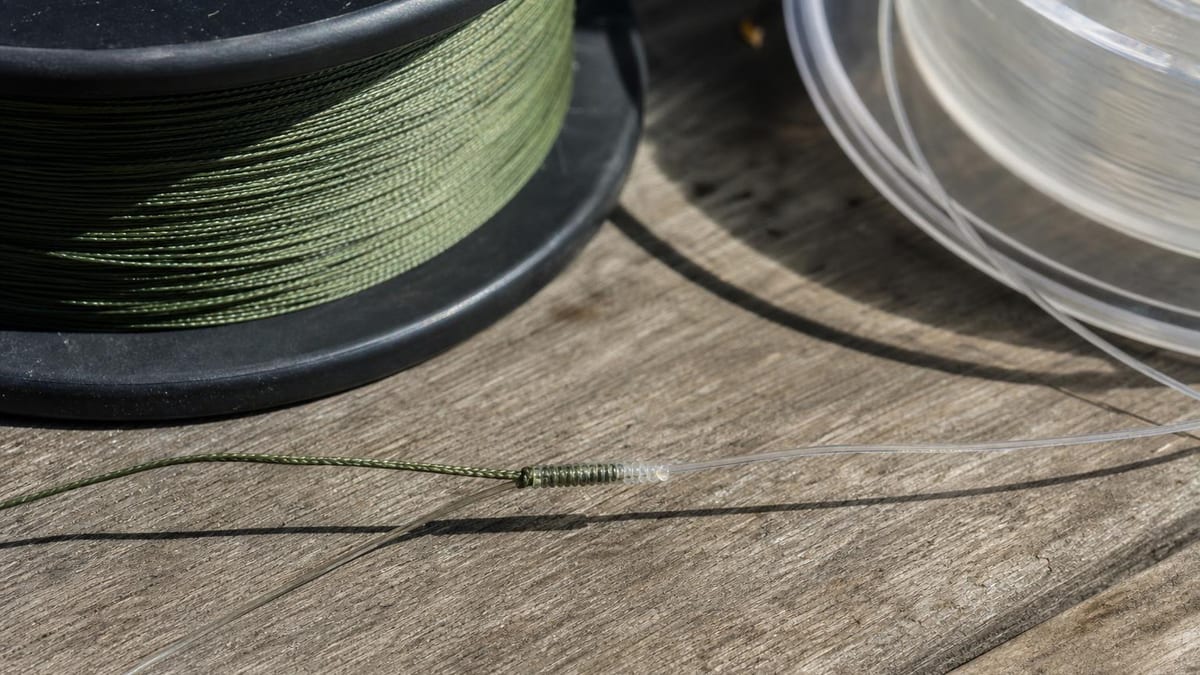
To join braid to a fluorocarbon leader, use a line-to-line knot rather than a hook knot. A double uni is the easiest to learn and manufacturer guides put it at up to 90% of line strength; an FG knot is slimmer through the guides but harder to tie. Braid is slippery, so extra wraps and careful seating matter more than they do in monofilament.
Key takeaways
- Joining two lines needs a line-to-line knot; a Palomar or clinch is the wrong tool for the job.
- Manufacturer guidance puts the uni-to-uni at up to 90% of line strength for lines of similar diameter.
- A surgeon's knot is the usual choice when the two lines differ noticeably in diameter.
- Braid has no stretch and a slick surface, so it needs more wraps than fluorocarbon in the same knot.
- Every knot costs strength — published testing shows knotted line breaks below the unknotted line.
Why this connection needs its own knot
Joining two lines is a different problem from tying a hook, and it needs a different family of knots. A Palomar or a clinch anchors line to a fixed object with an eye; a braid-to-leader connection has to hold two slippery, flexible strands against each other under load, with nothing rigid in between.
The connection also has to travel. Unlike a hook knot, this one passes through the rod guides on every cast, so its size matters as much as its strength. A knot that holds perfectly but catches on the tip ring costs you distance and eventually costs you the cast.
That gives you two things to balance: grip and profile. Different knots trade between them, which is why more than one is worth knowing.
The knots worth learning
Three line-to-line knots cover almost every braid-to-leader situation, and they trade ease of tying against how slim the finished connection is.
Double uni (uni-to-uni). The easiest entry point, because it is one simple knot tied twice — once in each line — then drawn together. Manufacturer guidance describes the uni-to-uni as suited to joining lines of similar diameter and preserving up to 90% of line strength. Use more turns on the braid side than the leader side.
Surgeon’s knot. The standard answer when the two lines differ noticeably in diameter, which is common when a light braid meets a heavy leader. It is quick and forgiving, though bulkier than the alternatives.
FG knot. A friction knot in which the braid is woven around the leader rather than knotted through it. It is by far the slimmest connection through the guides, which is why it dominates where long casts matter. It is also the hardest of the three to tie well, especially in wind, and a badly tied one fails suddenly.
Learn the double uni first. A knot you tie correctly under pressure beats a theoretically better knot you fumble.
Why braid behaves differently
Braid is slick and has almost no stretch, and both properties work against a knot. Where monofilament gives a little under load and grips itself, braid transmits force directly to the connection and can creep through turns that would hold another line.
The practical answer is more wraps on the braid side. Where a leader might take five or six turns, the braid side commonly gets seven or eight, sometimes more with very fine diameters. The extra turns add friction that the material does not supply on its own.
Seating matters just as much. Wet the knot, then pull it up slowly and evenly rather than snapping it tight — braid drawn up fast can bed down unevenly and cut into itself.
Every knot costs strength
Assume the connection is the weakest point in your setup, because it usually is. One study comparing measured leader breaking strength with manufacturer claims found that the average breaking strength of each line tested with a knot was lower than the same line without one.
The same study noted that the ranking of products changed depending on whether a knot was present — the leader that tested strongest unknotted was not the strongest once tied. That is a useful caution against choosing line by rated strength alone, since you never fish it unknotted.
It is also a reason not to over-trust published percentages, including the ones quoted above. Treat them as a guide to which knots are in the right class, not as a specification you can rely on.
Keeping the connection fishable
Keep the leader short enough that the knot sits outside the guides when you are ready to cast, unless you are deliberately fishing a long leader and accept the trade. This is the main practical reason anglers move from a bulky surgeon’s knot to a slim FG as their casting improves.
Trim both tag ends close. A long tag on a line-to-line knot collects weed and can catch in the guides at exactly the wrong moment.
Check the connection regularly. Braid-to-leader knots take abrasion every cast, and a connection that has been through a rocky bottom or a fish’s gill plate deserves inspection rather than trust. Retying takes a minute; losing a fish to a worn knot takes the day.
Match the leader to the job rather than habit — heavier and more abrasion-resistant around structure, lighter and longer in clear water where visibility is the constraint.
Limitations and context
Knot performance depends on the specific lines, diameters and how carefully the knot is tied, so no ranking transfers cleanly to your setup. The only test that matters is a steady pull against the rod before you cast, which finds a badly tied knot while it costs nothing.
Published, independent testing of knot strength is also scarce, as the study above points out. Where this guide gives numbers, they come from manufacturer documentation rather than independent verification, and we have flagged them as such rather than presenting them as established fact.
Frequently asked questions
Why use a fluorocarbon leader with braid at all?
Braid is thin, strong and has almost no stretch, which makes it sensitive and good for casting, but it is highly visible and has poor abrasion resistance against rock and shell. A short fluorocarbon leader gives you a less visible, more abrasion-resistant final section while keeping braid's advantages on the reel.
Which braid-to-leader knot is easiest to learn?
The double uni, also called uni-to-uni. It is the same simple knot tied twice, once in each line, then pulled together, so there is only one thing to learn. Manufacturer guidance describes it as preserving up to 90% of line strength when joining lines of similar diameter.
Why does my braid knot slip?
Usually too few wraps, or seating it too fast. Braid is slick and does not stretch, so a knot that would grip in monofilament can creep under load. Most anglers use noticeably more turns on the braid side than the leader side, wet the knot, and draw it up slowly and evenly.
How long should the leader be?
Long enough to do its job and short enough to fish comfortably. A leader of roughly a rod length or less keeps the connection knot outside the guides on the cast, which matters because a bulky knot clicking through the guides costs distance and can catch. Clear water and abrasive structure are the usual reasons to go longer.
Sources
- Top Five Must-Know Knots — Berkley Fishing (manufacturer documentation). Accessed August 2, 2026.
- Comparing Measured Fluorocarbon Leader Breaking Strength with Manufacturer Claims — arXiv preprint. Accessed August 2, 2026.
How we choose sources: sources policy.
More in this series
Know when it's worth going.
Fishing Club AI turns live weather, pressure and moon data into a simple bite forecast for your spot — so the skills you practise get used on the right day.
Get the App