Snook
Centropomus undecimalis
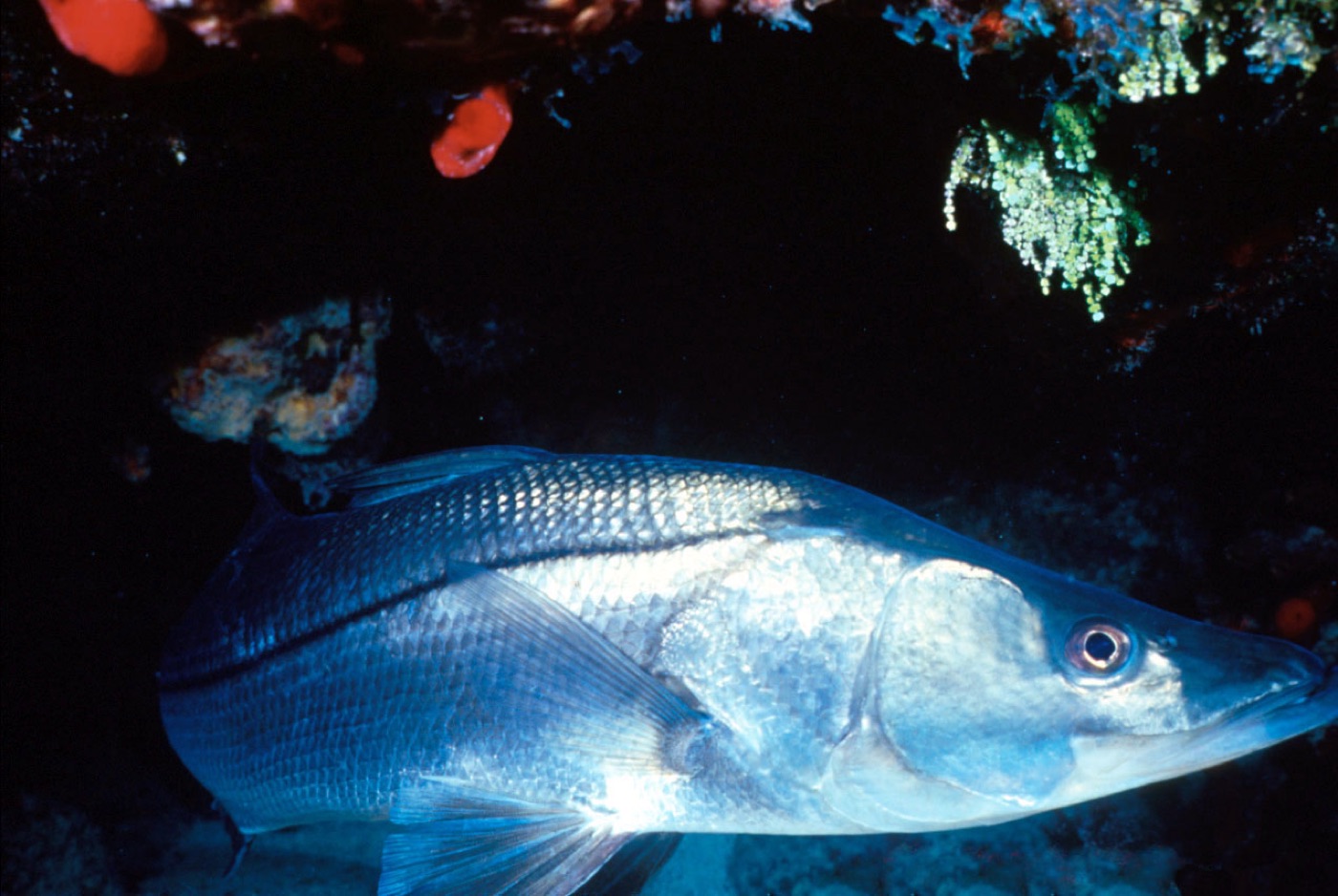
Snook is a warm-water coastal gamefish marked by a sharp black lateral line running the full length of its yellow-tinged silver body.
MoreFull Species Details
- Species Name
- Centropomus undecimalis
- Family
- Centropomidae
- Order
- Carangiformes
- Also Known As
- Common snook, Robalo, Linesider, Sergeant fish
Snook (Centropomus undecimalis) Fish Description
Snook is a warm-water coastal gamefish marked by a sharp black lateral line running the full length of its yellow-tinged silver body.
The body is long and sloping, silver to brassy-yellow with a distinct dark line down each side and a sharply protruding lower jaw. The head is flat on top with a concave profile, giving the fish a pike-like look. The fins often flush bright yellow, especially the pelvic and tail fins. A pair of sharp gill-plate edges can cut line and hands, so anglers handle snook with care. Coloration brightens in clear coastal water and dulls in tannic backcountry creeks. The prominent lateral line is the species' single most reliable field mark.
Snook is native to the warm coastal waters of the western Atlantic, from Florida through the Gulf of Mexico to Brazil. The species is highly sensitive to cold and cannot survive prolonged temperatures below about 60 degrees Fahrenheit, which confines it to the southern United States. Snook move between salt, brackish, and fresh water, often holding in mangroves, passes, and river mouths. Anglers prize snook for their explosive strikes, powerful runs toward structure, and fine table quality, making them a premier inshore target in Florida.
Interesting Facts About Snook
- The world record common snook weighed 53 pounds 10 ounces, caught in Costa Rica in 1978.
- Snook cannot survive prolonged water temperatures below about 60 degrees Fahrenheit.
- The species can live more than 20 years in the wild.
- Snook begin life as males and many later change into females.
- The species spawns near passes and inlets through the warm summer months.
Show more facts
- Snook tolerate fresh, brackish, and salt water, moving freely between them.
- A severe 2010 cold snap killed large numbers of snook across Florida.
- The sharp edge of the gill cover can slice fishing line and skin.
- Snook ambush prey in current, facing into the flow beside structure.
- Older, larger snook are predominantly female, a result of sex change.
- Florida manages snook tightly with seasonal closures and slot limits.
- Snook strike hard and immediately run toward cover such as dock pilings.
Average Speed & Size
Snook is a powerful, structure-oriented swimmer that typically reaches 20 to 34 inches and 3 to 15 pounds. Trophy fish exceed 40 inches and 25 pounds, with the largest surpassing 50 pounds. The species holds in current beside cover, then explodes forward in a short, violent burst to ambush prey. Once hooked, a snook makes an immediate, drag-burning run toward pilings or mangrove roots, using sudden power rather than open-water endurance to break free.
Where to Find Them
Snook is found in warm coastal waters, estuaries, and mangrove shorelines across southern Florida and the tropical western Atlantic. The species holds near structure that breaks current: dock pilings, bridge shadows, mangrove roots, passes, and river mouths. Snook favor water above 60 degrees Fahrenheit and stage near inlets to spawn in summer, moving into rivers and backwaters in cooler months. They feed facing into moving tide. Snook are absent from cold northern coasts and open offshore waters, confined by their intolerance of cool temperatures.
Snook Fishing Tips
Snook fishing is challenging and exciting, demanding accurate casts to structure and a quick response to violent strikes. Success comes from fishing moving tide around cover and turning fish away from pilings before they cut the line.
Equipment
Use a 7- to 7-foot-6 medium-heavy spinning rod paired with a strong reel spooled with 20- to 40-pound braid and a 30- to 50-pound abrasion-resistant leader. The heavy leader resists the snook's sharp gill plates and rough structure. A stout rod and firm drag are essential to stop a hooked fish before it reaches pilings or mangrove roots.
Chumming
Chumming with live baitfish is a highly effective way to fire up snook around passes and structure. Steadily releasing live pilchards or threadfins up-current draws fish out from cover and into a feeding frenzy. On the outgoing tide, the chum sweeps past ambush points and pulls snook into casting range.
Bait
Live pilchards, pinfish, and shrimp are the top natural baits, matched to the local forage. Effective lures include swimbaits, jigs, and topwater plugs worked tight to structure at dawn and dusk.
Patience
Snook hold in ambush and often ignore poorly presented baits, so accurate casts tight to cover matter more than volume. Fish the moving tide and wait for the aggressive window when snook feed hardest.
Conditions that change the bite
- What Barometric Pressure Is Best for Fishing? No research supports a single best barometric pressure for fishing. What pressure really does, how big a weather swing is, and what to watch instead.
- Best Time of Day to Fish: What Evidence Shows Dawn and dusk are measurably better — and the edge is smaller than the folklore says. The 13-year dataset, the light mechanism, and what matters more.
- Dissolved Oxygen: The Condition Anglers Can't See Fish live or die by oxygen you can't see. How temperature, depth, dawn and turnover move it, which species need more, and how to fish around the invisible map.
Guides for fishing this species
- Best Knots for Joining Braid to Fluorocarbon How to join braid to a fluorocarbon leader: which line-to-line knots to use, why braid slips, and how to keep the connection small enough to pass the guides.
- How to Tie a Double Uni Knot The double uni knot in five diagrammed steps — the standard way to join braid to leader or any two lines, with the wrap counts that make it work.
- How to Tie a Palomar Knot The Palomar knot in four steps, why it suits braided line, the three mistakes that weaken it, and when a different knot is the better choice.
- How to Tie an FG Knot The FG knot in five diagrammed steps — the slim braid-to-leader weave, why tension is everything, and when its extra effort actually pays.
Related Species
Know when they'll bite.
BiteScore forecasts when snook will feed at your spot — from live weather, pressure, and moon data.
Get the App