Tarpon
Megalops atlanticus
Tarpon is a large, prehistoric coastal gamefish clad in massive silver scales, renowned as one of the greatest fighting fish in the sea.
MoreFull Species Details
- Species Name
- Megalops atlanticus
- Family
- Megalopidae
- Order
- Elopiformes
- Also Known As
- Silver king, Atlantic tarpon, Sabalo, Grande écaille
Tarpon (Megalops atlanticus) Fish Description
Tarpon is a large, prehistoric coastal gamefish clad in massive silver scales, renowned as one of the greatest fighting fish in the sea.
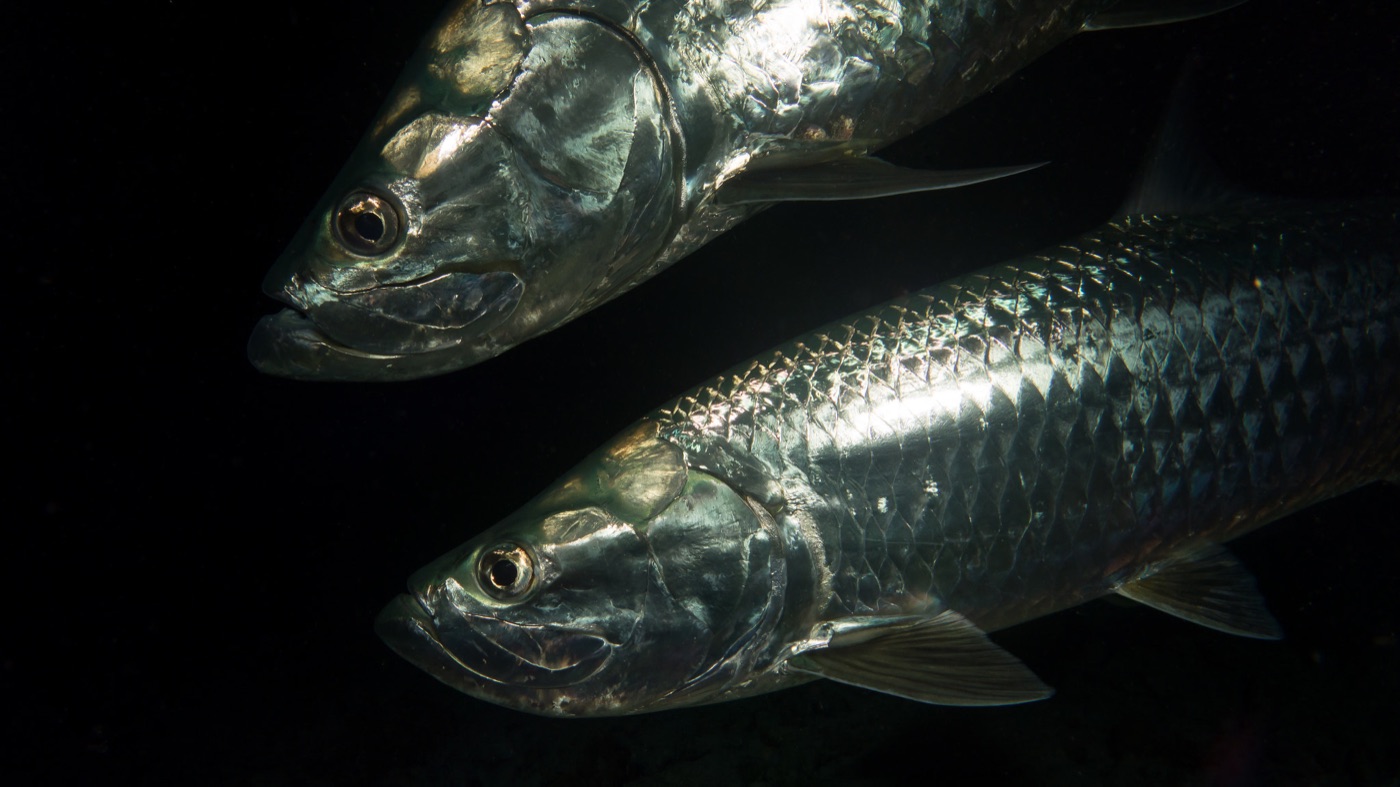
The body is deep and compressed, armored in large, bright, mirror-like scales that give the fish its silver-king nickname. The mouth is broad and upturned, set with a bony lower jaw, and the last ray of the dorsal fin extends into a long trailing filament. The eyes are large and the back a dusky green-blue over gleaming silver flanks. Tarpon possess a specialized swim bladder that lets them gulp air at the surface, an ancient adaptation that helps them survive in oxygen-poor water. Their sheer size and chrome flanks make hooked tarpon unmistakable as they leap.
Tarpon is native to the warm Atlantic, ranging along the western coast from Virginia to Brazil and across to West Africa. The species tolerates a wide range of salinity and often enters rivers, estuaries, and stagnant backwaters. Tarpon migrate seasonally along warm coastlines and gather in large numbers around passes and beaches to spawn offshore. Anglers pursue tarpon almost entirely for sport, releasing nearly all they catch, drawn by the fish's blistering runs and spectacular, gill-rattling leaps that define big-game inshore fishing.
Interesting Facts About Tarpon
- The world record tarpon weighed 286 pounds 9 ounces, caught in Guinea-Bissau in 2003.
- Tarpon can live more than 50 years, with some exceeding 60.
- The species can gulp air at the surface using a lung-like swim bladder.
- Tarpon are an ancient lineage, largely unchanged for over 100 million years.
- A single large female can carry more than 12 million eggs.
Show more facts
- Tarpon larvae drift as transparent, ribbon-like leptocephali before developing.
- The species is almost always released, as its flesh is bony and poorly regarded.
- Hooked tarpon leap repeatedly, often clearing the water entirely.
- Tarpon tolerate fresh, brackish, and salt water throughout their range.
- The huge silver scales were once used to make jewelry and ornaments.
- Tarpon gather by the hundreds around Florida passes during the spring run.
- Anglers land only a fraction of the tarpon they hook, given the fish's leaps.
Average Speed & Size
Tarpon is a large, powerful swimmer that typically reaches 4 to 6 feet and 40 to 120 pounds. Trophy fish exceed 7 feet and 200 pounds, with the record near 286 pounds. The species cruises coastlines and flats at a steady pace, then unleashes explosive speed and towering leaps once hooked. A tarpon's fight combines long, drag-burning runs with repeated jumps that can throw the hook, making it among the most demanding and thrilling of all inshore gamefish to land.
Where to Find Them
Tarpon is found in warm coastal waters, estuaries, flats, and river mouths along the western Atlantic, concentrating in Florida and the Gulf of Mexico. The species holds near passes, beaches, bridges, and channels where current sweeps bait, and cruises shallow flats in loose, visible schools. Tarpon favor water above 74 degrees Fahrenheit and follow the spring and summer migration along warm coasts. They tolerate low-oxygen backwaters other fish avoid. Tarpon are absent from cold temperate seas, restricted by their need for consistently warm water.
Tarpon Fishing Tips
Tarpon fishing is a demanding big-game pursuit that rewards preparation and stamina. Success comes from intercepting migrating or laid-up fish, presenting bait naturally, and bowing to the fish on each leap to keep the hook set.
Equipment
Use a heavy 7- to 8-foot spinning or conventional rod paired with a high-capacity reel holding 200 or more yards of 30- to 60-pound braid, plus an 60- to 80-pound leader and a short bite tippet. Fly anglers use 11- and 12-weight rods. The heavy tackle is essential to fight a fish that may weigh over 100 pounds through long runs and leaps.
Chumming
Chumming with live baitfish or cut menhaden can draw tarpon to a boat holding near a pass or channel. A steady flow of chum on moving tide concentrates fish and triggers feeding. Anglers also anchor up-current of a known travel route and let chunks drift back to intercept passing schools.
Bait
Live crabs, mullet, and pinfish are the top natural baits during the tarpon run. Effective lures and flies include large soft-plastic swimbaits, plugs, and streamer flies that imitate the local forage.
Patience
Tarpon are wary and often refuse a poorly presented bait, so a stealthy approach and an accurate lead ahead of moving fish are essential. Bow to the fish on every jump and expect a long, patient fight to land one.
Conditions that change the bite
- What Barometric Pressure Is Best for Fishing? No research supports a single best barometric pressure for fishing. What pressure really does, how big a weather swing is, and what to watch instead.
- Best Time of Day to Fish: What Evidence Shows Dawn and dusk are measurably better — and the edge is smaller than the folklore says. The 13-year dataset, the light mechanism, and what matters more.
- Dissolved Oxygen: The Condition Anglers Can't See Fish live or die by oxygen you can't see. How temperature, depth, dawn and turnover move it, which species need more, and how to fish around the invisible map.
Related Species
Know when they'll bite.
BiteScore forecasts when tarpon will feed at your spot — from live weather, pressure, and moon data.
Get the App