Permit
Trachinotus falcatus
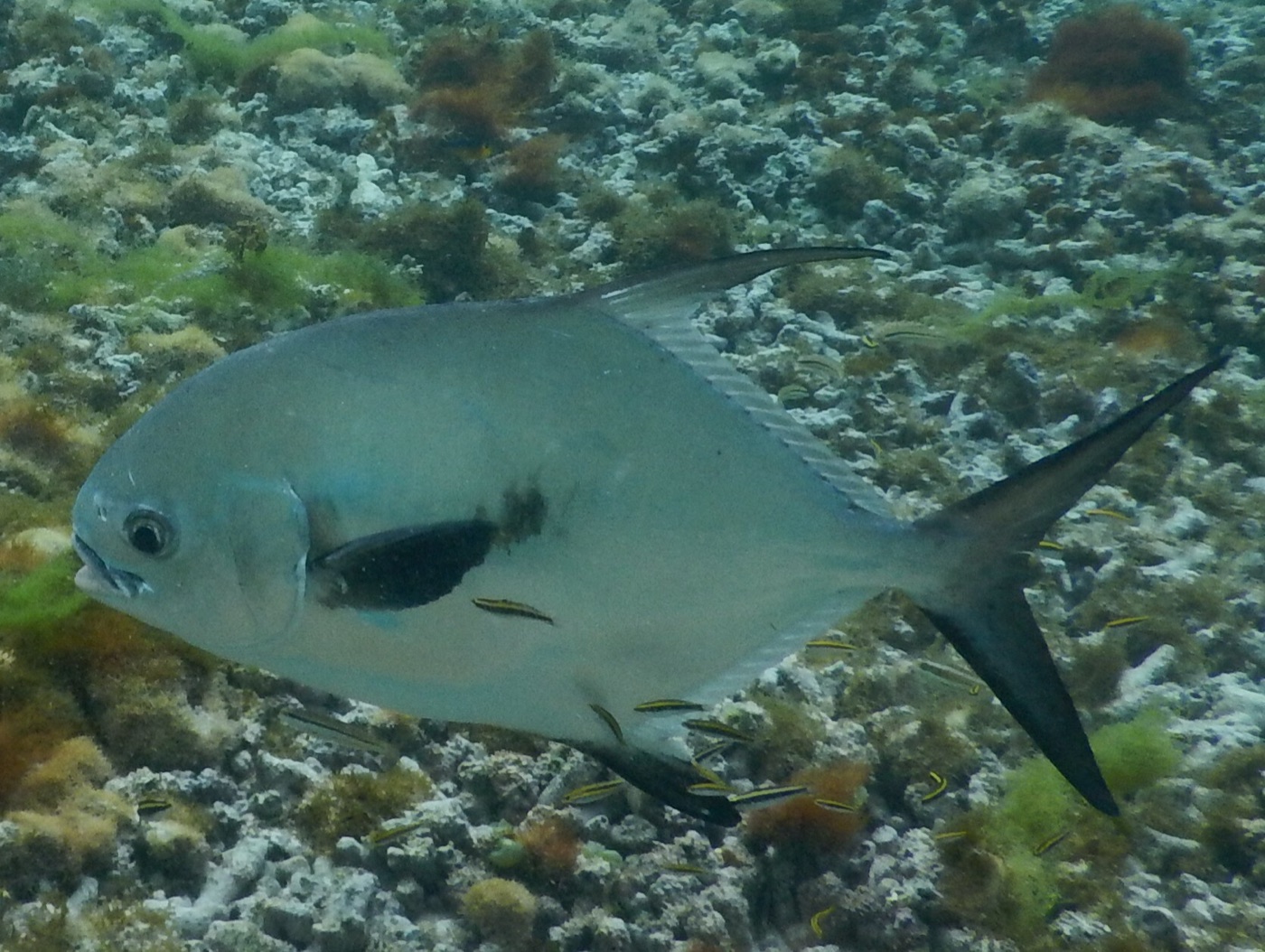
Permit is the flats angler's hardest prize — a tall, flat-sided jack with elongated dorsal and anal fins and a deeply forked tail, told from the smaller Florida pompano by a dorsal fin that begins over the anal fin.
MoreFull Species Details
- Species Name
- Trachinotus falcatus
- Family
- Carangidae
- Order
- Perciformes
- Also Known As
- Round pompano, Palometa, Cobbler
Permit (Trachinotus falcatus) Fish Description
Permit is the flats angler's hardest prize — a tall, flat-sided jack with elongated dorsal and anal fins and a deeply forked tail, told from the smaller Florida pompano by a dorsal fin that begins over the anal fin.
The Florida Museum's description captures the shape: a very tall, flat fish, most distinctive for its elongated dorsal and anal fins and its deeply forked tail, silvery with dark fins and often a shadowed patch behind the pectoral. The perennial confusion is with Florida pompano, and the state's identification sheet settles it structurally: on a permit the dorsal fin begins over the anal fin and the forehead rises sharply to a hump; on a pompano the dorsal begins forward of the anal fin and the forehead slopes gently. Size finishes the argument — the sheet caps pompano near 25 inches and 8 pounds, while permit reach 45 inches and 50, with the Museum recording fish to 48 inches and 79 pounds.
Permit live a double life. On the flats they are the nervous, tailing sight-fishing target of legend — schooling fish hunting crabs, gastropods, sea urchins and bivalves over sand and seagrass, crushing shells with granular teeth. Around deeper structure they become almost a different animal, gathering in large schools at wrecks and reefs. Research by the Bonefish and Tarpon Trust tied the two lives together: nearly 70% of Lower Keys flats permit migrate to one site, Western Dry Rocks, to spawn — and more than 30% of permit hooked there during catch-and-release fishing were eaten by sharks before landing, evidence behind Florida's April-to-July spawning closure at the site. The flats fishery they anchor was valued at $465.8 million in total economic impact in a 2012 Keys study.
Interesting Facts About Permit
- The dorsal fin begins over the anal fin — on a Florida pompano it begins forward of it.
- The forehead rises sharply to a hump; a pompano's slopes gently.
- Pompano top out near 25 inches and 8 pounds; permit reach 45 inches and 50 pounds.
- The Florida Museum records permit to at least 48 inches and 79 pounds.
- Permit crush crabs, snails, urchins and bivalves with granular teeth.
Show more facts
- Young fish school and hunt the flats; older fish grow more solitary.
- Around wrecks and reefs they gather in large schools.
- Spawning peaks May and June in the Keys, over reefs and nearshore waters.
- Nearly 70% of Lower Keys flats permit migrate to a single spawning site, Western Dry Rocks.
- More than 30% of permit hooked there were taken by sharks before landing — behind a seasonal closure.
- Over 1,000 permit have been dart-tagged and 150-plus acoustically tagged in Keys research.
- A 2012 study valued Keys flats fishing at $465.8 million in total economic impact.
Average Speed & Size
We publish no typical-size figure for permit, because no agency source we verified offers one — an honest gap worth noting on a species this famous. The verified bounds: Florida's identification sheet allows fish to 45 inches and 50 pounds, and the Florida Museum records a maximum of at least 48 inches and 79 pounds. On the flats, any permit is a big fish in shallow water — long, flat-sided and attached to a first run that uses the whole lagoon. Their reputation as the hardest of the flats grand slam rests not on size but on refusal: no fish inspects a crab more sceptically.
Where to Find Them
Permit split their address. The classic encounter is on grass and sand flats — the Florida Museum puts them hunting inshore on sandy seagrass flats, and greatest abundance in southern Florida within a range running Massachusetts to Brazil. Look for tailing fish and pushing wakes in thigh-deep water, especially on flooding tides. The other address is structure: reefs, jetties and wrecks, where the Museum notes they occur in large schools, down to about 30 metres. In the Keys, spawning season concentrates fish offshore from May and June — with special rules including a spawning-site closure; Florida's permit regulations are specific and current, so check the state's official page before fishing.
Permit Fishing Tips
Permit fishing on the flats is sight-fishing at its most demanding: a wary fish, a single natural food, and a presentation that must land close without landing loud. Most days are counted in shots, not fish.
Equipment
A 9- or 10-weight fly rod or a medium spinning outfit with a long leader covers the flats; the reel needs real backing, because the first run is long. Around wrecks, tackle steps up. Polarised glasses are not optional — this is a fishery of seeing fish before casting.
Chumming
Not used on the flats, where stealth is everything. Around deeper wrecks, live crabs drifted back serve the same concentrating purpose where regulations allow.
Bait
The crab is the currency: live crabs on the flats and around structure, and crab-pattern flies for the long game. Shrimp take fish too. Whatever lands must land quietly — a permit's inspection begins before the bait settles.
Patience
The species is a patience test with fins. Expect refusals, take the shots the fish offers, and strike gently when the line comes tight — the crushing mouth holds hooks poorly. Handle fish briefly and check Florida's current rules, including seasonal closures, before targeting them in the Keys.
Conditions that change the bite
- What Barometric Pressure Is Best for Fishing? No research supports a single best barometric pressure for fishing. What pressure really does, how big a weather swing is, and what to watch instead.
- Best Time of Day to Fish: What Evidence Shows Dawn and dusk are measurably better — and the edge is smaller than the folklore says. The 13-year dataset, the light mechanism, and what matters more.
- Dissolved Oxygen: The Condition Anglers Can't See Fish live or die by oxygen you can't see. How temperature, depth, dawn and turnover move it, which species need more, and how to fish around the invisible map.
Guides for fishing this species
- Catch and Release: Doing It So the Fish Survives Wet hands, under a minute of air, cut deep hooks, revive facing the current. NOAA and state agency best practices for releases that actually survive.
Related Species
Know when they'll bite.
BiteScore forecasts when permit will feed at your spot — from live weather, pressure, and moon data.
Get the App