Brook Trout
Salvelinus fontinalis
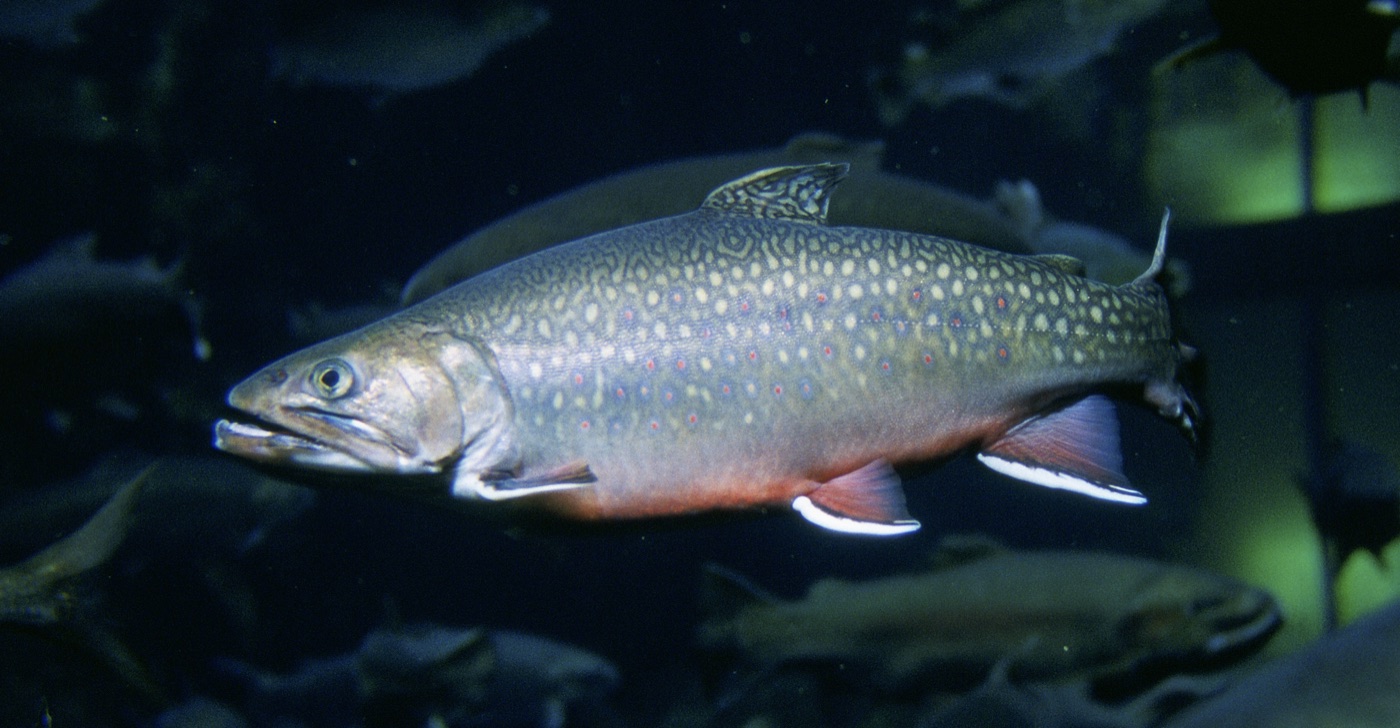
Brook trout is a small char of the salmon family, marked by pale worm-like markings on the back and red spots ringed with blue along the flanks.
MoreFull Species Details
- Species Name
- Salvelinus fontinalis
- Family
- Salmonidae
- Order
- Salmoniformes
- Also Known As
- Brookie, Speckled trout, Squaretail, Char
Brook Trout (Salvelinus fontinalis) Fish Description
Brook trout is a small char of the salmon family, marked by pale worm-like markings on the back and red spots ringed with blue along the flanks.
The back is dark olive with distinctive light, worm-like vermiculations, while the flanks carry scattered red dots each encircled by a blue halo. The lower fins are edged in white over a thin black line, a reliable field mark. During spawning, males flush deep orange to red along the belly, among the most striking coloration of any freshwater fish. The tail is squared rather than forked, giving rise to the name squaretail. As a char rather than a true trout, the brook trout shows light markings on a dark ground instead of dark spots on a light one.
Brook trout is native to the cold headwaters, streams, and lakes of eastern North America, from the Appalachians to eastern Canada. Stocking has spread the species west and to cold waters on other continents. It demands the coldest, cleanest, most oxygen-rich water of the common trout, which makes its presence a sign of a healthy stream. Anglers cherish brook trout for their beauty, their willingness to take a fly in small mountain water, and the pristine settings in which they live, more than for their usually modest size.
Interesting Facts About Brook Trout
- The world record brook trout weighed 14 pounds 8 ounces, caught in Ontario in 1915.
- Brook trout are a char, not a true trout, in the genus Salvelinus.
- The species needs cold, clean water, ideally below 65 degrees Fahrenheit.
- Brook trout are highly sensitive to pollution and warming, marking healthy streams.
- The species spawns in autumn over clean gravel in flowing water.
Show more facts
- Sea-run brook trout, called salters, spend time in coastal salt water.
- Most wild brook trout in small streams live only 3 to 4 years.
- The brook trout is the official state fish of nine US states.
- Spawning males turn vivid orange-red along the belly and lower fins.
- Brook trout can hybridize with brown trout to produce a sterile tiger trout.
- The species retreats to spring-fed pools and seeps to survive summer heat.
- Brook trout were the first trout many eastern US anglers ever caught, historically.
Average Speed & Size
Brook trout is a quick, darting swimmer that typically reaches 6 to 12 inches and under a pound in small streams. In large lakes and rich rivers the species grows far bigger, exceeding 20 inches and 5 pounds, with the record near 14 pounds. Brook trout dash from cover to seize drifting insects, relying on short bursts of speed in tight quarters rather than sustained pursuit. Stream fish stay small because cold, sparse headwaters limit their growth.
Where to Find Them
Brook trout is found in cold, clean headwater streams, spring-fed creeks, and northern lakes across eastern North America. The species holds in shaded pools, undercut banks, and behind rocks where cold current gathers, and in the coolest depths of lakes. Brook trout demand water below about 65 degrees Fahrenheit and the highest oxygen levels of any common trout. In summer they crowd into spring seeps and cold tributaries. Brook trout are absent from warm, silty, or polluted waters, whose temperature and low oxygen the species cannot survive.
Brook Trout Fishing Tips
Brook trout fishing is accessible yet intimate, often taking place in small, tight mountain streams. Success depends on a stealthy approach and a natural presentation in cold, clear water.
Equipment
Use an ultralight spinning rod of 5 to 6 feet with 2- to 4-pound line, or a short 3- or 4-weight fly rod for small streams. The light tackle suits the brook trout's small average size and the cramped quarters of headwater fishing. A short rod aids accurate casts under overhanging brush.
Chumming
Chumming is prohibited in nearly all trout waters, so a careful, natural approach replaces it. Casting upstream and letting bait or fly drift back naturally keeps the presentation in the strike zone without spooking fish. Approaching from downstream, out of the trout's field of view, is the most effective tactic.
Bait
Live worms and small insects are effective natural baits where regulations allow. Productive lures and flies include tiny spinners, small spoons, and imitations of mayflies, caddis, and terrestrial insects.
Patience
Brook trout in clear headwater spook at the slightest disturbance, so move slowly, keep a low profile, and cast from cover. A drag-free drift and a quiet approach matter far more than long casts.
Conditions that change the bite
- What Barometric Pressure Is Best for Fishing? No research supports a single best barometric pressure for fishing. What pressure really does, how big a weather swing is, and what to watch instead.
- Best Time of Day to Fish: What Evidence Shows Dawn and dusk are measurably better — and the edge is smaller than the folklore says. The 13-year dataset, the light mechanism, and what matters more.
- Dissolved Oxygen: The Condition Anglers Can't See Fish live or die by oxygen you can't see. How temperature, depth, dawn and turnover move it, which species need more, and how to fish around the invisible map.
Guides for fishing this species
- Trout Fishing for Beginners: Water Temperature First A thermometer teaches more than a tackle box. Where trout can survive, when to stop fishing for them, and the light rigs that work on stocked water.
- Trout vs Salmon: Same Family, Very Different Lives Trout, salmon and char all share one family — the real split is life history. Why Pacific salmon die after spawning, steelhead don't, and where char fit in.
- Catch and Release: Doing It So the Fish Survives Wet hands, under a minute of air, cut deep hooks, revive facing the current. NOAA and state agency best practices for releases that actually survive.
- Dry Fly vs Nymph: Which One, and When Dry flies copy adult insects on top; nymphs copy the stage that lives underwater for months. The biology behind the choice, and the rule agencies give.
- Fishing Soft Plastics How to rig soft plastics, what research shows happens when a fish swallows one, and why bass colour vision makes most tackle-aisle shades irrelevant.
- Fly Fishing Basics: What It Is and How to Start Fly fishing explained by state agencies: why you cast the line instead of the lure, the outfit you actually need, what flies imitate, and where to begin.
Related Species
Know when they'll bite.
BiteScore forecasts when brook trout will feed at your spot — from live weather, pressure, and moon data.
Get the App