Fly Line, Leader and Tippet: The Setup Explained
A fly outfit is four lengths of line in series: backing on the spool, fly line that carries the weight of the cast, a tapered leader that transfers that energy down to almost nothing, and tippet — the fine final section your fly is tied to. Match the line weight number to your rod, and replace tippet as it shortens.
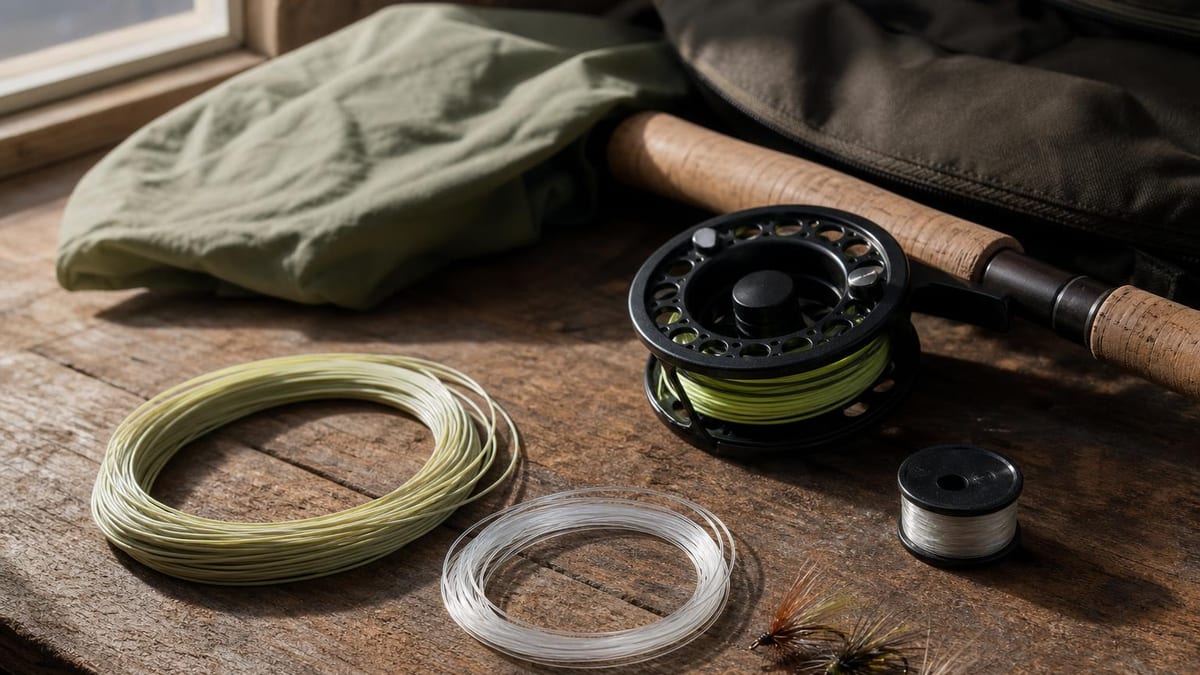
Key takeaways
- In fly fishing you cast the line, not the lure — the fly line's weight carries a nearly weightless fly to the fish.
- Line weight numbers run from 1 upward (to 14 or 15), and the number comes from the weight of the front 30 feet.
- Match the numbers: a 5-weight line belongs on a 5-weight rod. Rod, line and reel are a matched set.
- Floating (F) or sinking (S) is a coating choice — air bubbles float the line, tungsten or lead sinks it.
- Backing goes on first because a spool filled only with fly line would hold too much memory.
- The leader tapers from a thick butt to fine tippet so casting energy transfers smoothly and the fly turns over.
Four lines, in series
A spinning setup has one line: the stuff on the spool goes to the lure. A fly setup has four sections, each doing a different job, joined in a chain from reel to fly — backing, fly line, leader, tippet. Understanding what each one is for makes the whole discipline click, because every piece exists to solve a problem created by the same odd fact: the fly weighs almost nothing.
Take Me Fishing states the inversion cleanly. In spin fishing, the weight of the lure being cast pulls line off the reel. In fly fishing, the weight of the fly line being cast is what carries the fly to the fish. You are not casting a lure with line attached; you are casting a line with a fly attached. Everything below follows from that.
Fly line: the part that carries the cast
Fly line is the engine, and its number is the spec that matters. Take Me Fishing explains how the rating works: although a fly line runs 90 to 105 feet or more, its weight designation — 1-weight through 15-weight — is determined by the weight of the front 30 feet. The scale starts at 1 for the lightest and rises to about 14 or 15 at the heaviest.
Match the number to your rod. Their example: a 5-weight line is an appropriate match for a 4/5/6 reel mounted on a 5-weight rod; a 4-weight reel pairs ideally with 4-weight line. Rods are engineered to bend under a specific line weight, so a mismatch either leaves the rod unloaded or overwhelms it. This is the fly-fishing equivalent of the rod power and action matching every angler learns eventually.
Float or sink is a coating decision. Take Me Fishing describes the manufacturing: fly lines float because they are designed with tiny air bubbles in the surface coating; add lead or tungsten to the coating instead and the line sinks. Lines are marked (F) for floating and (S) for sinking. Which to buy first is easy — a floating line is the popular choice because it’s easy to use and pairs with dry flies as well as some wet flies fished below the surface.
The specialists come later. Full-sinking lines, per the same source, are best suited to still waters and designed to get flies down to the level where fish are feeding. Sink-tips — sinking sections usually 8 to 15 feet long joined to the front of a floating line — are best used in moving water and are described as excellent for shallow and deep nymphing.
Backing: the layer nobody sees
Under the fly line sits backing, and it is not just filler. Take Me Fishing explains the reason: because of the composition and diameter of fly line, a reel filled entirely with fly line would retain too much “memory” — the coiling that makes line behave badly. So the first layer on the spool is backing, described as a heavy braid-type line with no memory.
The second reason is the romantic one: when a fish runs past the length of your fly line, backing is what’s left. It is tied to the reel with an arbor knot — the same slide-and-stopper knot that starts line on any spinning reel, and one Take Me Fishing names specifically for fly line backing.
Leader: the taper that turns the fly over
Between the thick fly line and the nearly weightless fly, something has to bridge the gap in diameter and energy. That’s the leader. Take Me Fishing describes its purpose — connecting fly line to fly so the fly is presented in a way that resembles the movements of the insect it imitates — and its anatomy: three sections, butt, midsection and tippet.
The taper is the whole point. To consistently turn the fly over in casting, the midsection must taper down from the thick, heavy butt to the thin tippet; that tapering — which takes up nearly half the leader’s total length — allows a smooth transfer of energy from the main line through the leader and tippet to the fly, so the line straightens properly. A level piece of monofilament won’t do this: energy hits the diameter change and collapses, and your fly lands in a heap.
On length, the verified figures are situational rather than universal: a standard leader for stream trout, bass and panfish is 9 feet, some run as long as 22 feet, and spring-creek leaders are often 12 feet or longer. Washington’s Department of Fish and Wildlife, writing about clear high-mountain lakes, advises that long leaders of 12 feet or more work better than short ones, with tippets as small as possible while maintaining 2 to 3 pounds of breaking strength. Clearer, flatter, spookier water buys longer leaders.
Tippet: the part you actually spend
Tippet is the leader’s final section — in Take Me Fishing’s words, the thinnest part of the leader and the part attached to the fly. It’s also the consumable: every fly change costs you a few inches, and when the tippet gets short you tie on fresh tippet rather than replacing a whole tapered leader.
Sizing uses an “X” system that runs, per the same source, from the strong and stiff 03X down to the light, wispy 8X for the smallest flies — smaller number, heavier tippet. Their rule of thumb for matching tippet to fly is to divide the fly size by three (a size 10 fly → roughly 3X), and the source itself calls this approximate, which is the honest way to use it. The governing principle is simpler and needs no table: the smaller the fly, the smaller the tippet diameter.
The knots that hold the chain together
Four sections mean three junctions, and fly fishing has specific answers for each:
| Junction | Knot |
|---|---|
| Backing → reel | Arbor knot |
| Backing → fly line, or fly line → leader | Nail knot — Take Me Fishing calls it versatile enough for either, and good for connecting two lines of different diameter |
| Fly line → leader (modern alternative) | Loop-to-loop — many fly lines now come with pre-made loops, so you add a loop knot to your leader and interlock them |
| Leader → tippet | Surgeon’s knot or blood knot |
| Tippet → fly | Improved clinch and similar terminal knots |
Two verified judgements are worth carrying. On the leader-to-tippet join, Take Me Fishing rates the surgeon’s knot above the more popular blood knot on two counts: stronger breaking strength, and better for joining widely divergent monofilament sizes — which is exactly what a tapered leader meeting new tippet is. And on the fly line connection, they note the needle nail knot is the most secure of all leader-line connections, but takes more time and is harder to master than loop-to-loop.
That is the entire fly setup: backing for memory and insurance, fly line for the cast, a tapered leader to deliver the energy, and tippet fine enough to disappear. Once the chain makes sense, the cast and the fly choice are the only questions left — and our knots library has every junction above, step by step.
Frequently asked questions
Why does fly fishing use a heavy line instead of a heavy lure?
Because the fly weighs almost nothing. Take Me Fishing puts the contrast plainly: in spin fishing the weight of the lure pulls line off the reel, while in fly fishing the weight of the fly line being cast is what carries the fly to the fish. Everything else about the setup follows from that inversion — the rod is built to load with line weight, the leader exists to transfer that energy down to a fly too light to carry itself.
What do fly line weight numbers mean?
They rate the line's mass, not its length. Take Me Fishing explains that although fly line runs 90 to 105 feet or more, its weight designation — 1-weight through 15-weight — is determined by the weight of the front 30 feet. The scale starts at 1 for the lightest and climbs to about 14 or 15 at the heaviest. Light numbers suit small flies and small water; heavy numbers throw big flies and cut wind.
How do I match line weight to my rod and reel?
Match the numbers and stop thinking about it. Take Me Fishing's example: a 5-weight line is an appropriate match for a 4/5/6 fly reel mounted on a 5-weight rod, and a 4-weight reel is ideally paired with a 4-weight line. Rods are built to load with a specific line weight — a mismatched line either fails to flex the rod or overloads it, and either way the cast suffers.
What is backing and why do I need it?
It's the line under your fly line, and it solves two problems. Take Me Fishing explains the first: because of the composition and diameter of fly line, a reel filled only with fly line would retain too much memory — so the first layer is backing, a heavy braid-type line with no memory. It also gives a running fish somewhere to go once the fly line is gone. Backing is tied to the reel with an arbor knot, the same knot that starts any spinning reel.
What is the difference between a leader and tippet?
The tippet is part of the leader — its last and finest part. Take Me Fishing describes a fly leader as having three sections: butt, midsection and tippet, with the tippet being the thinnest part and the part your fly ties to. The taper is functional: the midsection must taper down from the thick, heavy butt to the thin tippet so casting energy transfers smoothly and the line straightens out properly. As you cut and retie flies, the tippet shortens — so you add fresh tippet rather than replacing the whole leader.
Sources
- Select the Best Fly Fishing Line — Take Me Fishing (Recreational Boating & Fishing Foundation). Accessed August 16, 2026.
- How to Choose Fly Line — Take Me Fishing (Recreational Boating & Fishing Foundation). Accessed August 16, 2026.
- Best Fly Fishing Leaders — Take Me Fishing (Recreational Boating & Fishing Foundation). Accessed August 16, 2026.
- How to Select the Right Tippet — Take Me Fishing (Recreational Boating & Fishing Foundation). Accessed August 16, 2026.
- Fly Fishing Basics: Loading the Reel — Take Me Fishing (Recreational Boating & Fishing Foundation). Accessed August 16, 2026.
- Popular Fly Fishing Knots — Take Me Fishing (Recreational Boating & Fishing Foundation). Accessed August 16, 2026.
- How to Tie a Nail Knot — Take Me Fishing (Recreational Boating & Fishing Foundation). Accessed August 16, 2026.
- High lakes fishing — Washington Department of Fish & Wildlife. Accessed August 16, 2026.
How we choose sources: sources policy.
More in this series
Know when it's worth going.
Fishing Club AI turns live weather, pressure and moon data into a simple bite forecast for your spot — so the skills you practise get used on the right day.
Get the App