Flathead Catfish
Pylodictis olivaris
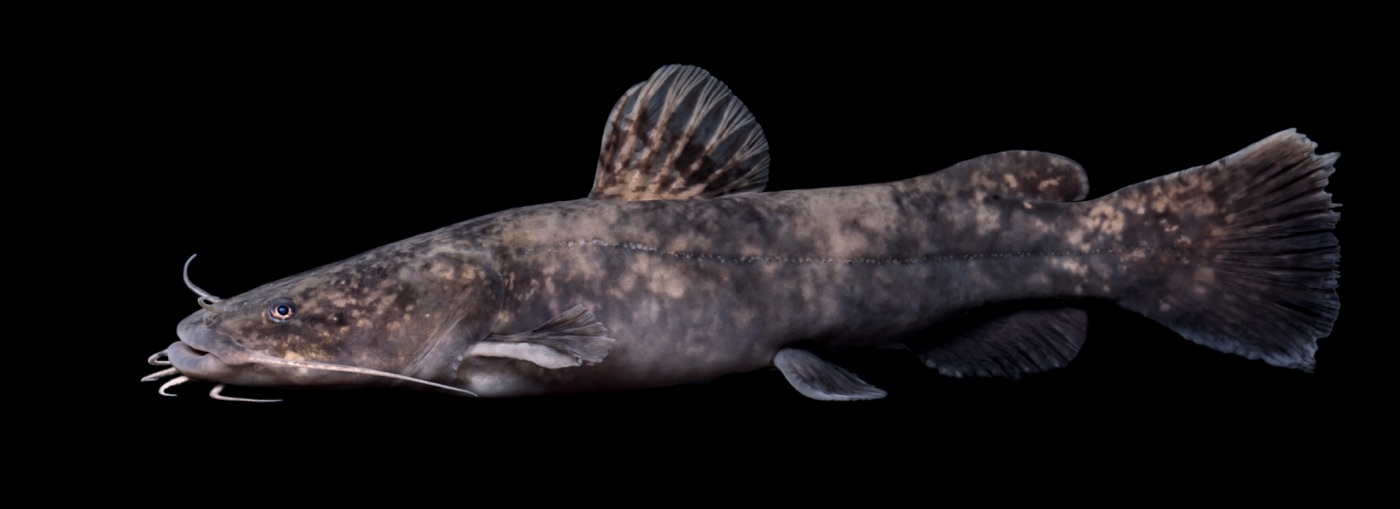
Flathead catfish is a large, solitary river predator distinguished by a broad flattened head, a protruding lower jaw, and a squared tail.
MoreFull Species Details
- Species Name
- Pylodictis olivaris
- Family
- Ictaluridae
- Order
- Siluriformes
- Also Known As
- Flathead, Yellow cat, Mud cat, Shovelhead cat
Flathead Catfish (Pylodictis olivaris) Fish Description
Flathead catfish is a large, solitary river predator distinguished by a broad flattened head, a protruding lower jaw, and a squared tail.
The body is long and muscular, mottled yellow-brown to olive over a pale, often cream-colored belly, with a broad, strikingly flat head. The lower jaw juts past the upper, and the tail is squared or only slightly notched, unlike the deeply forked tails of the blue and channel catfish. Barbels ring the wide mouth, and the eyes are small and set high. Coloration varies from bright yellow in clear water to dark mottled brown in stained rivers. The flat head, jutting jaw, and squared tail together identify the species at a glance and set it apart from other catfish.
Flathead catfish is native to the Mississippi, Missouri, and Ohio river basins and the Gulf coastal rivers. The species has been introduced beyond its range, where as an aggressive predator it can disrupt native fish populations. Flathead catfish are solitary hunters that hold in deep holes, log jams, and cover during the day and roam to feed at night. Anglers pursue the species for its enormous size and powerful fight, and for its distinctive preference for live prey, which makes targeting flatheads a specialized pursuit centered on live bait fished near cover.
Interesting Facts About Flathead Catfish
- The world record flathead catfish weighed 123 pounds, caught in Kansas in 1998.
- Flathead catfish strongly prefer live prey over cut or prepared bait.
- The species can live more than 20 years in large river systems.
- Flathead catfish have a squared tail, unlike the forked-tail blue and channel cats.
- The species spawns in early summer in dark, sheltered cavities and holes.
Show more facts
- Males guard the nest and fan the eggs until the young hatch.
- Flathead catfish are solitary and rarely gather in groups like other catfish.
- The species holds in cover by day and roams to feed after dark.
- Introduced flatheads can severely reduce native fish where they are stocked.
- The broad flat head and jutting lower jaw give the species its name.
- Young flathead catfish appear bright yellow, darkening with age and water color.
- Trophy flatheads over 50 pounds are prized and often released alive.
Average Speed & Size
Flathead catfish is a powerful, ambush-oriented swimmer that typically reaches 20 to 40 inches and 5 to 30 pounds. Trophy fish exceed 50 inches and 70 pounds, with the record near 123 pounds. The species holds near cover and moves deliberately, then lunges to seize live prey in a short, powerful strike. Flatheads do not roam far by day, but they hunt actively at night. Once hooked, a big flathead fights with immense, stubborn power, using its bulk to bulldog back toward the log jams and holes it calls home.
Where to Find Them
Flathead catfish is found in large rivers, reservoirs, and their deep holes across the central and southern United States. The species holds by day in the deepest cover it can find: log jams, undercut banks, submerged timber, and rock piles. Flathead catfish favor warm water and slow to moderate current, moving out of cover to hunt over flats and channel edges after dark. Solitary by nature, each fish claims its own prime lie. Flathead catfish are largely absent from cold headwater streams and clear northern lakes, needing warm, structured river habitat.
Flathead Catfish Fishing Tips
Flathead catfish fishing is a specialized night pursuit built almost entirely around live bait fished near heavy cover. Success comes from placing a lively bait close to the log jams and holes where big flatheads hold and waiting for them to move.
Equipment
Use a heavy 7-foot-6 to 8-foot rod paired with a strong reel spooled with 30- to 80-pound braid and an abrasion-resistant leader. The heavy tackle is essential to pull a large fish out of the timber and cover where flatheads live. A powerful rod and strong drag let anglers turn a hooked flathead before it wraps the line around submerged wood.
Chumming
Chumming is far less effective for flathead catfish, which prefer live prey and hunt by ambush rather than scent-trailing to cut bait. Anglers instead position lively baits precisely against cover where flatheads hold. Rather than drawing fish with chum, success depends on placing bait in the fish's ambush zone and letting it work.
Bait
Live baitfish such as bluegill, bullheads, and large shad are by far the top choices, since flatheads favor live prey. Lively, hardy baits fished near cover consistently outproduce cut or prepared baits.
Patience
Flathead catfish are solitary and hunt mainly at night, so anglers set live baits near cover and wait, often for hours, for a single big fish. Fishing after dark near heavy structure rewards patience and persistence.
Conditions that change the bite
- What Barometric Pressure Is Best for Fishing? No research supports a single best barometric pressure for fishing. What pressure really does, how big a weather swing is, and what to watch instead.
- Best Time of Day to Fish: What Evidence Shows Dawn and dusk are measurably better — and the edge is smaller than the folklore says. The 13-year dataset, the light mechanism, and what matters more.
- Dissolved Oxygen: The Condition Anglers Can't See Fish live or die by oxygen you can't see. How temperature, depth, dawn and turnover move it, which species need more, and how to fish around the invisible map.
Guides for fishing this species
- Catfish Fishing: The Bottom, the Bait and the Hole Catfish feed on the bottom and hide in deep holes by day. What each species eats, when to set the hook, and why fishing after rain works.
- Live Bait for Fishing: What Each Bait Catches, and the One Rule About Leftovers Texas Parks and Wildlife says which bait suits which fish and how to hook it. The U.S. Fish and Wildlife Service says why you never pour the bucket back.
- Night Fishing: Why It Works, and What Changes After Dark Some of the best-known gamefish are described by state agencies as nocturnal. What that means for where they move at night, and what the rules require of you.
- The Fish Finder Rig: Sliding Sinker Bottom Fishing How to build the fish finder rig — sliding sinker, bead, swivel, leader — why fish never feel the weight, and how to pair it with circle hooks.
Related Species
Know when they'll bite.
BiteScore forecasts when flathead catfish will feed at your spot — from live weather, pressure, and moon data.
Get the App