Muskie
Esox masquinongy
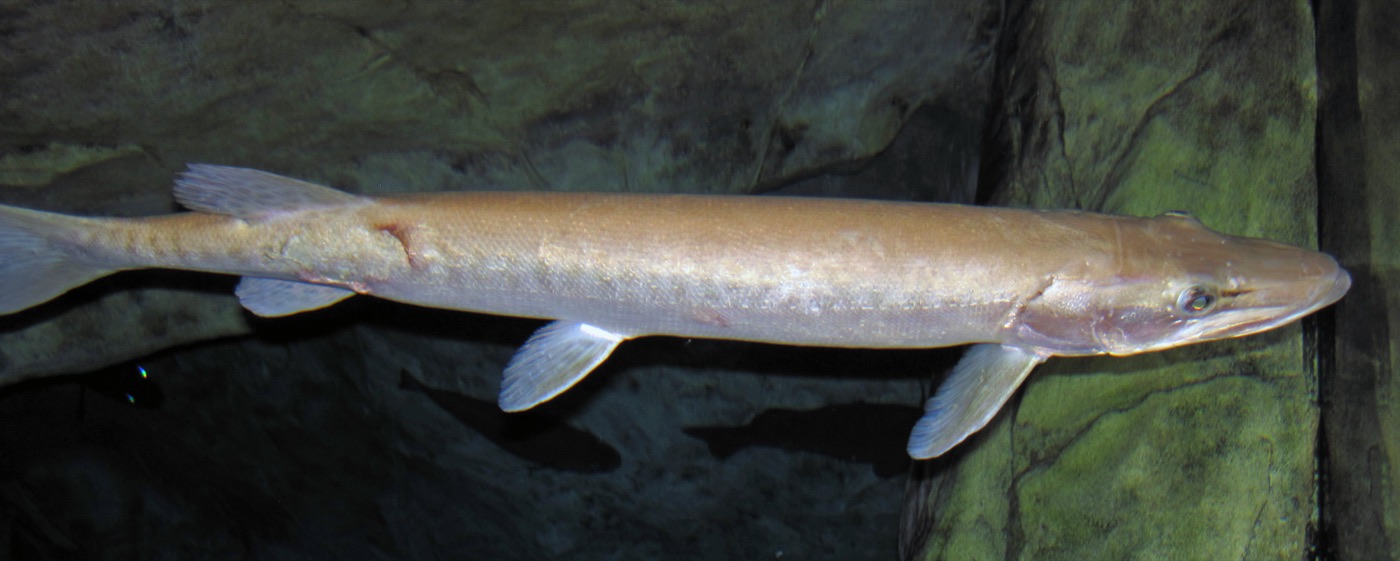
Muskie is the largest member of the pike family, a long, toothy freshwater predator renowned as one of the hardest gamefish to catch.
MoreFull Species Details
- Species Name
- Esox masquinongy
- Family
- Esocidae
- Order
- Esociformes
- Also Known As
- Muskellunge, Musky, Lunge, Fish of ten thousand casts
Muskie (Esox masquinongy) Fish Description
Muskie is the largest member of the pike family, a long, toothy freshwater predator renowned as one of the hardest gamefish to catch.
The body is long, cylindrical, and torpedo-shaped, light silver to green or brown with dark vertical bars or spots over a pale background. The head is broad and duck-billed, and the jaws are set with hundreds of sharp teeth built to seize large prey. The dorsal and anal fins sit far back near the deeply forked tail, a design that delivers explosive acceleration. Muskie can be told from the similar northern pike by the pattern of sensory pores under the jaw and by their darker markings on a lighter body. Their sheer length and predatory build make them unmistakable.
Muskie is native to the Great Lakes region, the upper Mississippi basin, and the St. Lawrence River system of North America. The species has been widely stocked to create trophy fisheries beyond its original range. Muskie are solitary ambush hunters that hold near weed edges, drop-offs, and structure in cool lakes and rivers. Anglers pursue muskie for the challenge above all: the fish is famously difficult, earning the nickname the fish of ten thousand casts, and its size and violent strikes make landing one a celebrated achievement.
Interesting Facts About Muskie
- The world record muskie weighed 67 pounds 8 ounces, caught in Wisconsin in 1949.
- Muskie are the largest members of the pike family, Esocidae.
- The species is nicknamed the fish of ten thousand casts for its difficulty.
- Muskie can live more than 20 years, and large fish are typically old females.
- The species spawns in spring in shallow, weedy bays after ice-out.
Show more facts
- Muskie are solitary ambush predators that rarely school.
- The jaws hold hundreds of sharp teeth for seizing large prey.
- Muskie can strike prey up to a third or more of their own length.
- A follow to the boat without a strike is a hallmark of muskie fishing.
- The species prefers cool water and moves deeper as summer warms lakes.
- Muskie and northern pike can interbreed to produce the sterile tiger muskie.
- Nearly all trophy muskie are released to sustain the fishery.
Average Speed & Size
Muskie is a large ambush predator that typically reaches 30 to 45 inches and 10 to 25 pounds. Trophy fish exceed 50 inches and 40 pounds, with the record near 67 pounds. The species holds motionless near cover, then unleashes explosive acceleration to seize prey in a single violent lunge. Muskie do not roam or chase over distance, relying on burst speed from a standstill. Once hooked, a big muskie fights with powerful surges and headshakes, and it may follow a lure to the boat before committing to strike.
Where to Find Them
Muskie is found in cool lakes and rivers across the Great Lakes region, the upper Midwest, and stocked waters beyond. The species holds near weed edges, rocky points, drop-offs, and submerged timber that offer ambush cover. Muskie favor water in the 60s and low 70s Fahrenheit and move deeper as summer heat builds, returning shallow in cooler months. They relate closely to structure and baitfish concentrations. Muskie are absent from warm southern lowland waters and small, weedless ponds, needing the cool, structured habitat of northern lakes and rivers.
Muskie Fishing Tips
Muskie fishing is the ultimate freshwater test of persistence, demanding long hours and heavy tackle for a single strike. Success comes from covering structure with large lures and being ready to convert the follows that muskie so often make.
Equipment
Use a heavy 8- to 9-foot casting rod paired with a strong reel spooled with 65- to 100-pound braid and a heavy fluorocarbon or wire leader. The stout tackle is needed to cast large lures all day and to control a powerful fish near cover. A heavy leader is essential to resist the muskie's teeth, and a long rod aids the figure-eight boatside maneuver that triggers following fish.
Chumming
Chumming is not used for muskie, which are solitary sight predators located by casting structure. Anglers instead cover water methodically, working weed edges and points with large lures. The figure-eight retrieve at the boat replaces chum as the key trigger, turning a following muskie into a strike at the last moment.
Bait
Large live suckers are the top natural bait for trophy muskie. Effective lures include big bucktails, glide baits, jerkbaits, and topwater plugs worked over and along structure.
Patience
Muskie test patience like no other freshwater fish, often requiring thousands of casts for one strike. Working structure thoroughly and finishing every retrieve with a figure-eight turns rare follows into landed fish.
Conditions that change the bite
- What Barometric Pressure Is Best for Fishing? No research supports a single best barometric pressure for fishing. What pressure really does, how big a weather swing is, and what to watch instead.
- Best Time of Day to Fish: What Evidence Shows Dawn and dusk are measurably better — and the edge is smaller than the folklore says. The 13-year dataset, the light mechanism, and what matters more.
- Dissolved Oxygen: The Condition Anglers Can't See Fish live or die by oxygen you can't see. How temperature, depth, dawn and turnover move it, which species need more, and how to fish around the invisible map.
Guides for fishing this species
- How to Choose a Fishing Rod: Length, Power and Action Rod length, power, action and material explained with agency guidance — what each spec trades away, and the honest beginner setup agencies recommend.
Related Species
Know when they'll bite.
BiteScore forecasts when muskie will feed at your spot — from live weather, pressure, and moon data.
Get the App