Northern Pike
Esox lucius
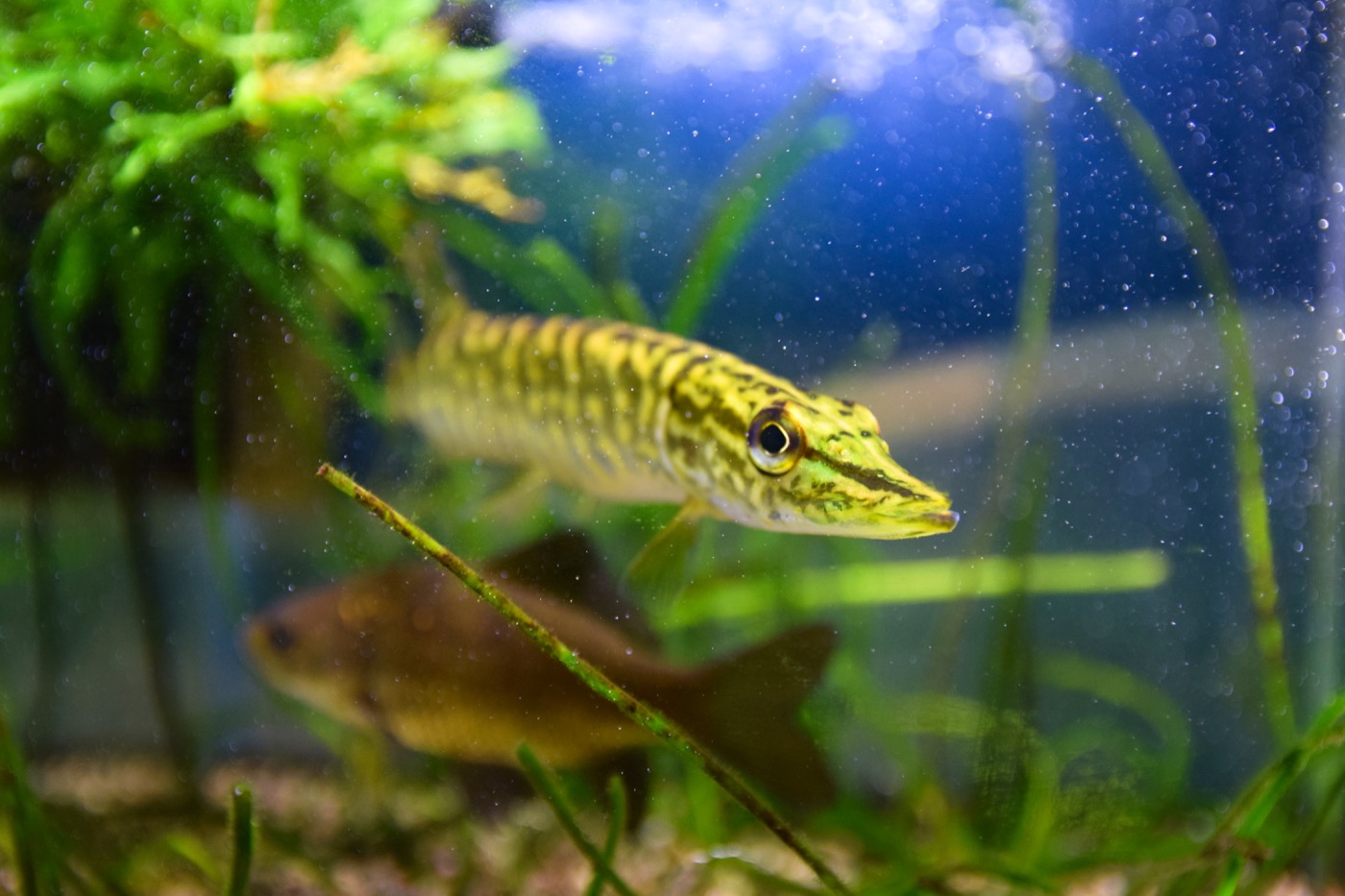
Northern pike is a long, aggressive freshwater predator of the pike family, marked by light bean-shaped spots scattered across a dark green body.
MoreFull Species Details
- Species Name
- Esox lucius
- Family
- Esocidae
- Order
- Esociformes
- Also Known As
- Pike, Northern, Jackfish, Great northern pike
Northern Pike (Esox lucius) Fish Description
Northern pike is a long, aggressive freshwater predator of the pike family, marked by light bean-shaped spots scattered across a dark green body.
The body is elongated and torpedo-shaped, dark olive to green with rows of light, bean-shaped spots along each flank, the reverse of the muskie's dark markings on a light body. The head is broad and duck-billed, and the mouth is lined with sharp, backward-slanting teeth. The dorsal and anal fins sit far back near the forked tail, giving the pike explosive short-range speed. Coloration darkens in weedy, stained water and lightens in clear lakes. The pale horizontal spots on a dark ground reliably separate the northern pike from its larger cousin the muskellunge.
Northern pike is native to the northern United States, Canada, and across northern Europe and Asia, giving it one of the widest ranges of any freshwater fish. The species thrives in cool, weedy lakes, slow rivers, and backwaters throughout the Northern Hemisphere. Pike are ambush predators that hold in vegetation and strike passing prey with sudden violence. Anglers pursue northern pike for their aggressive, slashing strikes, their willingness to hit large lures, and their abundance across cold northern waters, making them a staple of both open-water and ice fishing.
Interesting Facts About Northern Pike
- The world record northern pike weighed 55 pounds 1 ounce, caught in Germany in 1986.
- Northern pike have one of the widest natural ranges of any freshwater fish.
- The species can live more than 20 years in cold northern waters.
- Pike spawn in early spring, often right after ice-out, in flooded vegetation.
- The mouth holds hundreds of sharp, backward-slanting teeth.
Show more facts
- Northern pike carry light, bean-shaped spots on a dark green body.
- Pike are ambush predators that strike from cover with explosive speed.
- Large northern pike over 20 pounds are almost always females.
- The species can seize prey up to a third of its own body length.
- Northern pike remain active under ice, making them a top winter target.
- Cool water suits pike best, and they seek deeper, cooler water in summer heat.
- Pike and muskie can hybridize to produce the sterile tiger muskie.
Average Speed & Size
Northern pike is a burst-speed ambush predator that typically reaches 20 to 34 inches and 3 to 12 pounds. Trophy fish exceed 40 inches and 20 pounds, with the record near 55 pounds. The species lies motionless in weeds, then accelerates in a sudden, explosive lunge to seize prey within a fraction of a second. Pike rely on short-range speed rather than sustained pursuit, and a hooked fish fights with hard runs and violent headshakes, often thrashing at the surface near the boat.
Where to Find Them
Northern pike is found in cool, weedy lakes, slow rivers, and backwaters across the northern United States, Canada, and Eurasia. The species holds in and along vegetation, weed edges, bays, and drop-offs where it can ambush passing prey. Pike favor cool water and stay shallow in spring and fall, retreating to deeper, cooler water during summer heat. They remain active through winter beneath the ice. Northern pike are absent from warm southern lowland waters and fast, cold trout streams, preferring the cool, weedy lakes and rivers of the north.
Northern Pike Fishing Tips
Northern pike fishing is action-packed and beginner-friendly, thanks to the fish's aggression and abundance. Success comes from working large lures near weeds and using a leader to survive the pike's slashing teeth.
Equipment
Use a 7-foot medium-heavy casting or spinning rod paired with a strong reel spooled with 30- to 50-pound braid and a wire or heavy fluorocarbon leader. The leader is essential to withstand the pike's sharp teeth, which easily sever ordinary line. A rod with solid backbone drives the hook home and turns a hooked fish away from the thick weeds it calls home.
Chumming
Chumming is not typically used for pike, which are located by casting weedy structure. Anglers cover water with large, flashy lures that provoke reaction strikes from ambush-holding fish. In winter, tip-ups baited with live or dead bait set over weed edges replace active casting and let anglers cover several spots at once.
Bait
Live or dead baitfish such as suckers and smelt are top natural baits, especially through the ice. Effective lures include large spoons, spinnerbaits, jerkbaits, and soft swimbaits worked near vegetation.
Patience
Northern pike strike readily, so patience matters less than covering water and keeping a leader in place. Work the weed edges thoroughly, as pike often hold in specific ambush spots along the vegetation.
Conditions that change the bite
- What Barometric Pressure Is Best for Fishing? No research supports a single best barometric pressure for fishing. What pressure really does, how big a weather swing is, and what to watch instead.
- Best Time of Day to Fish: What Evidence Shows Dawn and dusk are measurably better — and the edge is smaller than the folklore says. The 13-year dataset, the light mechanism, and what matters more.
- Dissolved Oxygen: The Condition Anglers Can't See Fish live or die by oxygen you can't see. How temperature, depth, dawn and turnover move it, which species need more, and how to fish around the invisible map.
Guides for fishing this species
- Spinning vs Baitcasting Reels: Which One and When How spinning and baitcasting reels actually work — fixed spool vs revolving spool, backlash, drag and line weights — with agency guidance on choosing.
- Walleye vs Yellow Perch Same family, and one eats the other. The glassy eye, canine teeth and white tail tip that mark a walleye — and the barred, schooling perch it hunts.
Related Species
Know when they'll bite.
BiteScore forecasts when northern pike will feed at your spot — from live weather, pressure, and moon data.
Get the App