Blue Catfish
Ictalurus furcatus
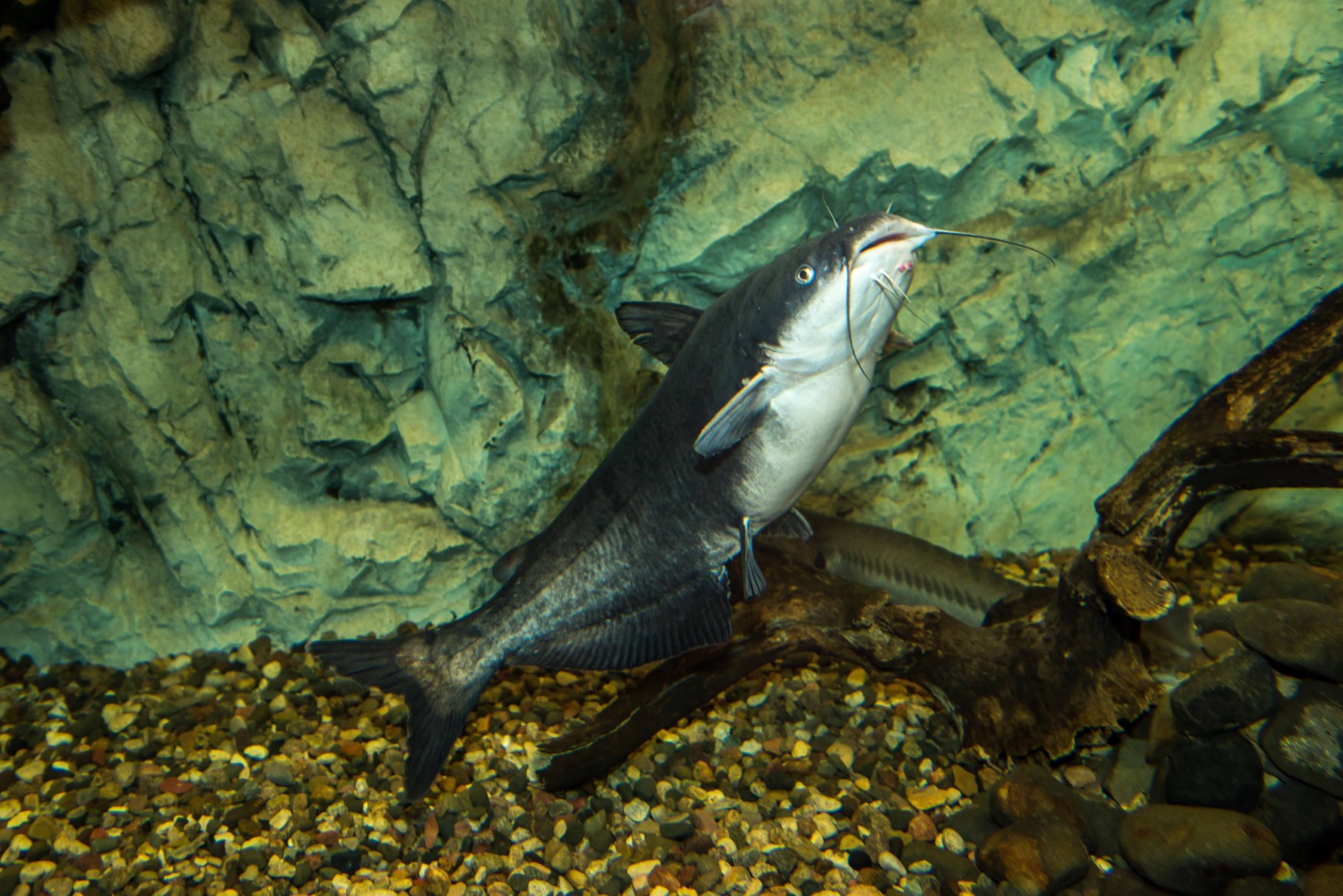
Blue catfish is the largest catfish species in North America, a scaleless river giant with a slate-blue body and a deeply forked tail.
MoreFull Species Details
- Species Name
- Ictalurus furcatus
- Family
- Ictaluridae
- Order
- Siluriformes
- Also Known As
- Blue cat, Hump-back blue, Chucklehead cat, Forktail cat
Blue Catfish (Ictalurus furcatus) Fish Description
Blue catfish is the largest catfish species in North America, a scaleless river giant with a slate-blue body and a deeply forked tail.
The body is smooth and scaleless, slate-blue to gray on the back fading to a clean white belly, without the dark spots of the channel catfish. The tail is deeply forked, and the anal fin is long and straight-edged, a key trait separating the blue from the rounded-fin channel and flathead. Long barbels around the wide mouth carry taste and smell receptors used to hunt in murky water. A pronounced hump often rises in front of the dorsal fin on large adults. The plain slate-blue body and straight, long anal fin identify the species reliably.
Blue catfish is native to the Mississippi, Missouri, and Ohio river systems and the rivers of the Gulf coast. The species has been widely introduced to reservoirs and to Atlantic coastal rivers, where it now grows to enormous size and, in some waters, threatens native species. Blue catfish favor large rivers and open reservoir waters with current and deep holes. Anglers pursue the species above all for its immense size and bruising fight, since blue catfish are the heaviest freshwater gamefish many anglers will ever hook, along with firm, mild flesh.
Interesting Facts About Blue Catfish
- The world record blue catfish weighed 143 pounds, caught in Virginia in 2011.
- Blue catfish are the largest catfish species native to North America.
- The species can live more than 20 years and possibly beyond 30.
- Blue catfish have a straight-edged anal fin, unlike the rounded channel catfish.
- The species spawns in early summer in dark, sheltered cavities.
Show more facts
- Blue catfish tolerate brackish water and range into tidal coastal rivers.
- Introduced blue catfish now threaten native species in Chesapeake Bay rivers.
- The species feeds on fish, crustaceans, and mussels, often as an opportunist.
- Large blue catfish develop a pronounced hump ahead of the dorsal fin.
- Blue catfish use barbels rich with taste receptors to hunt in murky water.
- The species favors current and deep holes in large rivers and reservoirs.
- Trophy blue catfish over 50 pounds are increasingly targeted and released.
Average Speed & Size
Blue catfish is a powerful, deliberate swimmer that typically reaches 20 to 40 inches and 5 to 30 pounds. Trophy fish exceed 50 inches and 80 pounds, with the record near 143 pounds. The species patrols deep river channels and holes at a steady, unhurried pace, relying on smell and taste rather than speed to find food. Once hooked, a big blue catfish pulls with tremendous, sustained power, using its bulk and the current to bulldog toward the bottom in long, stubborn runs that test heavy tackle.
Where to Find Them
Blue catfish is found in large rivers, reservoirs, and tidal coastal rivers across the central and southeastern United States. The species holds in deep channels, holes, and near current breaks where food gathers, often in open water rather than tight to cover. Blue catfish favor moving water and follow baitfish through the seasons, moving to deep holes in cold weather. They tolerate brackish water in coastal systems. Blue catfish are largely absent from small headwater streams and cold northern lakes, needing the deep, flowing waters of large rivers and reservoirs.
Blue Catfish Fishing Tips
Blue catfish fishing is a big-fish pursuit built around heavy tackle and fresh cut bait fished in deep water. Success comes from anchoring or drifting over channels and holes and presenting bait near the bottom where large blues hold.
Equipment
Use a heavy 7-foot-6 to 8-foot rod paired with a strong reel spooled with 30- to 80-pound braid and a sturdy leader. The heavy tackle is essential to move a fish that may weigh over 50 pounds through current and toward the boat. A rod with a strong backbone and a reel with a smooth, powerful drag are needed to control long, bulldogging runs in deep water.
Chumming
Chumming with soured grain or cut bait is highly effective for blue catfish, drawing fish to a spot through scent. A steady scent trail released up-current over a deep hole pulls foraging blues within range. Anglers often pre-bait a hole and then anchor above it, letting the current carry scent to fish holding downstream.
Bait
Fresh cut shad, skipjack, and other baitfish are the top choices, as blue catfish strongly prefer fresh, oily cut bait. Whole or halved baitfish fished on the bottom target the largest fish.
Patience
Blue catfish locate bait by scent and may take time to find a stationary offering, so anglers set heavy baits and wait, often after dark. Fishing deep holes and letting fresh bait work rewards patience over frequent recasting.
Conditions that change the bite
- What Barometric Pressure Is Best for Fishing? No research supports a single best barometric pressure for fishing. What pressure really does, how big a weather swing is, and what to watch instead.
- Best Time of Day to Fish: What Evidence Shows Dawn and dusk are measurably better — and the edge is smaller than the folklore says. The 13-year dataset, the light mechanism, and what matters more.
- Dissolved Oxygen: The Condition Anglers Can't See Fish live or die by oxygen you can't see. How temperature, depth, dawn and turnover move it, which species need more, and how to fish around the invisible map.
Guides for fishing this species
- Catfish Fishing: The Bottom, the Bait and the Hole Catfish feed on the bottom and hide in deep holes by day. What each species eats, when to set the hook, and why fishing after rain works.
- Night Fishing: Why It Works, and What Changes After Dark Some of the best-known gamefish are described by state agencies as nocturnal. What that means for where they move at night, and what the rules require of you.
- The Fish Finder Rig: Sliding Sinker Bottom Fishing How to build the fish finder rig — sliding sinker, bead, swivel, leader — why fish never feel the weight, and how to pair it with circle hooks.
Related Species
Know when they'll bite.
BiteScore forecasts when blue catfish will feed at your spot — from live weather, pressure, and moon data.
Get the App