Alligator Gar
Atractosteus spatula
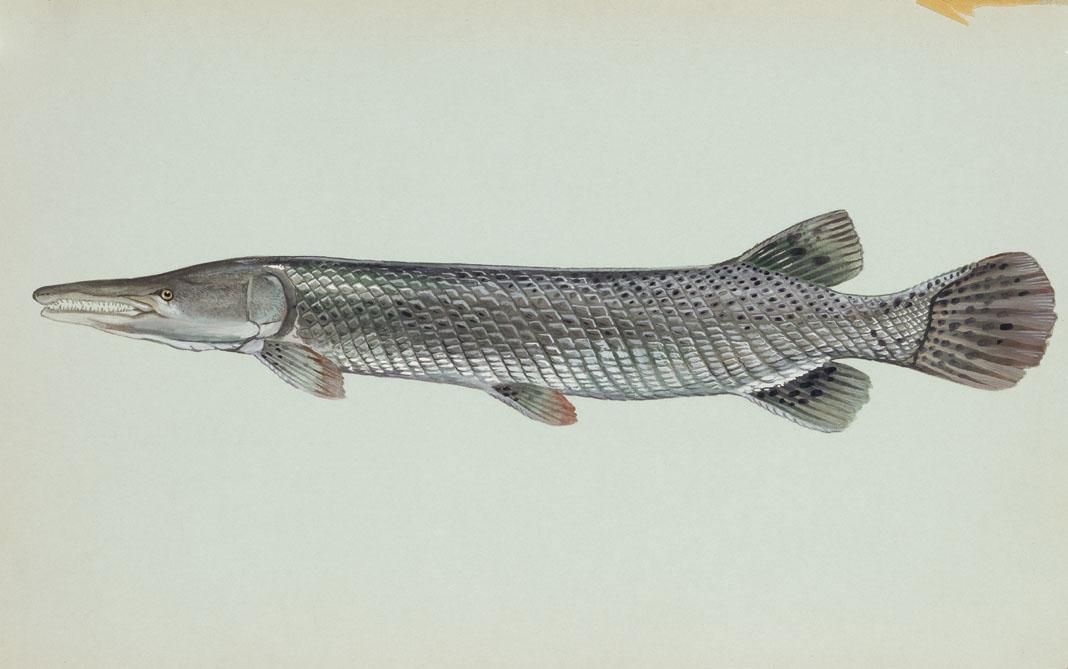
Alligator gar is a giant, armor-plated survivor from the age of dinosaurs, breathing air through a lung-like swim bladder and carrying a double row of teeth in its broad, alligator-like snout.
MoreFull Species Details
- Species Name
- Atractosteus spatula
- Family
- Lepisosteidae
- Order
- Lepisosteiformes
- Also Known As
- Catán, Gator gar
Alligator Gar (Atractosteus spatula) Fish Description
Alligator gar is a giant, armor-plated survivor from the age of dinosaurs, breathing air through a lung-like swim bladder and carrying a double row of teeth in its broad, alligator-like snout.
Nothing else in North American fresh water looks like this. The body is torpedo-long and clad in hard, diamond-shaped ganoid scales that Florida's agency describes as heavy armor — the Florida Museum compares them to medieval chainmail. The broad snout carries the mark that separates alligator gar from every other gar: a double row of teeth in the upper jaw, the inner row larger than the outer. The deepest strangeness is respiratory. A highly vascularised swim bladder connected to the throat lets the fish gulp air at the surface, which is why gar roll like slow porpoises on hot, still days — and why they thrive in water too poor in oxygen for their prey.
Texas Parks and Wildlife calls the species old as the dinosaurs, and the life history moves on that geological clock: females do not reproduce until about age ten, spawn only when spring floods cover vegetation at water temperatures above 68 °F, and may reproduce just a few times a decade — while living, by Texas's account, to nearly 100 years. That slow arithmetic is why Texas manages them as a trophy fishery, with a one-fish daily bag and, on the Trinity River, a 48-inch maximum with a lottery for a single larger fish per year. The old accusation — that gar ruin sport fisheries — is one the agency answers directly: a lake with five to ten thousand gar can hold a hundred thousand to half a million bass and crappie.
Interesting Facts About Alligator Gar
- A double row of upper-jaw teeth separates alligator gar from all other gars.
- The ganoid scales are hard, diamond-shaped armor — compared by the Florida Museum to chainmail.
- A vascularised swim bladder connected to the throat lets them gulp air at the surface.
- Texas describes the lineage as old as the dinosaurs — the living-fossil label is earned.
- They may live to nearly 100; the world-record fish was estimated at 95 years old.
Show more facts
- Females do not reproduce until about age ten, and spawn only a few times each decade.
- Growth starts fast — up to 30 inches by the first winter — then slows for decades.
- Spawning needs spring floods over vegetation, at water above 68 °F.
- The eggs are toxic to eat — Texas warns bluntly against gar caviar.
- Adults eat mostly rough fish: carp, gizzard shad, buffalo and freshwater drum.
- Texas answers the old myth directly: gar do not wreck bass fisheries — the numbers are against it.
- It is the most salt-tolerant gar, ranging into coastal bays and estuaries.
Average Speed & Size
A typical adult alligator gar is measured against people, not other fish: Texas Parks and Wildlife puts a six-footer at about 100 pounds and 10 to 30 years old. The world record, from Mississippi in 2011, ran 8 feet 5 inches and 327 pounds — and was aged at 95 years. Texas's rod-and-reel record has stood since 1953 at 302 pounds. Hooked, a big gar fights like what it is: an enormous, armored, air-breathing animal that thrashes at the surface and cannot be rushed. The fight is measured in leader strength and patience.
Where to Find Them
Think big, slow and southern. Texas lists large rivers and lakes and sometimes coastal bays, with strongholds in the Trinity River, Lake Livingston, Falcon Reservoir and Choke Canyon corridor; Florida notes the species is the most salt-tolerant gar. Look for deep, sluggish pools, oxbows and backwaters, and in summer watch for rolling — the surfacing gulp of an air-breather betrays fish no sonar found. Spawning concentrates gar dramatically: spring floods over vegetated flats, in water warmer than 68 °F, draw groups into shallows where they are visible from the bank.
Alligator Gar Fishing Tips
Alligator gar fishing is heavy, slow and deliberate — closer to big-game fishing than bass fishing. The bony, tooth-lined jaw and the trophy-fishery rules shape everything about how it is done.
Equipment
Heavy tackle throughout: a stout rod, 80-pound-class line, and long steel or heavy mono leaders against the teeth and armor. Landing gear matters — a big gar is subdued beside the boat, not lifted green. Check state rules first; Texas requires reporting for large fish and restricts methods on trophy water.
Chumming
Not the method. Gar are located by rolling fish and by knowing the deep holes and backwaters they occupy — a scouting problem, not an attraction problem.
Bait
Fresh cut bait from the rough fish they actually eat — carp, shad, buffalo — fished on the bottom or under a float. The take is long and slow; gar mouth a bait before turning it, and striking early pulls it from the bony jaw.
Patience
The whole fishery runs on it. Wait through the long take before setting, fight the fish on the reel without hurrying, and handle with real care — for the fish, whose decades-long life makes each adult precious, and for yourself, around a jaw that demands respect. Release big females; the population's future is a handful of old fish.
Conditions that change the bite
- What Barometric Pressure Is Best for Fishing? No research supports a single best barometric pressure for fishing. What pressure really does, how big a weather swing is, and what to watch instead.
- Best Time of Day to Fish: What Evidence Shows Dawn and dusk are measurably better — and the edge is smaller than the folklore says. The 13-year dataset, the light mechanism, and what matters more.
- Dissolved Oxygen: The Condition Anglers Can't See Fish live or die by oxygen you can't see. How temperature, depth, dawn and turnover move it, which species need more, and how to fish around the invisible map.
Guides for fishing this species
- Types of Fish: How Species Are Grouped 36,500 species sort four ways: by water, by migration, by family, and by law. A plain map of the types of fish — with every group linked to real profiles.
Related Species
Know when they'll bite.
BiteScore forecasts when alligator gar will feed at your spot — from live weather, pressure, and moon data.
Get the App