Common Carp
Cyprinus carpio
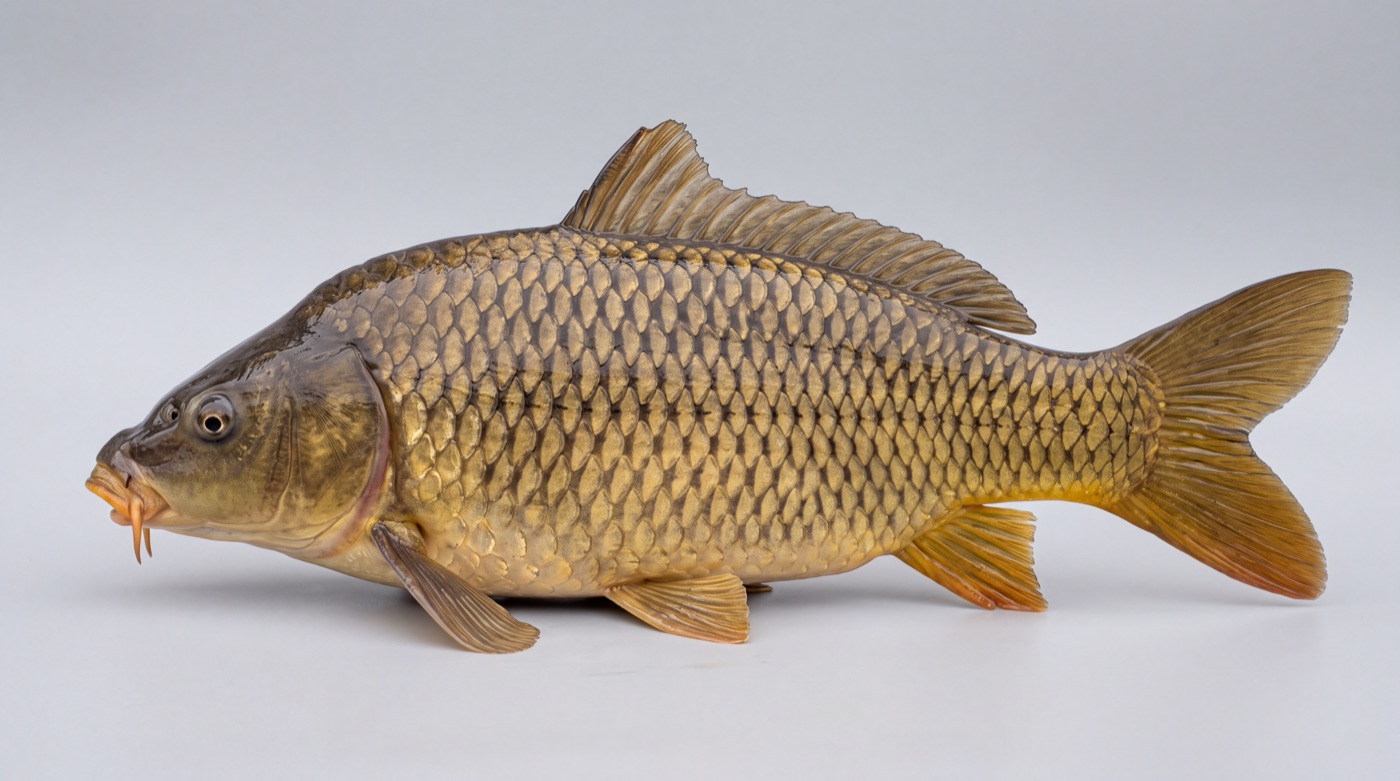
Common carp is a heavy-bodied, brassy-scaled fish of the minnow family, identified by the two pairs of barbels on its upper jaw and known equally as a hard-fighting sport fish and an ecological problem.
MoreFull Species Details
- Species Name
- Cyprinus carpio
- Family
- Cyprinidae
- Order
- Cypriniformes
- Also Known As
- European carp
Common Carp (Cyprinus carpio) Fish Description
Common carp is a heavy-bodied, brassy-scaled fish of the minnow family, identified by the two pairs of barbels on its upper jaw and known equally as a hard-fighting sport fish and an ecological problem.
The body is deep, thick and heavily built, covered in large brassy to olive-gold scales, with a long dorsal fin running much of the back. The identification is at the mouth: North Carolina's wildlife commission notes that two pairs of barbels are present on the upper jaw, which help to distinguish carp from suckers, and Missouri's agency describes the same arrangement as two barbels on each side of the upper jaw. Four in total, and no other common fish of this size and shape has them. Mirror, leather, Israeli and koi carp are not separate species — Texas Parks and Wildlife states plainly that they are all the same fish, differing only in how their scales developed.
Common carp are native to Eurasia and were spread across North America deliberately. The US Fish Commission imported them from Germany in 1877 and spent the next two decades stocking and distributing them as a food fish; today the US Geological Survey records the species in every state except Alaska. The consequences were not the ones intended. Carp feed by rooting through soft bottoms, dislodging plants and stirring sediment, which strips submerged vegetation and clouds the water. They are extraordinarily tolerant fish — of low oxygen, of temperature extremes, and even of brackish water — which is precisely why they thrive where other species struggle.
Interesting Facts About Common Carp
- Two pairs of barbels sit on the upper jaw — four in total, and the surest way to tell a carp from a sucker.
- Mirror, leather, Israeli and koi carp are all the same species, differing only in scale pattern.
- The species is native to Eurasia, not North America.
- The US Fish Commission imported carp from Germany in 1877 and stocked them nationally for two decades as a food fish.
- They are now recorded in every state except Alaska.
Show more facts
- The ecological damage comes from feeding: rooting in the substrate dislodges plants and raises turbidity.
- In one documented case carp eliminated a lake's submerged vegetation and continuously stirred up bottom sediment.
- They find food by smell and taste rather than by sight, so muddy water costs them nothing.
- They tolerate dissolved oxygen down to three parts per million and temperatures from 34 to 106 °F.
- They have been captured in US waters at salinities up to 17.6 parts per thousand.
- The US Geological Survey gives a typical lifespan of around 20 years.
- Spawning runs from March to September in shallow water, at temperatures between 48 and 90 °F.
Average Speed & Size
Carp get big and pull hard, which is the source of their growing reputation among anglers. Missouri's Department of Conservation gives adults at 12 to 25 inches and 1 to 8 pounds, while West Virginia describes an average of 4 to 10 pounds with fish often exceeding 20. Maximum size is far larger: Washington's wildlife department records a maximum length of 47 inches and a weight of over 88 pounds, and state records sit in the mid to high forties — 48 pounds in North Carolina, 47 in Missouri and West Virginia. A hooked carp uses its whole body weight in a long, dogged run, and West Virginia's agency describes the species as one of the largest, hardest fighting fish in its waters.
Where to Find Them
Carp favour exactly the water other species avoid. The US Geological Survey describes them as most abundant in manmade impoundments, lakes, and turbid sluggish streams receiving sewage or agricultural runoff, and Missouri notes they are least abundant in clear, high-gradient streams. Look for muddy, vegetated pools, shallow weedy bays and soft-bottomed flats, with adults favouring deeper pools. They can feed at any depth but prefer the bottom. Spawning takes place in shallow water from March to September at temperatures from 48 to 90 °F, with most activity from March to June, over submerged vegetation, plant debris and stones. In spring, look for backs and tails breaking the surface over shallow flats.
Common Carp Fishing Tips
Carp fishing rewards stealth and scent rather than casting distance or lure choice. These are wary bottom feeders that find food by smell in water where they cannot see, so the approach matters more than the tackle.
Equipment
A medium-heavy rod with 10- to 20-pound line handles most fish, and the reel needs a smooth drag rather than power because a big carp runs long rather than fast. Fly anglers use heavier outfits than the fish's size suggests, sight-casting to feeding fish in shallow water where accuracy matters more than distance.
Chumming
Pre-baiting an area is the classic carp method and it works because these fish feed by scent and return to a reliable food source. Introducing bait over several days conditions fish to feed confidently in one spot. Check local rules first — chumming is restricted or prohibited in some waters.
Bait
Sweet, doughy and grain-based baits suit a fish that feeds by smell and taste, and sweetcorn is the standard for good reason. Fly anglers use small nymph and crayfish patterns presented to visible feeding fish.
Patience
Move quietly and watch the water. Carp in shallow water spook at footfall and shadow long before they see a bait, so approach and stillness decide the day. Give a bait time to be found rather than recasting — a fish hunting by scent needs to arrive at it.
Conditions that change the bite
- What Barometric Pressure Is Best for Fishing? No research supports a single best barometric pressure for fishing. What pressure really does, how big a weather swing is, and what to watch instead.
- Best Time of Day to Fish: What Evidence Shows Dawn and dusk are measurably better — and the edge is smaller than the folklore says. The 13-year dataset, the light mechanism, and what matters more.
- Dissolved Oxygen: The Condition Anglers Can't See Fish live or die by oxygen you can't see. How temperature, depth, dawn and turnover move it, which species need more, and how to fish around the invisible map.
Guides for fishing this species
- Fishing Hook Sizes Explained: From #32 to 19/0 How hook sizing really works — numbers down, aughts up — plus hook anatomy, matching size to bait and species, and why agencies push circle and barbless hooks.
- How to Snell a Hook: The Snell Knot The traditional snell knot in five diagrammed steps — why wrapping the shank instead of the eye changes hooksets, and where snelling shines.
Related Species
Know when they'll bite.
BiteScore forecasts when common carp will feed at your spot — from live weather, pressure, and moon data.
Get the App