White Crappie
Pomoxis annularis
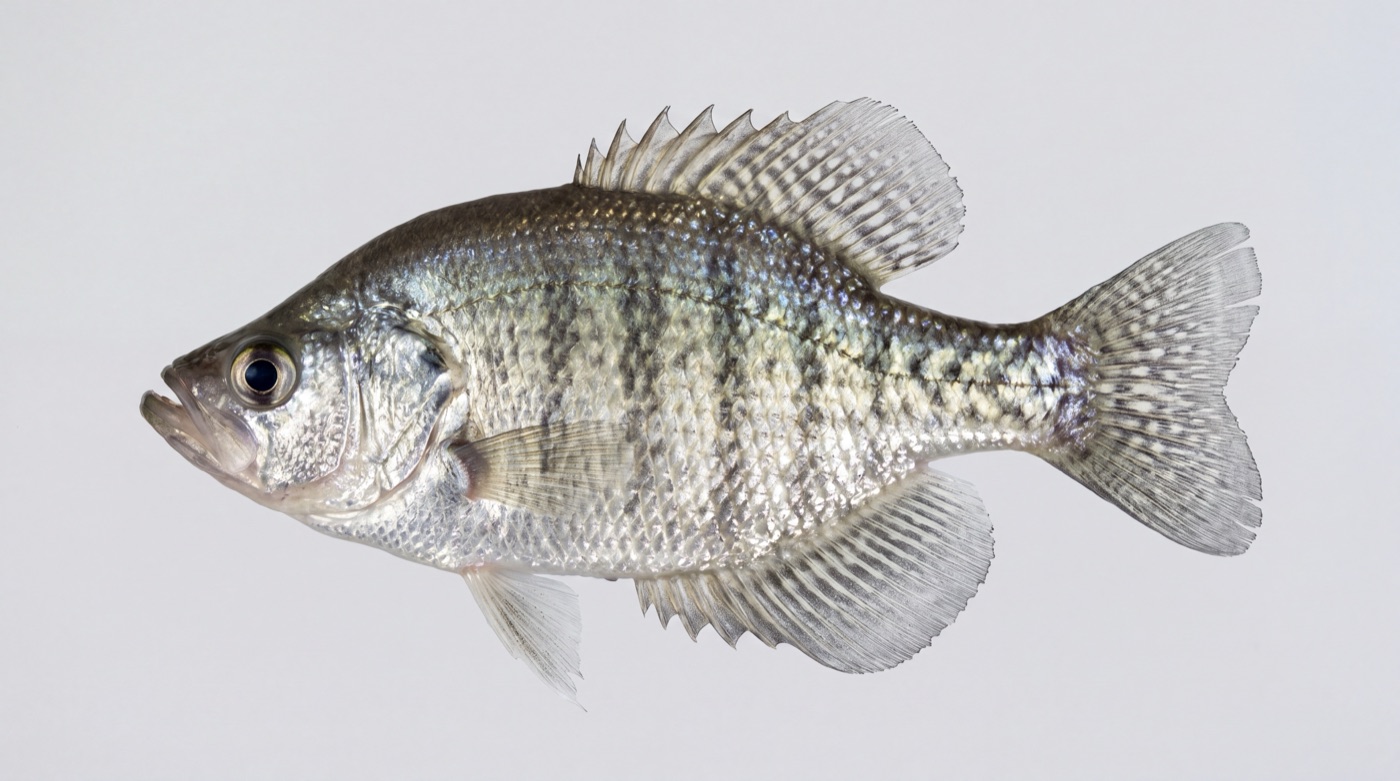
White crappie is a deep-bodied panfish of the sunfish family, separated from its black crappie cousin by the faint vertical bars along its flanks and a dorsal fin that usually carries six spines rather than seven or eight.
MoreFull Species Details
- Species Name
- Pomoxis annularis
- Family
- Centrarchidae
- Order
- Centrarchiformes
- Also Known As
- Papermouth, Sac-a-lait
White Crappie (Pomoxis annularis) Fish Description
White crappie is a deep-bodied panfish of the sunfish family, separated from its black crappie cousin by the faint vertical bars along its flanks and a dorsal fin that usually carries six spines rather than seven or eight.
The body is deep, thin and silvery, and the markings are the identification. Missouri's Department of Conservation describes five to ten often faint, dark, regularly arranged vertical bars — an orderly pattern quite unlike the black crappie's irregular speckles and blotches. The second check is the dorsal fin: white crappie usually have six spines where black crappie have seven or eight. Both fish share the thin, papery mouth membrane that tears under pressure and gives them the shared nickname papermouth. Where the two species overlap, count the spines rather than trusting colour, because both fade and darken with mood and water clarity.
White crappie live in open water in or near submerged timber and other cover, in ponds, lakes, reservoirs and the slow-flowing backwaters of large rivers. The difference from the black crappie is not really where they live but what they tolerate: Missouri's agency notes that the black crappie is less tolerant of turbid water and siltation, and Oklahoma's wildlife department puts it plainly, describing white crappie as adapted to slightly turbid lakes while black crappie requires clear ones. That single trait is why the white crappie dominates muddy reservoirs and why the two can be caught in the same lake but rarely at the same spot.
Interesting Facts About White Crappie
- The dorsal fin usually has six spines; a black crappie has seven or eight.
- The flank carries five to ten faint, regularly arranged vertical bars, not scattered speckles.
- Black crappie are less tolerant of turbid water and siltation, which is why white crappie dominate muddy reservoirs.
- Oklahoma's wildlife department describes white crappie as adapted to slightly turbid lakes and black crappie as requiring clear ones.
- Spawning runs from about mid-April to early June, once water temperature passes roughly 56 °F.
Show more facts
- Oklahoma reports spawning shortly after water reaches 55 to 65 °F.
- Adults eat primarily small fish — minnows and young shad — plus aquatic insects and small crustaceans.
- In spring they use the shallow ends of coves, later moving to water 15 feet deep or more.
- Missouri gives a usual length of 9 to 10 inches, seldom exceeding 15.
- The thin, papery mouth membrane tears easily, which is why a steady rod beats a hard hook set.
- Both crappie species hold in open water in or near submerged timber rather than tight to a bank.
Average Speed & Size
White crappie are a panfish and the numbers reflect it. Missouri's Department of Conservation gives a usual length of 9 to 10 inches, seldom exceeding 15, and Oklahoma reports the average crappie caught in that state at between half a pound and a pound and a half. Missouri's weight guidance runs higher, describing about two pounds as usual and four as seldom exceeded — the two agencies are describing different populations and different anglers, and the honest answer is that a one-pound white crappie is a good fish in most water. There is no meaningful fight to describe: the species is caught for its numbers and its table quality, and the real skill is landing one without tearing the hook through its paper-thin mouth.
Where to Find Them
Look for submerged timber in open water rather than for a shoreline. White crappie occupy open water in or near standing timber and other cover in ponds, lakes, reservoirs and the slow backwaters of large rivers, and unlike many panfish they suspend rather than hugging the bottom. Depth follows the season: Oklahoma's wildlife department describes fish in the shallow ends of coves in spring, moving later to water 15 feet deep or more. Spawning begins once water temperature passes the mid-50s, running from about mid-April to early June. Where a lake carries colour or silt, expect white crappie rather than black — the tolerance for turbidity is the clearest predictor of which species you will find.
White Crappie Fishing Tips
Crappie fishing is a depth problem before it is anything else. The fish suspend at a particular level around cover, and finding that level matters far more than the lure you tie on.
Equipment
Light tackle throughout: a long, soft-tipped rod with four- to eight-pound line is the standard, and the soft tip is doing real work. Because the mouth membrane tears so readily, a rod that bends rather than jolts is what keeps a hooked fish attached. Small jigs and light wire hooks suit the size of the fish.
Chumming
Sinking brush piles or other cover is the traditional approach where it is permitted, and it works because it creates the structure the species organises itself around. Check local rules first — placing structure in public water is regulated in many states.
Bait
Live minnows match the primary diet of small fish and are consistently effective. Small jigs fished at a set depth beside timber cover the same ground and let you search levels faster.
Patience
Find the depth, then stay on it. Crappie suspend in schools at a specific level, so a bait fished two feet too high is ignored entirely. Once a fish comes, work the same depth carefully rather than moving — and set the hook by lifting steadily, never sharply.
Conditions that change the bite
- What Barometric Pressure Is Best for Fishing? No research supports a single best barometric pressure for fishing. What pressure really does, how big a weather swing is, and what to watch instead.
- Best Time of Day to Fish: What Evidence Shows Dawn and dusk are measurably better — and the edge is smaller than the folklore says. The 13-year dataset, the light mechanism, and what matters more.
- Dissolved Oxygen: The Condition Anglers Can't See Fish live or die by oxygen you can't see. How temperature, depth, dawn and turnover move it, which species need more, and how to fish around the invisible map.
Guides for fishing this species
- Crappie Fishing: How to Find Them and How Not to Lose Them Crappie hold on structure and take a bait softly, so the two things that decide your day are where you look and how gently you set the hook.
- Panfish: What Counts, and Why They Matter More Than You Think Panfish is an angler's word, not a biologist's — Wisconsin's legal list has 8 species, New Jersey counts three groups. Who qualifies and why they matter.
- Ice Fishing Basics: How Thick Does the Ice Need to Be? State agencies publish minimum ice thickness guidelines — and say plainly that no ice is ever 100% safe. What the numbers are and what they assume.
Related Species
Know when they'll bite.
BiteScore forecasts when white crappie will feed at your spot — from live weather, pressure, and moon data.
Get the App