Spotted Bass
Micropterus punctulatus
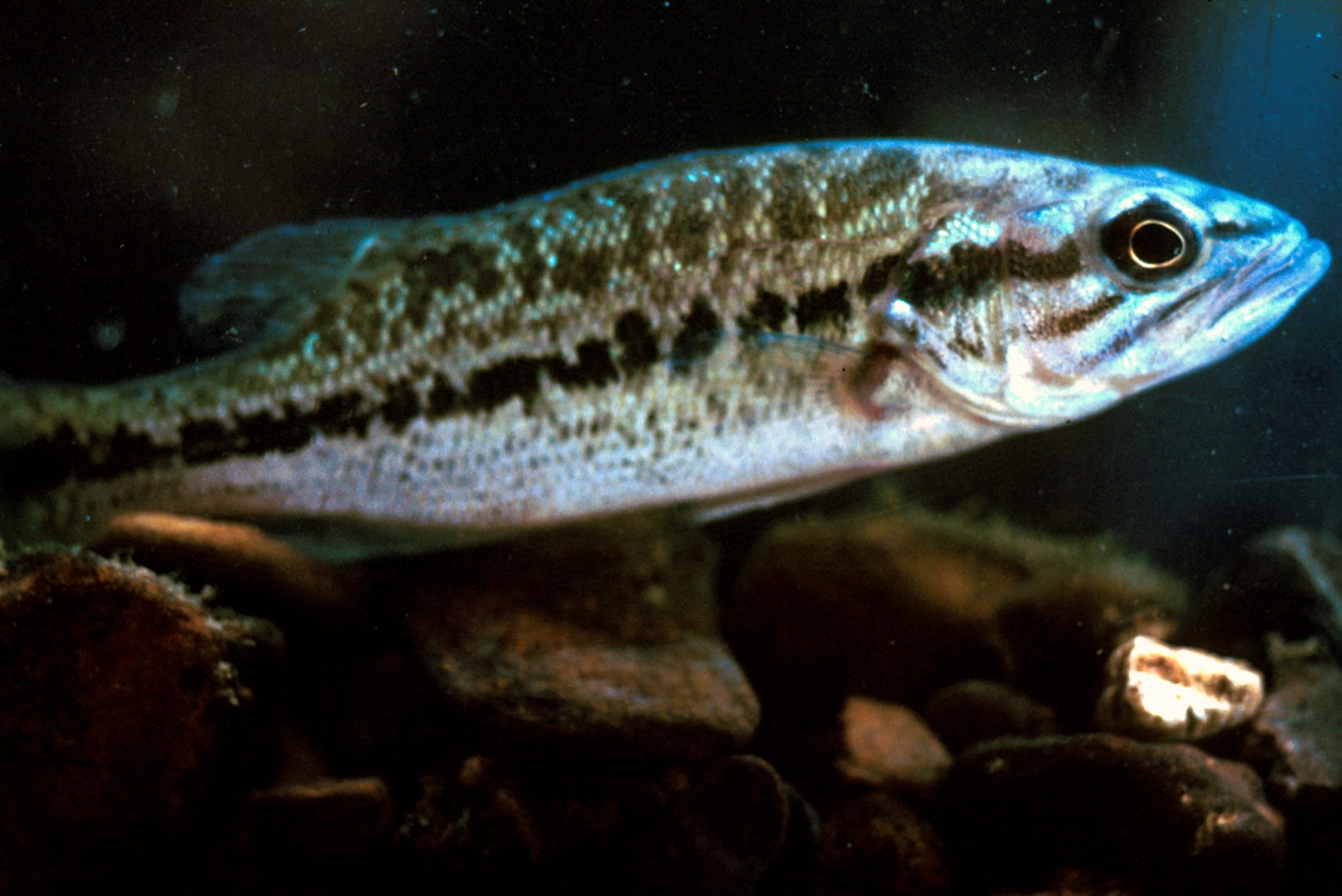
Spotted bass is the black bass of moving water, named for the rows of dark spots along its lower sides and told from a largemouth by a jaw that stops at the eye and clearly connected dorsal fins.
MoreFull Species Details
- Species Name
- Micropterus punctulatus
- Family
- Centrarchidae
- Order
- Perciformes
- Also Known As
- Kentucky spotted bass, Spotted black bass
Spotted Bass (Micropterus punctulatus) Fish Description
Spotted bass is the black bass of moving water, named for the rows of dark spots along its lower sides and told from a largemouth by a jaw that stops at the eye and clearly connected dorsal fins.
At a glance a spotted bass reads as a largemouth with better grooming: a dark lateral band, greenish back, pale belly — and below the band, the feature in the name. Texas Parks and Wildlife explains that punctulatus, Latin for dotted, refers to rows of dark spots on the lower sides. The reliable field checks are structural. Florida's agency notes the upper jaw does not extend past the eye, and the first and second dorsal fins are clearly connected — on a largemouth the jaw reaches past the eye and the fins are nearly separated. There is also a rectangular tooth patch on the tongue, though it is a weaker mark than most anglers believe.
Spotted bass fill the gap between their two famous relatives. Texas Parks and Wildlife describes them in areas too warm, turbid and sluggish for smallmouth, but with more current than largemouth prefer — which makes flowing water the simplest predictor. They hold along current-swept banks, rock, riprap and gravel in streams, rivers and reservoirs, run deeper than largemouth, and school more readily. One modern complication deserves honesty: across much of the South, fish long called spotted bass have turned out to be Alabama bass. North Carolina's agency states that outside a small native range, fish anglers there catch that look like spotted bass are actually Alabama bass, separable reliably only by scale counts and genetics.
Interesting Facts About Spotted Bass
- The name is Latin: punctulatus, dotted, for the rows of dark spots along the lower sides.
- The upper jaw does not extend past the eye — the quickest split from a largemouth.
- The first and second dorsal fins are clearly connected, unlike a largemouth's.
- A rectangular tooth patch sits on the tongue, and the second dorsal fin base carries scales.
- They live in water too warm and sluggish for smallmouth but with more current than largemouth like.
Show more facts
- They are usually caught much deeper than largemouth, and are more inclined to school.
- Crayfish and immature insects make up the bulk of the diet.
- Spawning runs April and May over rock and gravel at 57 to 74 °F, often near tributary mouths.
- The male guards the nest, as in other black bass.
- Much of the South's 'spotted bass' fishing is actually Alabama bass — a separate species.
- Alabama bass tooth patches are often smaller and fainter, and their lateral-line scale counts run higher.
- Florida notes they do not enter brackish water, unlike largemouth.
Average Speed & Size
Spotted bass are the middleweight of the black bass. Alabama's agency gives a typical fish at 12 to 17 inches, Texas notes the species exceeds 5.5 pounds at the top end, and Florida's state record is a modest 3.75 pounds — a three-pounder is a genuinely good spotted bass almost everywhere. We do not quote a world record: the historic candidates have been tangled by the reclassification of many big 'spots' as Alabama bass, and no figure survived source verification. What they concede in size they return in effort — a spotted bass fights like a smallmouth, using current and diving hard.
Where to Find Them
Follow the current. Spotted bass hold where water moves: current-swept banks, points and riprap in rivers and reservoirs, over rock and gravel rather than soft bottom. Alabama's agency lists aquatic vegetation, submerged logs and rock or riprap walls in flowing streams, rivers and reservoirs, and Florida adds clear, slow water over gravel. Expect them deeper than largemouth on the same water, and when you catch one, work the area — North Carolina notes they school more than their relatives. Spawning pulls them to rock and gravel in April and May at 57 to 74 °F, often near the mouths of tributary streams.
Spotted Bass Fishing Tips
Spotted bass fishing is black bass fishing with the dial turned toward current, depth and rock. Smaller baits and moving water separate a good spot day from a largemouth day on the same lake.
Equipment
A medium spinning outfit with 8- to 12-pound line covers most spotted bass water — a size down from typical largemouth tackle, matching a fish that runs smaller and holds in clearer water. Sensitivity matters because so much of the fishing follows deep rock.
Chumming
Not used for black bass. Location does the concentrating: find moving water over rock, and the schooling habit does the rest — one fish usually means several.
Bait
Crayfish imitations earn their keep on a species whose diet is led by crayfish: small jigs, soft plastic craws and crankbaits worked along rock. Small spinnerbaits and finesse worms cover the rest.
Patience
Fish deeper and faster-moving water than instinct suggests before concluding the fish are absent. On reservoirs, follow schooling fish with your electronics rather than waiting — and in the South, be aware the 'spot' you caught may formally be an Alabama bass; the fishing is the same, the record book is not.
Conditions that change the bite
- What Barometric Pressure Is Best for Fishing? No research supports a single best barometric pressure for fishing. What pressure really does, how big a weather swing is, and what to watch instead.
- Best Time of Day to Fish: What Evidence Shows Dawn and dusk are measurably better — and the edge is smaller than the folklore says. The 13-year dataset, the light mechanism, and what matters more.
- Dissolved Oxygen: The Condition Anglers Can't See Fish live or die by oxygen you can't see. How temperature, depth, dawn and turnover move it, which species need more, and how to fish around the invisible map.
Guides for fishing this species
- Largemouth vs Smallmouth Bass Jaw against the eye, dorsal notch, direction of the markings — the three agency-worded checks that separate largemouth from smallmouth every time.
- The Drop Shot Rig: Finesse Fishing Off the Bottom The drop shot rig explained — hook above the weight, bait suspended off bottom, and the clear-water, deep-water and pressured-lake situations it was made for.
Related Species
Know when they'll bite.
BiteScore forecasts when spotted bass will feed at your spot — from live weather, pressure, and moon data.
Get the App