Pumpkinseed
Lepomis gibbosus
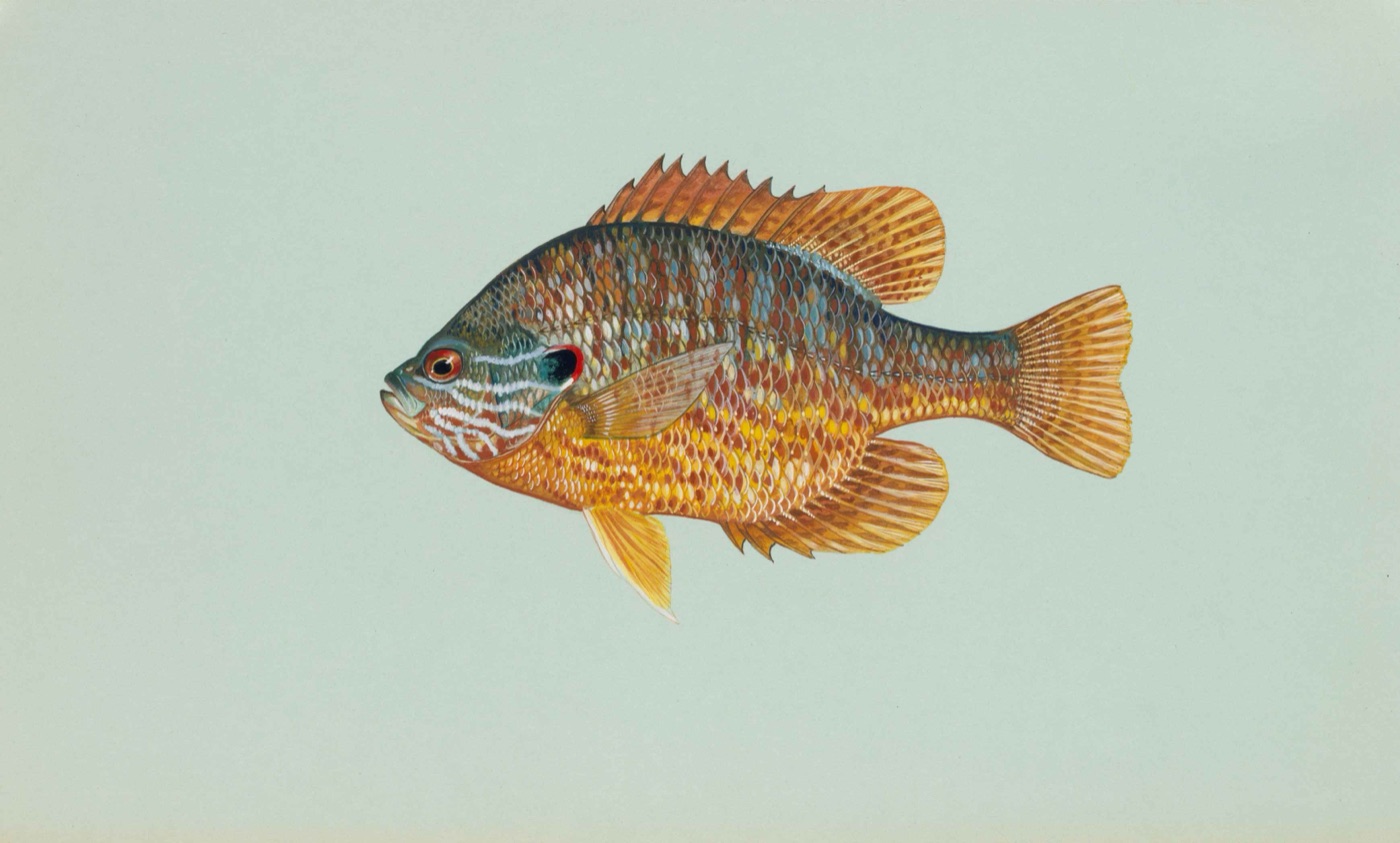
Pumpkinseed is the most colourful of the common sunfish, told from a bluegill by the orange-red spot on its black ear flap and the wavy blue lines across its cheeks.
MoreFull Species Details
- Species Name
- Lepomis gibbosus
- Family
- Centrarchidae
- Order
- Perciformes
- Also Known As
- —
Pumpkinseed (Lepomis gibbosus) Fish Description
Pumpkinseed is the most colourful of the common sunfish, told from a bluegill by the orange-red spot on its black ear flap and the wavy blue lines across its cheeks.
Few North American fish carry this much colour: an oval, deep body washed in orange, gold and blue-green, speckled flanks, and the two field marks that settle any identification. North Carolina's agency describes the ear flap as black with an orange-red spot on the outer margin, and the cheek carrying four to eight wavy lines that are often bright blue. Iowa's biologists word it as a bright red semi-circular spot with six or more wavy emerald bars on the cheeks. A bluegill has neither — its ear flap is plain black and its cheek unlined — which makes this the easiest split in the sunfish family.
Pumpkinseeds live where summer is quiet: shallow areas of lakes and slow rivers with submerged vegetation and brushy cover, quiet ponds, clear slow creek pools. The diet leans harder into shells than a bluegill's — aquatic insects, snails, small clams and other invertebrates, with South Dakota adding crustaceans and small fish. Spawning is a long, visible affair: Iowa puts nest preparation in May at 60 to 68 °F with peak activity in early June and spawning continuing through July, and New Jersey notes males build and guard the nests and breed roughly every eleven days through the season, with females producing four to seven thousand eggs. The saucer nests in knee-deep water are a June shoreline's furniture.
Interesting Facts About Pumpkinseed
- The black ear flap carries an orange-red spot on its outer margin — the mark a bluegill never has.
- Four to eight wavy, often bright blue lines cross the cheek and gill cover.
- Iowa's description: a bright red semi-circular spot with six or more wavy emerald bars on the cheek.
- The diet includes snails and small clams alongside aquatic insects.
- They favour shallow water with submerged vegetation and brushy cover.
Show more facts
- Nesting starts in May at 60 to 68 °F, peaks in early June, and runs through July.
- Males build and protect the nest, breeding roughly every eleven days in season.
- A female produces about 4,000 to 7,000 eggs in a season.
- The University of Michigan gives a spawning span of 13 to 28 °C, late spring to late summer.
- New Jersey gives an average size around 7 inches; Iowa says adults reach 8 to 10.
- State records sit near a single pound — North Carolina's is 1 pound 6 ounces.
- The species name gibbosus refers to the deep, humped body shape.
Average Speed & Size
This is a hand-sized fish, and that is its charm. New Jersey's environmental agency gives an average around 7 inches, Iowa allows adults of 8 to 10, and the records confirm the ceiling: 1 pound 6 ounces in North Carolina, just under a pound in Iowa. On tackle scaled to match — the lightest spinning gear or a small fly rod — a pumpkinseed fights with the same flat-sided, circling stubbornness as a bluegill, and its colours out-dress everything else in the bucket.
Where to Find Them
Look in the quietest, weediest water available. North Carolina puts pumpkinseeds in shallow areas of lakes and slow-moving rivers with submerged vegetation and brushy cover; South Dakota adds that the shallows are where they stay. Ponds, harbours, creek pools and lake margins with weed growth all hold them, usually within sight of the bank. From May through July, spawning colonies make the fish easiest of all to find — clusters of pale, fanned nests in shallow water, each guarded by a male that will attack nearly anything entering its circle.
Pumpkinseed Fishing Tips
Pumpkinseed fishing is close-range, light-tackle work — the classic first fish, and a genuinely pleasant way to spend an evening at any age. Small hooks and small offerings are the entire secret.
Equipment
The lightest spinning rod you own, 2- to 6-pound line, and small hooks — a pumpkinseed's mouth is tiny, and most missed bites are oversized hooks. A small float makes bites visible and keeps bait above weed.
Chumming
Rarely needed and often prohibited; the fish are already concentrated along weed edges. A few crumbs of bait can start competitive feeding around a dock, where regulations allow.
Bait
A piece of worm under a float is the eternal standard, matching a diet of insects and invertebrates. Fly anglers do well with small wet flies and nymphs; tiny jigs and spinners cover the artificial side.
Patience
Little is required — willingness is the species' trademark. Fish tight to weed and brush rather than open water, respect nest-guarding males in June by releasing them quickly, and downsize everything before concluding the fish have gone.
Conditions that change the bite
- What Barometric Pressure Is Best for Fishing? No research supports a single best barometric pressure for fishing. What pressure really does, how big a weather swing is, and what to watch instead.
- Best Time of Day to Fish: What Evidence Shows Dawn and dusk are measurably better — and the edge is smaller than the folklore says. The 13-year dataset, the light mechanism, and what matters more.
- Dissolved Oxygen: The Condition Anglers Can't See Fish live or die by oxygen you can't see. How temperature, depth, dawn and turnover move it, which species need more, and how to fish around the invisible map.
Guides for fishing this species
- Panfish: What Counts, and Why They Matter More Than You Think Panfish is an angler's word, not a biologist's — Wisconsin's legal list has 8 species, New Jersey counts three groups. Who qualifies and why they matter.
- Fishing with Kids: How a State Education Programme Sets Up a First Trip Minnesota's MinnAqua programme has taught kids to fish for decades and publishes how: the rig, adult ratio, hooks, and why the first cast has no hook.
- The Slip Float Rig: Bobber Fishing at Any Depth How the slip float rig works — bobber stop, bead, sliding float, weight, hook — why it beats a fixed bobber, and the small-float rule agencies keep repeating.
- The Split Shot Rig: The Simplest Rig That Works Pinch one shot above a hook and you have a rig. How far above, how much weight, why the slow fall catches fish — and the wacky rig it leads into.
Related Species
Know when they'll bite.
BiteScore forecasts when pumpkinseed will feed at your spot — from live weather, pressure, and moon data.
Get the App