Lake Trout
Salvelinus namaycush
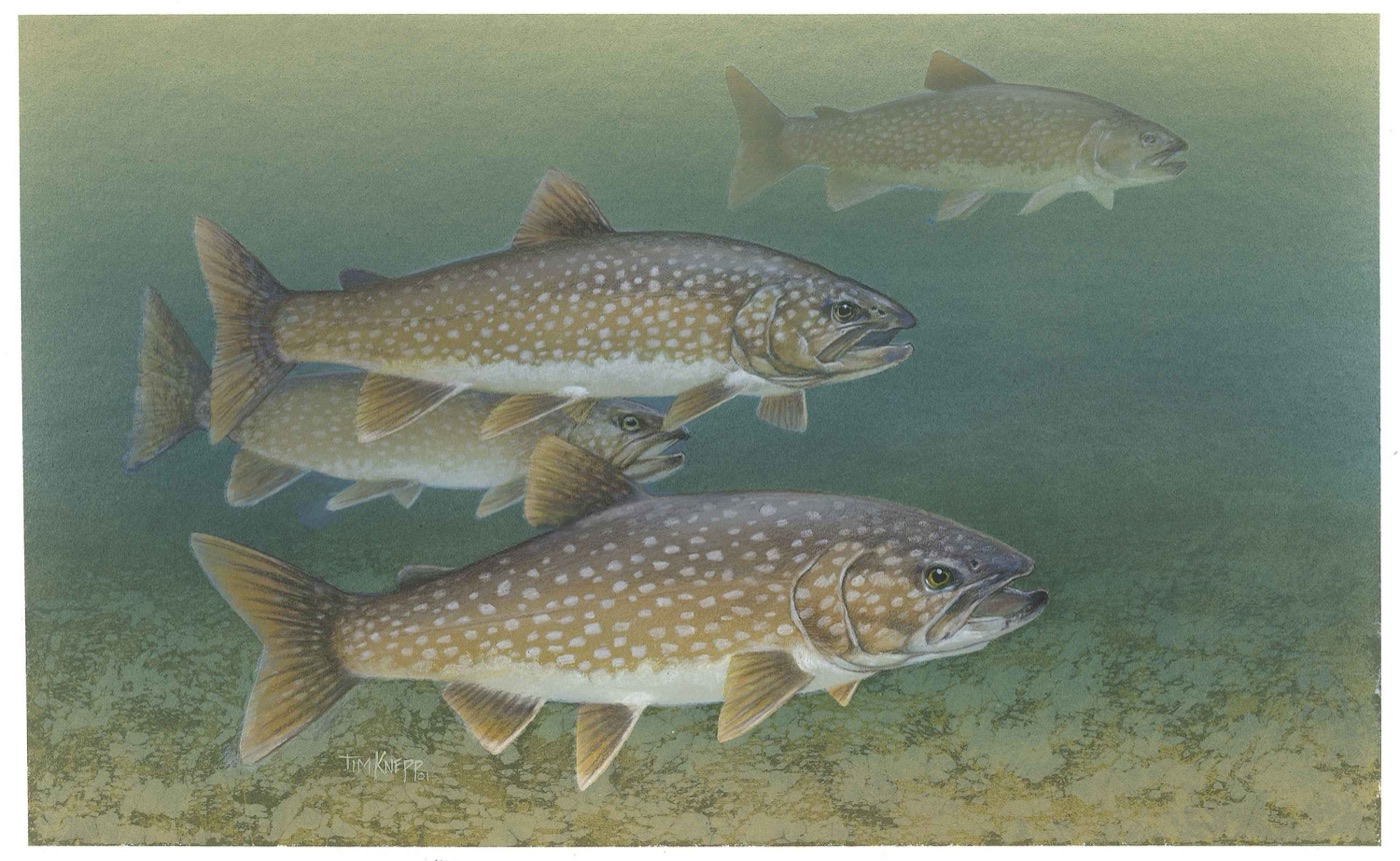
Lake trout is the largest char of the salmon family, a deep, cold-water fish marked by pale spots on a dark body and a deeply forked tail.
MoreFull Species Details
- Species Name
- Salvelinus namaycush
- Family
- Salmonidae
- Order
- Salmoniformes
- Also Known As
- Laker, Mackinaw, Togue, Gray trout
Lake Trout (Salvelinus namaycush) Fish Description
Lake trout is the largest char of the salmon family, a deep, cold-water fish marked by pale spots on a dark body and a deeply forked tail.
The body is long and streamlined, gray to dark green or nearly black, covered with numerous pale, cream-colored spots that extend onto the deeply forked tail. As a char, the lake trout shows light markings on a dark ground, the reverse of true trout. The head is large and the mouth wide, set with strong teeth for seizing fish. Coloration varies from silvery in some lakes to dark bronze in others, shaped by depth and water clarity. The pale spotting on a dark body and the deeply forked tail together separate the lake trout from the brook and other char.
Lake trout is native to the cold, deep lakes of northern North America, from the northern United States across Canada to Alaska. The species is the coldest-water and deepest-dwelling of the char, requiring large, cold, oxygen-rich lakes. Lake trout grow slowly and live long, and they retreat to great depths as surface waters warm. Anglers pursue the species for its impressive size, its strong deep-water fight, and the wild northern lakes it inhabits, though catching lakers demands reaching the cold depths where they hold for much of the year.
Interesting Facts About Lake Trout
- The world record lake trout weighed 72 pounds, caught in Canada's Great Bear Lake in 1995.
- Lake trout are the largest char in the salmon family, Salmonidae.
- The species can live more than 40 years, and some exceed 60 in cold northern lakes.
- Lake trout require cold, deep, oxygen-rich water and retreat to depth in summer.
- The species spawns in autumn over rocky lake bottoms, unlike stream-spawning trout.
Show more facts
- Lake trout grow slowly, and large fish are typically many decades old.
- The species is a char, showing light spots on a dark body.
- Lake trout can be found at depths exceeding 100 feet in summer.
- The invasive lake trout has harmed native trout in some western US lakes.
- Lake trout feed heavily on other fish, including ciscoes and smelt.
- The species is also called mackinaw in the West and togue in the Northeast.
- Cold northern lakes allow lake trout to reach the greatest ages of any freshwater sportfish.
Average Speed & Size
Lake trout is a strong, deep-water swimmer that typically reaches 15 to 30 inches and 3 to 15 pounds. Trophy fish exceed 40 inches and 30 pounds, with the record near 72 pounds. The species cruises the cold depths at a steady pace, following schools of baitfish rather than sprinting. Once hooked in deep water, a lake trout fights with strong, dogged runs and heavy headshakes, using its size and the cold depths to resist the angler through a slow, powerful battle rather than fast surface leaps.
Where to Find Them
Lake trout is found in large, cold, deep lakes across the northern United States, Canada, and Alaska. The species holds near the bottom and follows baitfish, staying in the cold, oxygen-rich depths that shallow-water fish cannot use. Lake trout move shallow in spring and fall when surface water is cold, then retreat below the thermocline into deep water through the summer. They spawn over rocky reefs in autumn. Lake trout are absent from warm and shallow waters, confined to the cold, deep lakes that meet their strict temperature and oxygen needs.
Lake Trout Fishing Tips
Lake trout fishing is a deep-water pursuit that changes sharply with the seasons, from shallow casting after ice-out to deep trolling in summer. Success comes from reaching the cold depths where lakers hold and presenting bait or lures at their level.
Equipment
Use a medium-heavy 7- to 8-foot trolling or jigging rod paired with a line-counter or high-capacity reel spooled with braid or wire to reach depth. The stout tackle handles heavy jigs, deep-diving lures, and downrigger or wire-line setups needed to fish below the thermocline. A strong rod and smooth drag control the lake trout's powerful, deep runs.
Chumming
Chumming is seldom used for lake trout, which are located instead with electronics and reached by trolling or jigging at depth. Anglers use sonar to find fish and baitfish schools, then present lures at the marked level. Rather than drawing fish with chum, success depends on getting the offering down to the cold depth where lakers are holding.
Bait
Live or cut baitfish such as ciscoes and smelt are top natural baits, especially when jigged deep. Effective lures include large spoons, tube jigs, and deep-diving or downrigger-trolled plugs that reach the fish's depth.
Patience
Lake trout hold deep and scattered for much of the year, so covering water by trolling and watching electronics matters more than waiting in one spot. Once fish are marked at depth, presenting lures at their exact level rewards the patient search.
Conditions that change the bite
- What Barometric Pressure Is Best for Fishing? No research supports a single best barometric pressure for fishing. What pressure really does, how big a weather swing is, and what to watch instead.
- Best Time of Day to Fish: What Evidence Shows Dawn and dusk are measurably better — and the edge is smaller than the folklore says. The 13-year dataset, the light mechanism, and what matters more.
- Dissolved Oxygen: The Condition Anglers Can't See Fish live or die by oxygen you can't see. How temperature, depth, dawn and turnover move it, which species need more, and how to fish around the invisible map.
Guides for fishing this species
- Trout Fishing for Beginners: Water Temperature First A thermometer teaches more than a tackle box. Where trout can survive, when to stop fishing for them, and the light rigs that work on stocked water.
- Trout vs Salmon: Same Family, Very Different Lives Trout, salmon and char all share one family — the real split is life history. Why Pacific salmon die after spawning, steelhead don't, and where char fit in.
Related Species
Know when they'll bite.
BiteScore forecasts when lake trout will feed at your spot — from live weather, pressure, and moon data.
Get the App