Chinook Salmon
Oncorhynchus tshawytscha
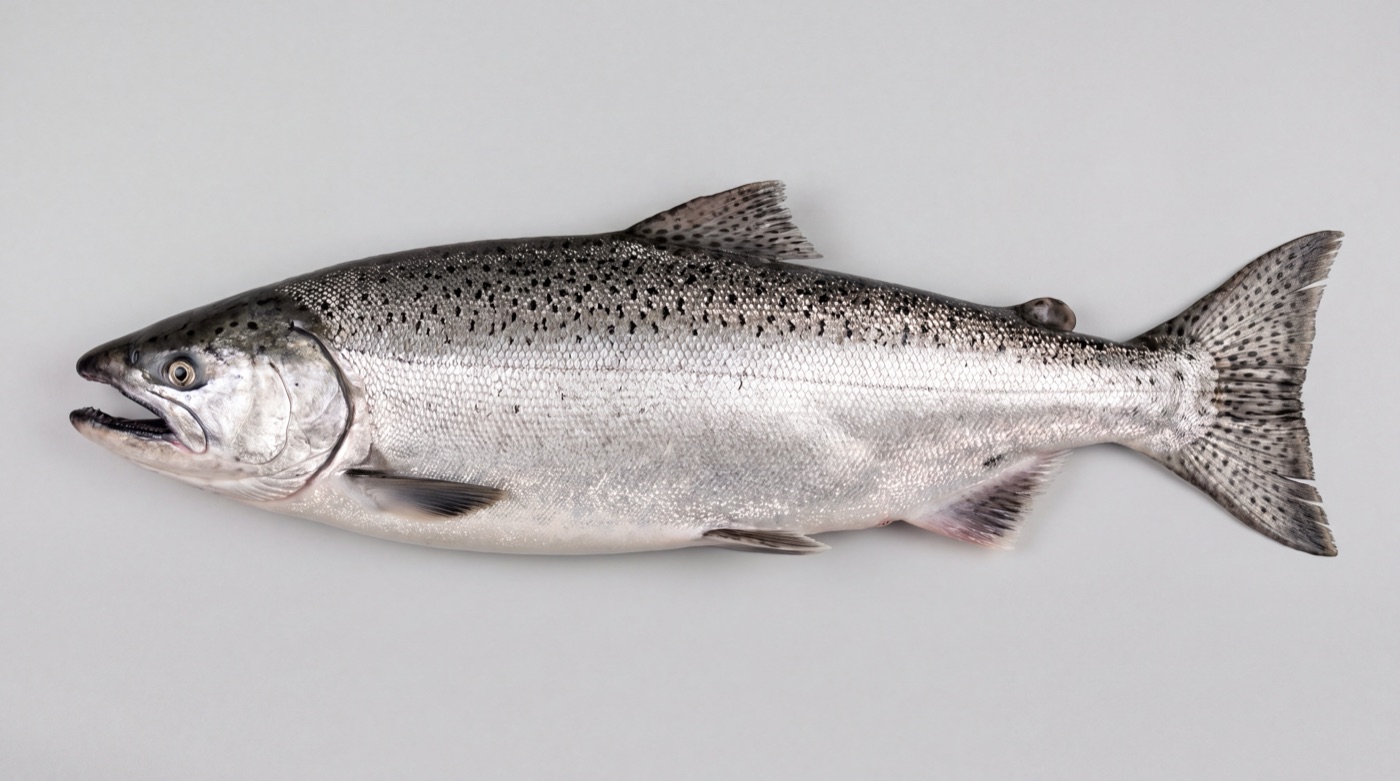
Chinook salmon is the largest of the Pacific salmon, identified by black spots across both lobes of its tail and by the black gums at the base of its lower teeth that earned it the nickname blackmouth.
MoreFull Species Details
- Species Name
- Oncorhynchus tshawytscha
- Family
- Salmonidae
- Order
- Salmoniformes
- Also Known As
- King salmon, Blackmouth, Tyee, Springer, Quinnat
Chinook Salmon (Oncorhynchus tshawytscha) Fish Description
Chinook salmon is the largest of the Pacific salmon, identified by black spots across both lobes of its tail and by the black gums at the base of its lower teeth that earned it the nickname blackmouth.
The body is heavy and deep for a salmon, blue-green to almost black above with bright silver sides in the ocean phase, carrying small irregular black spots on the back, the dorsal fin and — the key mark — usually on both lobes of the tail. Alaska's Department of Fish and Game words the second check just as plainly: black mouth with black gums at the base of the teeth on the lower jaw. Between those two features a chinook is separated from a coho in a couple of seconds. Note the hedge in the agency's own wording: spots are usually on both lobes, not always, which is why the gum check is the one to trust.
Chinook are anadromous, hatching in fresh water, feeding and growing at sea and returning to spawn in the river of their birth, where every fish dies after spawning. They favour big water: Oregon's wildlife department notes they especially favour deep, large rivers and lay their eggs in the largest gravel of any salmon. Runs are named for when they enter fresh water rather than when they spawn, so a single river can carry spring, summer, fall and winter runs with different timings and different destinations. Several distinct populations are protected under the Endangered Species Act, while many others are not.
Interesting Facts About Chinook Salmon
- The largest of the Pacific salmon, which is where the name king salmon comes from.
- Black spots appear on the back, the dorsal fin and usually on both lobes of the tail.
- Black pigment along the gum line gives the fish its other nickname, blackmouth.
- Every chinook dies after spawning.
- Fish return to spawn between ages two and seven, but are typically three or four.
Show more facts
- They may spend between one and eight years at sea, with three to four the average.
- They lay their eggs in the largest gravel of any salmon.
- Runs are named for river entry, not spawning: spring, summer, fall and winter runs exist.
- Spawning adults lose their silver and turn maroon to olive brown.
- The Alaska sport record is 97 pounds 4 ounces, from the Kenai River in 1985.
- Two populations are listed as endangered and seven as threatened — most chinook populations are not listed.
- Spring and summer runs travel hundreds of miles upstream; fall runs spawn closer to the ocean.
Average Speed & Size
Chinook are the biggest Pacific salmon by a clear margin. NOAA gives a typical mature fish at about three feet and 30 pounds while Washington's agency puts many caught fish at 10 to 15 pounds, and the species maximum reaches 4.9 feet and 129 pounds. The Alaska sport record stands at 97 pounds 4 ounces from the Kenai River in 1985. A heavier fish exists in the records — 126 pounds, taken at Petersburg in 1949 — but that was a commercial fish trap catch, not an angling capture, and the two should never be quoted as the same thing. A hooked chinook fights with sheer mass and long, deep runs rather than acrobatics.
Where to Find Them
Location depends entirely on which phase of the life cycle you are fishing. In the ocean, chinook range the open Pacific and marine shorelines, where immature fish are the ones known as blackmouth. In fresh water they favour large mainstem rivers with high flow — Washington's agency names the Columbia and Snake — with spring and summer runs pushing hundreds of miles upstream while fall runs stay closer to the sea and more often use small coastal streams. Timing is the crucial variable: NOAA gives spring-run migration as April through July, summer-run June to August, fall-run beginning late July and peaking in September, and winter-run December through May.
Chinook Salmon Fishing Tips
Chinook fishing is timing before technique. The fish are only available where you are for a narrow window, and knowing which run you are intercepting matters more than any choice of tackle.
Equipment
Heavy tackle is justified by the size of the fish and the water it runs in. A stout rod with a reel holding plenty of 20- to 40-pound line covers river fishing, and ocean trolling gear is heavier again. In big flows the priority is turning a fish before it reaches the next rapid, not casting distance.
Chumming
Chumming is prohibited in many salmon fisheries and is not the technique here. Fish are intercepted on their migration route instead — at the head and tail of holding pools, at confluences, and where a run must funnel through a constriction.
Bait
Roe, cured eggs and herring are the traditional baits where regulations allow them. Spinners, spoons and plugs cover water effectively, and fly anglers use large weighted patterns to get down to fish holding deep.
Patience
Fish the migration, not the spot. Returning chinook stop feeding as they move upriver, so takes come from aggression and territoriality rather than hunger, and holding water at first light is worth more than a whole afternoon elsewhere. Check the regulations for the specific run and river before you go — rules on salmon are among the most detailed in fishing and change year to year.
Conditions that change the bite
- What Barometric Pressure Is Best for Fishing? No research supports a single best barometric pressure for fishing. What pressure really does, how big a weather swing is, and what to watch instead.
- Best Time of Day to Fish: What Evidence Shows Dawn and dusk are measurably better — and the edge is smaller than the folklore says. The 13-year dataset, the light mechanism, and what matters more.
- Dissolved Oxygen: The Condition Anglers Can't See Fish live or die by oxygen you can't see. How temperature, depth, dawn and turnover move it, which species need more, and how to fish around the invisible map.
Guides for fishing this species
- Trout vs Salmon: Same Family, Very Different Lives Trout, salmon and char all share one family — the real split is life history. Why Pacific salmon die after spawning, steelhead don't, and where char fit in.
- The Slip Float Rig: Bobber Fishing at Any Depth How the slip float rig works — bobber stop, bead, sliding float, weight, hook — why it beats a fixed bobber, and the small-float rule agencies keep repeating.
- Types of Fish: How Species Are Grouped 36,500 species sort four ways: by water, by migration, by family, and by law. A plain map of the types of fish — with every group linked to real profiles.
Related Species
Know when they'll bite.
BiteScore forecasts when chinook salmon will feed at your spot — from live weather, pressure, and moon data.
Get the App