Coho Salmon
Oncorhynchus kisutch
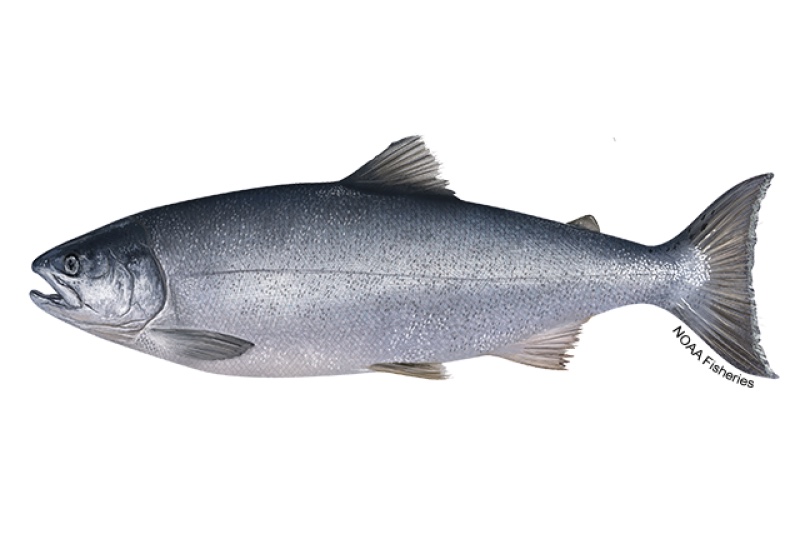
Coho salmon is a mid-sized Pacific salmon separated from the larger chinook by black spots on the upper lobe of the tail only, and by the pale gums at the base of its lower teeth.
MoreFull Species Details
- Species Name
- Oncorhynchus kisutch
- Family
- Salmonidae
- Order
- Salmoniformes
- Also Known As
- Silver salmon, White salmon, Medium red salmon
Coho Salmon (Oncorhynchus kisutch) Fish Description
Coho salmon is a mid-sized Pacific salmon separated from the larger chinook by black spots on the upper lobe of the tail only, and by the pale gums at the base of its lower teeth.
In the ocean the body is bright silver with a dark metallic blue or greenish back, carrying small black spots across the back and the dorsal fin. The tail is where the identification happens: NOAA describes spots on the upper lobe of the tail, and Alaska's Department of Fish and Game words it as spots usually on the upper lobe only. The confirming check is inside the mouth. Where a chinook has black gums at the base of the lower teeth, a coho's are white — the agency wording is that direct, and it is the mark to trust when spotting patterns are ambiguous.
Coho are anadromous and semelparous: they hatch in fresh water, feed at sea and return to spawn once, after which every fish dies. Their freshwater phase is longer and more complex than a chinook's — juveniles rear in rivers, estuaries and wetlands for at least one summer, spending one to three winters in streams and sometimes as many as five in lakes before heading to salt water. They favour small coastal streams with cold, clean water and stable gravel, and juveniles depend heavily on side channels and floodplains. Four population groups are listed under the Endangered Species Act; Alaska and most Washington coho are not.
Interesting Facts About Coho Salmon
- Black spots appear on the back and usually on the upper lobe of the tail only.
- The gum line at the base of the lower teeth is pale — white, where a chinook's is black.
- Every coho dies after spawning.
- They spend about a year and a half feeding in the ocean.
- Some stocks migrate more than 1,000 miles at sea.
Show more facts
- Juveniles rear in fresh water for at least one summer before going to sea.
- They may spend one to three winters in streams, and up to five winters in lakes.
- Some males, known as jacks, mature after only six months at sea.
- Spawning adults develop greenish-black heads and dark brown to maroon bodies.
- In Alaska they enter spawning streams from July to November, usually on high runoff.
- They need cold, clean freshwater streams with stable gravel to spawn.
- One population group is listed as endangered and three as threatened — most coho are not listed.
Average Speed & Size
Coho are a manageable size and famous for how they fight rather than how heavy they are. NOAA gives adults at 8 to 12 pounds and 24 to 30 inches, and Alaska's agency documents fish reaching 31 pounds, though we have not found a verified agency record figure and so do not quote one. What the species is known for is the fight: a hooked coho runs fast and jumps repeatedly, which combined with its willingness to take a fly makes it the Pacific salmon many anglers rate highest for sport.
Where to Find Them
Coho use smaller water than chinook, which changes where you look for them. In the ocean they hold nearshore and in estuaries; in fresh water they run small coastal streams with stable gravel, and juveniles rear in side channels and floodplain habitat rather than main current. Run timing varies by region — Alaska's agency gives stream entry from July to November, usually during periods of high runoff, while NOAA gives a West Coast return from September through December, with spawning generally in fall or early winter. Rain matters: fish often move upstream on a rise in flow, so a stream that looked empty can hold fish a day after heavy weather.
Coho Salmon Fishing Tips
Coho are the most willing of the Pacific salmon to chase a moving lure or fly, which makes them the best of the group for active fishing rather than waiting. The challenge is being on the water when a run arrives.
Equipment
Medium to medium-heavy tackle suits the size: a rod with some flex to absorb the jumps and 12- to 20-pound line covers most river fishing. Fly anglers do well with an eight- or nine-weight, since coho take a swung or stripped fly more readily than any other Pacific salmon.
Chumming
Chumming is prohibited in most salmon fisheries and is not the technique. Time the run instead — fish move upstream on rising water after rain, so a change in flow is the signal worth acting on.
Bait
Bright spinners, spoons and flies retrieved with movement work well because coho will chase. Where bait is permitted, roe is effective on fish holding in pools rather than actively moving.
Patience
Cover water rather than waiting on one spot. Coho respond to a moving presentation and will follow it some distance before committing, so a fly or lure stripped with pauses often draws a take that a static bait would not. Check the regulations for your river before you go — coho rules differ sharply between listed and unlisted populations.
Conditions that change the bite
- What Barometric Pressure Is Best for Fishing? No research supports a single best barometric pressure for fishing. What pressure really does, how big a weather swing is, and what to watch instead.
- Best Time of Day to Fish: What Evidence Shows Dawn and dusk are measurably better — and the edge is smaller than the folklore says. The 13-year dataset, the light mechanism, and what matters more.
- Dissolved Oxygen: The Condition Anglers Can't See Fish live or die by oxygen you can't see. How temperature, depth, dawn and turnover move it, which species need more, and how to fish around the invisible map.
Guides for fishing this species
- Trout vs Salmon: Same Family, Very Different Lives Trout, salmon and char all share one family — the real split is life history. Why Pacific salmon die after spawning, steelhead don't, and where char fit in.
- The Slip Float Rig: Bobber Fishing at Any Depth How the slip float rig works — bobber stop, bead, sliding float, weight, hook — why it beats a fixed bobber, and the small-float rule agencies keep repeating.
Related Species
Know when they'll bite.
BiteScore forecasts when coho salmon will feed at your spot — from live weather, pressure, and moon data.
Get the App