Cutthroat Trout
Oncorhynchus clarkii
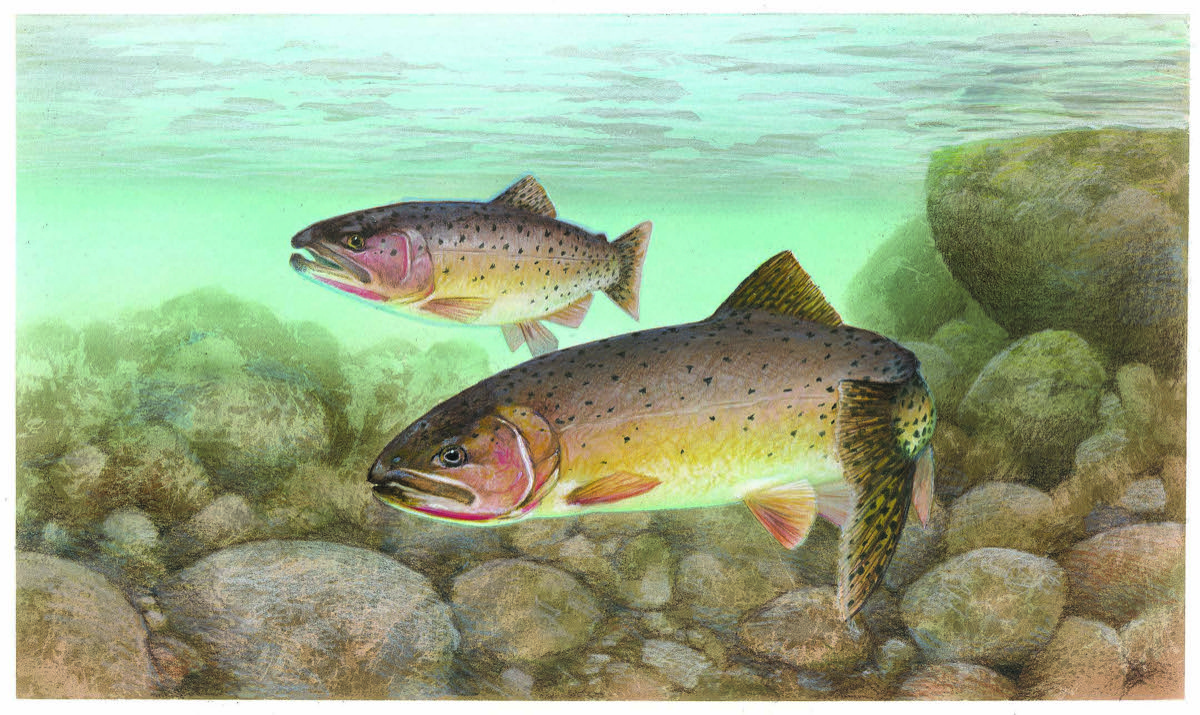
Cutthroat trout is the native trout of the American West, named for the vivid red slashes under each jaw — and unlike the Pacific salmon it shares a genus with, it survives spawning to spawn again.
MoreFull Species Details
- Species Name
- Oncorhynchus clarkii
- Family
- Salmonidae
- Order
- Salmoniformes
- Also Known As
- —
Cutthroat Trout (Oncorhynchus clarkii) Fish Description
Cutthroat trout is the native trout of the American West, named for the vivid red slashes under each jaw — and unlike the Pacific salmon it shares a genus with, it survives spawning to spawn again.
The name is the identification: Alaska's agency describes vivid red slash marks under each jaw bone, and Montana's wording is the same — red slashes near the lower jaws. The marks develop early, appearing once a juvenile reaches about three to five inches. Around them, the fish varies enormously, because cutthroat is really a family of subspecies shaped by isolated basins: coastal fish that run to sea, westslope fish of Montana and Idaho headwaters, and the Lahontan giant of the Great Basin's alkaline desert lakes — the largest of the group, per Oregon's agency, and well adapted to conditions few trout tolerate.
Two facts organise the species' story. First, the life-cycle exception: where every Pacific salmon dies after spawning, Alaska's agency notes cutthroat are capable of spawning multiple times, though they rarely survive to spawn three or more. Second, fragility. Montana reports its westslope cutthroat — the state fish, shared with the Yellowstone subspecies — reduced to less than 10% of historic range, pressured by habitat loss and hybridisation with rainbow trout, whose offspring anglers call cutbows. The Lahontan subspecies was federally listed as endangered in 1970 and reclassified as threatened in 1975, and its history includes a 41-pound fish from Pyramid Lake in 1925 — a record that shows what the desert lakes once grew.
Interesting Facts About Cutthroat Trout
- The red slashes under each jaw give the species its name and its surest field mark.
- The slashes develop when a juvenile reaches roughly 3 to 5 inches.
- Unlike Pacific salmon, cutthroat can spawn more than once — though rarely three times or more.
- Coastal cutthroat may go to sea, rearing 3 to 4 years in fresh water before a first migration in April.
- Sea-run fish stay out from a few days to over 100 days — brief compared with salmon.
Show more facts
- The diet spans fish, insects, gastropods and amphipods.
- Westslope and Yellowstone cutthroat are jointly Montana's state fish.
- Montana's westslope cutthroat occupy less than 10% of their historic range.
- Hybridisation with rainbow trout — the cutbow — is a leading conservation threat.
- The Lahontan subspecies was listed endangered in 1970, then threatened from 1975.
- The 1925 record Lahontan from Pyramid Lake weighed 41 pounds.
- Nevada counts Lahontan cutthroat in only 123 to 129 streams of their home basin.
Average Speed & Size
Size depends on which cutthroat and which water. Alaska's agency gives stream residents at 6 to 16 inches, sea-run fish seldom over 18, and a species ceiling around 27 inches and 8 pounds. The Lahontan subspecies rewrites those numbers: the largest of the group, with the verified 1925 Pyramid Lake record at 41 pounds. Most anglers meet the modest version — a foot-long native in a headwater stream — and prize it beyond its measurements, because a cutthroat in its home basin is the American West's original trout.
Where to Find Them
Match the subspecies to the geography. Coastal cutthroat live from northern California to Southcentral Alaska in small streams and estuaries, with seaward migrations beginning in April. Westslope fish hold in cold Montana and Idaho headwaters — increasingly the upper reaches, where hybridisation pressure is lowest. Lahontans cruise alkaline desert lakes and streams of the Great Basin. Everywhere, cutthroat are fish of cold, clean water and modest current, feeding opportunistically on insects, small fish and invertebrates. Where rainbow trout share the water, be aware many fish are cutbows — slashes faded, spots intermediate.
Cutthroat Trout Fishing Tips
Cutthroat are famously willing fish in unforgiving places — the challenge is the water, not the take. Light gear, dry flies and quiet feet cover most of it.
Equipment
A light fly outfit — three- to five-weight — or ultralight spinning gear suits stream fish; Lahontan lake fishing runs heavier. In small water, presentation matters far more than distance.
Chumming
Not used and generally prohibited in trout waters. Stealth is the substitute: approach from downstream, stay low, and let the first cast count.
Bait
Cutthroat rise readily to dry flies and attack small spinners — a diet of insects, amphipods and small fish leaves wide latitude. Where bait is legal, a drifted worm works; check rules first, as many native-cutthroat waters are artificials-only.
Patience
Respect the conservation picture. Many cutthroat fisheries are catch-and-release or tightly regulated to protect pure-strain natives — check the water's rules, wet your hands, and keep fish in the water. Release anything that might be a pure native quickly; the subspecies map depends on it.
Conditions that change the bite
- What Barometric Pressure Is Best for Fishing? No research supports a single best barometric pressure for fishing. What pressure really does, how big a weather swing is, and what to watch instead.
- Best Time of Day to Fish: What Evidence Shows Dawn and dusk are measurably better — and the edge is smaller than the folklore says. The 13-year dataset, the light mechanism, and what matters more.
- Dissolved Oxygen: The Condition Anglers Can't See Fish live or die by oxygen you can't see. How temperature, depth, dawn and turnover move it, which species need more, and how to fish around the invisible map.
Guides for fishing this species
- Trout Fishing for Beginners: Water Temperature First A thermometer teaches more than a tackle box. Where trout can survive, when to stop fishing for them, and the light rigs that work on stocked water.
- Dry Fly vs Nymph: Which One, and When Dry flies copy adult insects on top; nymphs copy the stage that lives underwater for months. The biology behind the choice, and the rule agencies give.
- How to Tie a Surgeon's Knot The surgeon's knot in five diagrammed steps — the fastest reliable way to join two lines, and the join that forgives different diameters.
Related Species
Know when they'll bite.
BiteScore forecasts when cutthroat trout will feed at your spot — from live weather, pressure, and moon data.
Get the App