AI or a Local Guide: Where Technology Stops
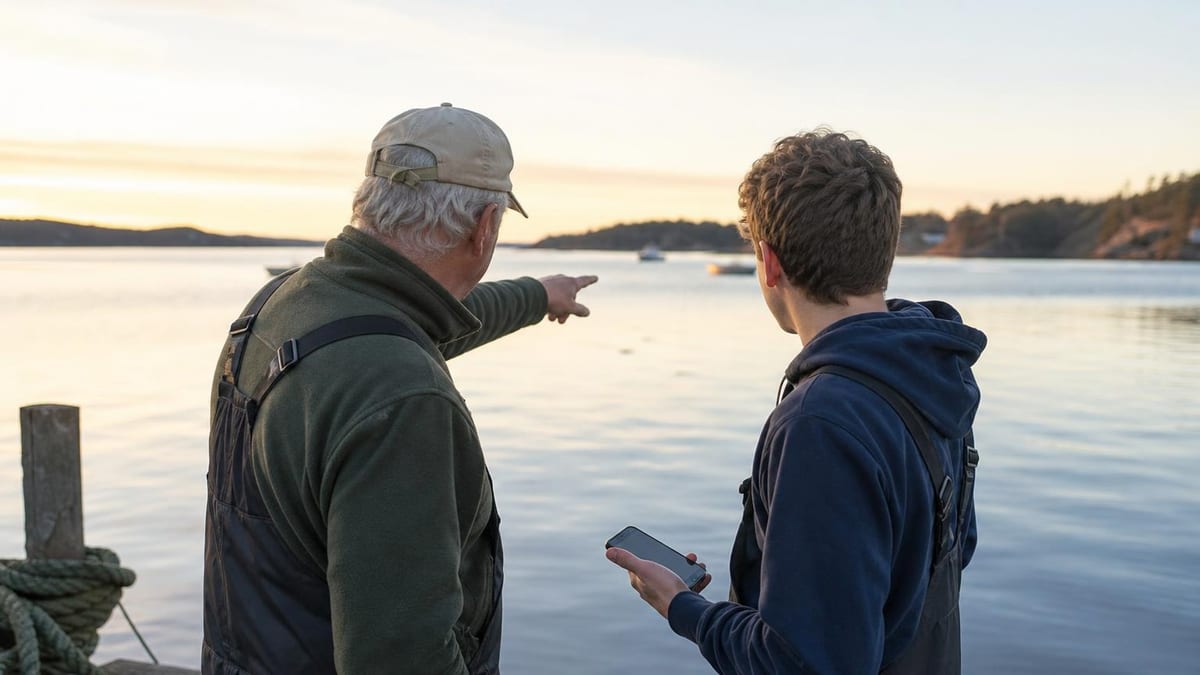
Software is good at data that is published and updates constantly — forecasts, tides, river gauges, species reference. Local knowledge holds what is specific and often unpublished: what was stocked last week, which gate is releasing, where fish actually sit on this water. The two barely overlap. One study of anglers found technology did not appear in the best model of actual catch at all, and was associated with lower satisfaction.
Key takeaways
- Skilled anglers caught roughly twice as much as unskilled ones in controlled trials on the same waters.
- In one study, fishing technology did not enter the best-fitting model of actual catch — and correlated with reduced satisfaction.
- Fishers' local knowledge matched scientific survey data closely in several published comparisons, and was gathered faster.
- Stocking schedules, emergency closures and dam releases are published per water and change without notice.
- A federal weather service tells mariners its own live bar reports should not be the only basis for a decision.
The finding that cuts against our own product
We should start with the study least flattering to fishing apps, because leaving it out would make everything after it less trustworthy.
Research on angler expectations and satisfaction found that technology use was not included in the most parsimonious model of actual catch. It did not improve anglers’ ability to meet their own expectations. And it was associated with decreased overall satisfaction.
That last part is the interesting one. A plausible reading is that tools raise what people expect before they raise what people catch, and the gap between the two is where disappointment lives. We publish a fishing app. We would rather tell you this result exists than have you find it somewhere else.
The same study found that variation among individual anglers explained a considerable share of the outcome — roughly 9% of expected catch, about a third of that model’s explanatory power, and around half of the explained variation in actual catch. Who is holding the rod matters measurably.
How much of a catch is the angler
Skill is not a vague virtue in fishing research; it has been measured, and the gap is large.
Controlled, randomised block experiments across two waters in north-eastern Germany, run over three years and involving around 2,000 fish, found that anglers who identified themselves as skilled achieved significantly greater catch per unit effort than unskilled anglers — a twofold difference on average. Same water, same day, same species, twice the fish.
Put that next to the effect sizes for environmental conditions. The largest study we have found on lunar effects, covering 341,959 catch records, measured a maximum effect of about 5%. A forecast is working with a few percent. Skill is working with a factor of two.
This is not an argument against forecasts. It is an argument about proportion. If you want to catch more fish, the evidence says learning to fish better dominates learning to read a score.
Local knowledge is data, not folklore
Fishers’ knowledge of their own waters has been tested against scientific survey data more than once, and it has held up.
One study in north-eastern Brazil compared 72 on-board scientific monitoring trips against 32 interviews with experienced fishers. The conclusion was that both methods provided similar and complementary bathymetric patterns of species occurrence and catch, and that both were accurate — with depth-distribution correlations of 0.98 to 0.99 for three species. Fishers’ identification of the rainy season correlated with recorded precipitation at 0.90. Notably, the interviews produced data faster than the on-board observations did.
Other work has found the same pattern with caveats worth keeping. A comparison with official fisheries statistics reported good agreement in general trends for catch per unit effort and overall harvest, while noting that two species showed contradictory patterns between the datasets. A third study found fishers’ recalled historical catches supported by independent landing data, while also documenting shifting baselines — experienced fishers recognised more overexploited species than beginners did, because they remembered more.
So local knowledge is neither infallible nor anecdote. It is a data source with its own strengths and its own biases, which is exactly what scientific survey data is.
The things published data cannot know
A great deal of what decides a fishing trip is published locally, changes without warning, and never reaches a general model.
Stocking is the clearest case. Oregon’s wildlife department publishes a trout stocking schedule that gives the week a water will be stocked rather than the exact date, states plainly that the schedule is subject to change without notice, and warns that some waters may not be stocked as planned because of poor water conditions, with those fish diverted elsewhere. No app knows that a truck went to a different lake.
Closures are more serious. Alaska’s Department of Fish and Game issues emergency orders that open or close seasons and areas, change bag limits and modify legal methods — and states that these may be issued at any time and have the same force and effect as law. Washington publishes emergency rules that override the printed pamphlet. These are per water, per date, per species.
Water level is a third. Reservoir operators publish pool and tailwater elevations, storage, releases and generation schedules, and schedule those releases in response to observed rainfall. A river that fished well yesterday can be unrecognisable today because of a decision made upstream.
Algal blooms are tiered and local. State advisories distinguish a watch — a bloom is possible and may be present — from a warning, and attach different guidance to each, including that at watch level boating and fishing are considered safe while spray inhalation may affect some people. Thresholds are not uniform between states, and guidance may exist at county or local level.
Where local knowledge is a safety matter
On some water, knowing the place is not an advantage but a requirement, and the agencies publishing the data say so first.
The National Weather Service publishes bar observations for the Columbia River and states, on the same page, that safe navigation is the responsibility of each vessel operator, that the report should not be used as the sole source of information when deciding to cross a bar, and that operators should use all means available to evaluate conditions and risk. It adds that the information reflects conditions at the time of observation and may not reflect current conditions.
That is a federal weather agency telling mariners that its own live feed is not sufficient on its own. Any app redistributing the same data inherits that limitation exactly, and should say so.
What guides actually are
Guiding is a licensed and examined profession, and it feeds the science that everyone else relies on.
In New York, a guide is defined as a person over 18 offering services for hire that include directing, instructing or aiding another in fishing, and licensing requires current first aid, CPR and a water safety course, plus two examinations passed at 70%. That is a formal standard, not an informal arrangement.
The for-hire sector is also a data source. Charter and headboat captains supply weekly trip, angler, hours, location and species information to federal surveys, which describes participating operators as making a vital contribution to understanding total recreational catch. When a stock assessment gets made, part of what it is made from came off those boats.
The scale is substantial: recreational fishing generated around $145.4 billion in sales impacts and supported roughly 694,041 full- and part-time jobs, with charter operations among the businesses counted.
None of that is in competition with software. An app can tell you the tide, the forecast and what the fish looks like. It cannot take you across a bar, and it has never fished the water you are about to fish.
What it cannot do
- An app cannot know what was stocked in your lake last week, or that a gate upstream started releasing this morning.
- It cannot tell you a closure was issued yesterday. Emergency orders carry the force of law and are published per water, per date, per species.
- It cannot judge whether the bar, current or wind at one specific place is safe today — the agencies that publish those observations say so themselves.
- It cannot substitute for skill. The measured gap between skilled and unskilled anglers on the same water was around twofold.
- It cannot tell you where fish sit on a particular water. That knowledge is accumulated by fishing it, and it is not written down anywhere.
Frequently asked questions
Is a fishing app better than a local guide?
They answer different questions, so the comparison does not really hold. An app is good at published data that changes constantly — forecasts, tides, gauge readings, species reference. A guide holds knowledge that is specific to one water and mostly unpublished: where fish hold, what has been stocked, what the pressure has been, which conditions are dangerous there. Neither substitutes for the other.
Does fishing technology actually improve your catch?
One study of anglers found it did not. Technology use was not included in the most parsimonious model of actual catch, did not improve anglers' ability to meet their own expectations, and was associated with decreased overall satisfaction. We publish a fishing app, and we think that result is worth reporting rather than burying — it suggests raised expectations can outrun what a tool delivers.
How much does angler skill matter?
A great deal. In controlled randomised trials across two waters and three years, anglers self-identifying as skilled achieved significantly greater catch per unit effort than unskilled anglers — a twofold difference on average. A separate study found that variation among individual anglers accounted for about half the explained variation in actual catch.
Is local fishing knowledge reliable, or just folklore?
It has been tested against scientific data repeatedly and held up well. One comparison of 72 on-board monitoring trips with interviews of experienced fishers found both methods accurate and complementary, with depth-distribution correlations of 0.98 to 0.99 for three species — and the interviews produced data faster. Other work has found local recollections supported by independent landing records.
What can an app tell me that a guide cannot?
Live public data across many places at once. Weather and marine forecasts, tide predictions, river gauge readings and charted contours are updated continuously and cover everywhere, which is exactly what a person cannot do. Comparing six nearby waters before deciding where to drive is a genuine advantage — it just is not the same skill as knowing one water well.
Related reading
Sources
- Comparing on-board scientific monitoring with fishers' local ecological knowledge — Lima et al., Journal of Ethnobiology and Ethnomedicine 13:30 (PMC5455079). Accessed August 6, 2026.
- Local ecological knowledge and scientific data reveal overexploitation — Bender et al., PLOS One 9(10):e110332 (PMC4198246). Accessed August 6, 2026.
- Comparing local ecological knowledge with official fisheries statistics — Ullah et al., Frontiers in Marine Science 10:974591. Accessed August 6, 2026.
- Angler skill and catch per unit effort in randomised trials — Futamura et al., North American Journal of Fisheries Management 45(6):1096-1107. Accessed August 6, 2026.
- Angler expectations, catch and satisfaction — Kerkhove et al., Fisheries 49(10):463-474. Accessed August 6, 2026.
- Trout Stocking Schedule — Oregon Department of Fish and Wildlife. Accessed August 6, 2026.
- Emergency Orders and News Releases — Alaska Department of Fish and Game. Accessed August 6, 2026.
- Fisheries Economics of the United States — NOAA Fisheries. Accessed August 6, 2026.
- Licensed Guide Program — New York State Department of Environmental Conservation. Accessed August 6, 2026.
- Columbia River Bar Observations — National Weather Service, Portland. Accessed August 6, 2026.
How we choose sources: sources policy.
More in this series
See the conditions for your own spot.
Fishing Club AI turns live weather, pressure and moon data into an hourly forecast — and shows you which factors moved the number.
Get the App