Can AI Identify a Fish From a Photo?
Often, yes — and the accuracy depends almost entirely on the photo and the species. Published studies report 89% to 99% accuracy, but on sets of only 9 to 23 species under controlled conditions. Some closely related fish cannot be separated from external appearance at all, and professionals key fish out by counting fin rays rather than by overall look. A photo result is a fast first hypothesis, not an identification.
Key takeaways
- Published accuracy figures come from tests on 9 to 23 species — not from the 30,000-plus species that exist.
- One study's accuracy fell from 94.3% to 89.0% simply by adding an 'other species' option.
- DNA work on one goby genus found 52 visually defined species contained 94 genetic lineages.
- Trained monitoring staff, holding the actual fish, misidentified specimens at an average rate of 17%.
- Around a quarter of 'research grade' citizen-science identifications in one marine study were inaccurate or uncertain.
What the published numbers actually measure
Accuracy figures for automated fish identification are real, and they describe far narrower tests than the headline suggests.
One study classifying fish in underwater video reported 94.3% accuracy across 16 species. Another, photographing 9 species at a fish counter under near-constant lighting, reported 95.29%. A third, working from a 23-species dataset of over 27,000 images, reported 99.93% classification accuracy.
Read those numbers with their conditions attached and they say something more modest. Nine species. Sixteen. Twenty-three. There are more than 30,000 fish species in the world, and the third dataset was heavily skewed — around 44% of its images were a single species, and the top fifteen species accounted for 97% of everything in it. A model can score very well on a test like that while having seen almost nothing of the tail.
This is why we publish no accuracy percentage for our own photo identification feature. A number would have to come from somewhere, and any number honest enough to be useful would have to state which species, which photos and which conditions it was measured on.
Why real photographs are harder than test sets
Performance drops as soon as the model has to consider that the answer might not be on its list.
The underwater-video study makes this unusually concrete. Its 94.3% across 16 species fell to 89.0% when an “other species” class was added — the same model, the same footage, one extra option representing everything it had not been trained on. Real fishing is permanently in that second condition. Whatever you are holding might be something the model has never seen.
Conditions do the rest of the damage. That study describes its own footage in terms of murkiness, blurriness and shifting luminosity, with reef structure and moving plants confusing the background. The controlled study, by contrast, deliberately held lighting near-constant at a fish counter. Those two setups produce numbers that should never be quoted side by side without saying which was which.
There is a subtler trap the same authors flag: models over-fit their training data and then fail on data they have not seen. A system tested on the water it was trained in flatters itself. It is the machine-learning equivalent of marking your own homework.
The fish that cannot be told apart by looking
Some species are beyond photography entirely, and this is not a limitation of software but of appearance itself.
DNA barcoding of the goby genus Trimma found that 52 species defined on morphological grounds actually contained 94 distinct genetic lineages, implying roughly 42 additional cryptic species and pushing the genus estimate from about 110 towards 200. For one of them, the researchers reported no known differences in morphology or colour pattern separating the genetic groups at all.
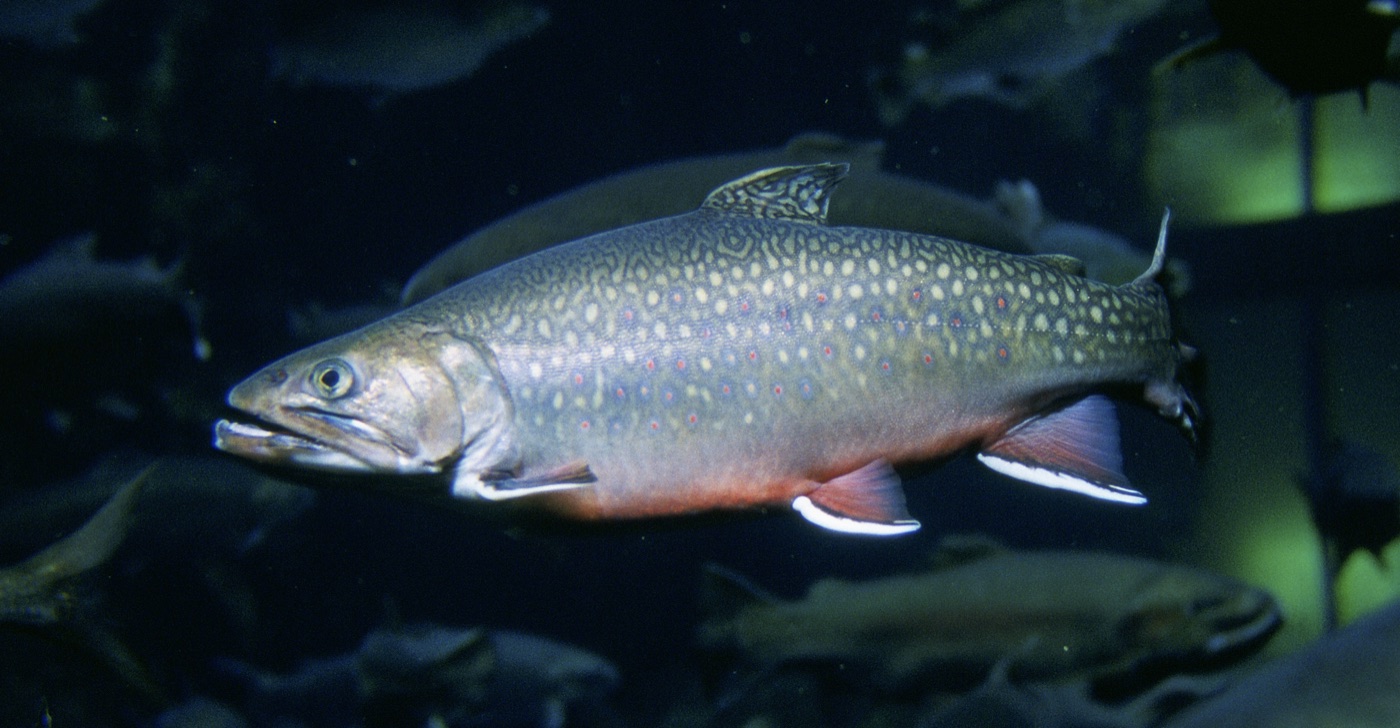
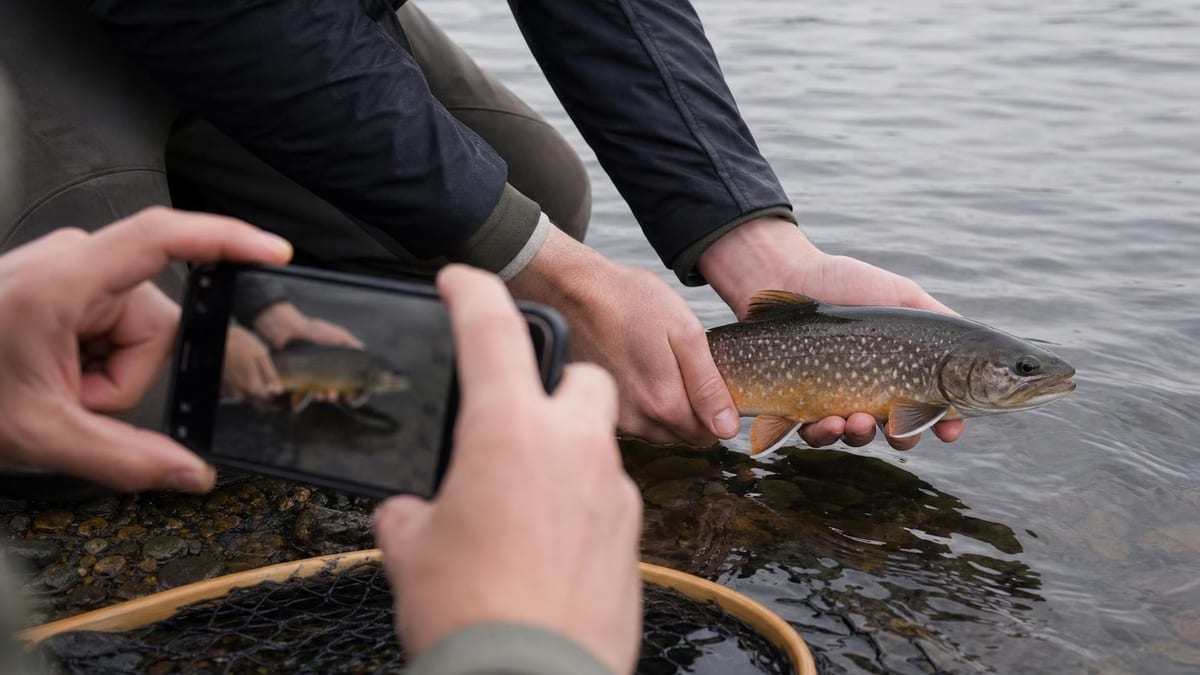
Hybrids create a related problem closer to home. Oregon’s wildlife department publishes a bull trout identification guide that tells observers to disregard every other feature and look only at the dorsal fin: unmarked on a bull trout, marked with solid black on a brook trout, and on a hybrid marked in a way that lacks the solid black and the distinct edges. That is a real, workable field character — and it is a single fin’s pattern, frequently out of focus in a photograph taken one-handed over the water.
What professionals use instead
Identification keys are built on counting, not on overall resemblance, and that difference explains most of what a photo cannot do.
A key works as a tabulation of characters arranged in couplets, each choice leading either to a species or to the next couplet. The characters that carry the weight are things like dorsal and anal fin ray counts — described as relatively stable and straightforward to obtain — alongside scale type, mouth position, and the fish’s locality, depth and habitat. Reference databases hold fin-ray counts for thousands of species precisely because those counts are the reliable currency.
A single side-on photograph rarely delivers a countable ray series or a countable scale row. So a photo model is not doing a lower-quality version of what a taxonomist does; it is doing a different thing, inferring from overall pattern what a key resolves by measurement.
Even people get this wrong
Human identification is not the reliable baseline it feels like, which is worth knowing before treating any automated result as uniquely suspect.
A study of fish monitoring in the San Francisco Estuary tested 32 observers against 155 specimens and found trained staff misidentified fish at an average rate of 17%. Error rose for smaller fish, rarer species and less experienced observers, and untrained or part-time observers were roughly six times more likely to produce a false-positive identification. These were professionals with the animal in their hands.
Anglers do better on distinctive fish and worse on confusable ones, exactly as you would expect. Expert review of 5,390 shark photographs from a Texas tournament found 97.2% overall angler accuracy — but 76.1% for spinner shark, with blacktip and spinner the dominant confusion pair.
Community verification has a similar tail. A study scoring citizen-science records of non-native marine species found that around 24.9% of observations carrying the platform’s “research grade” label contained inaccurate or uncertain identifications, with a further 18.4% impossible to score because of poor image quality or because the taxa required molecular confirmation.
The useful conclusion is not that identification is hopeless. It is that difficulty belongs to the fish. A distinctive species photographed side-on in good light is easy for a model, an angler and a biologist alike — and a cryptic species pair is hard for all three.
What it cannot do
- It cannot be a legal identification. Size, season, bag and protected-species rules turn on the species, and the look-alikes are often exactly what a model finds hardest.
- It cannot count fin rays, lateral-line scales or gill rakers from a single side-on photo — and those counts are what professional keys are built on.
- It cannot separate species that genuinely have no external differences. For some fish, genetics is the only answer available to anyone.
- It cannot tell you how confident to be in a way that transfers between photos. Performance on a clean reference shot and on a wet fish in your hand are different measurements.
- No published evaluation of a consumer photo identification feature exists that we could find — including of ours, which is why we publish no accuracy percentage.
Frequently asked questions
How accurate is AI fish identification?
The honest answer is that it depends on how many species are on the table and what the photo looks like. Peer-reviewed studies report figures from about 89% to over 99%, but on constrained sets — one used 9 species photographed under near-constant lighting, another 23 species from a dataset where a single species made up around 44% of all images. Those are real results for those tests. They do not transfer to a phone photo of any fish anywhere.
Why does adding more species make it less accurate?
Because a classifier picking between 9 known options is doing an easier job than one that must also consider everything it was never shown. In one underwater-video study, accuracy on 16 species was 94.3% — and 89.0% once an 'other species' class was added. Real fishing is the second situation: the fish in your hand might be something the model has never seen.
Are there fish that AI cannot identify from a photo?
Yes, and for some of them nobody can. DNA barcoding of one goby genus found that 52 species defined by their appearance actually contained 94 distinct genetic lineages, and for one of them the researchers reported no known differences in morphology or colour pattern separating the groups. If the difference is not visible to a taxonomist with the specimen, it is not visible to a camera.
How do experts identify a fish properly?
By counting things. Identification keys work as a series of either-or couplets, and the characters they rely on include dorsal and anal fin ray counts, scale rows and scale type, mouth position, and locality and depth. A single side-on photograph usually cannot deliver a countable ray or scale series, which is the structural reason a photo cannot do everything a key does.
Do people identify fish more reliably than software?
Not automatically. A study of trained monitoring staff in the San Francisco Estuary found an average misidentification rate of 17% across 155 test specimens and 32 observers — with the fish in hand. In a Texas shark tournament, expert review of 5,390 angler photos found 97.2% overall accuracy but only 76.1% for one species. Difficulty is a property of the fish, not only of the identifier.
Related reading
Sources
- Automatic fish species classification in underwater videos — ICES Journal of Marine Science 75(1):374. Accessed August 6, 2026.
- Fish species classification using deep learning on constrained imagery — PLOS One (PMC10132662). Accessed August 6, 2026.
- Fish detection and classification on the Fish4Knowledge dataset — PubMed Central (PMC11336429). Accessed August 6, 2026.
- DNA barcoding reveals cryptic diversity in the goby genus Trimma — PubMed Central (PMC3950426). Accessed August 6, 2026.
- Bull Trout Identification Guide — Oregon Department of Fish and Wildlife. Accessed August 6, 2026.
- Quick Identification — fin ray counts and identification keys — FishBase. Accessed August 6, 2026.
- Confidence scoring of citizen-science identifications of non-native marine species — PubMed Central (PMC11461752). Accessed August 6, 2026.
- Fish misidentification and potential implications for monitoring within the San Francisco Estuary — US Geological Survey / Journal of Fish and Wildlife Management. Accessed August 6, 2026.
- Angler accuracy in shark species identification from photographs — PLOS One. Accessed August 6, 2026.
How we choose sources: sources policy.
More in this series
See the conditions for your own spot.
Fishing Club AI turns live weather, pressure and moon data into an hourly forecast — and shows you which factors moved the number.
Get the App