Spanish Mackerel
Scomberomorus maculatus
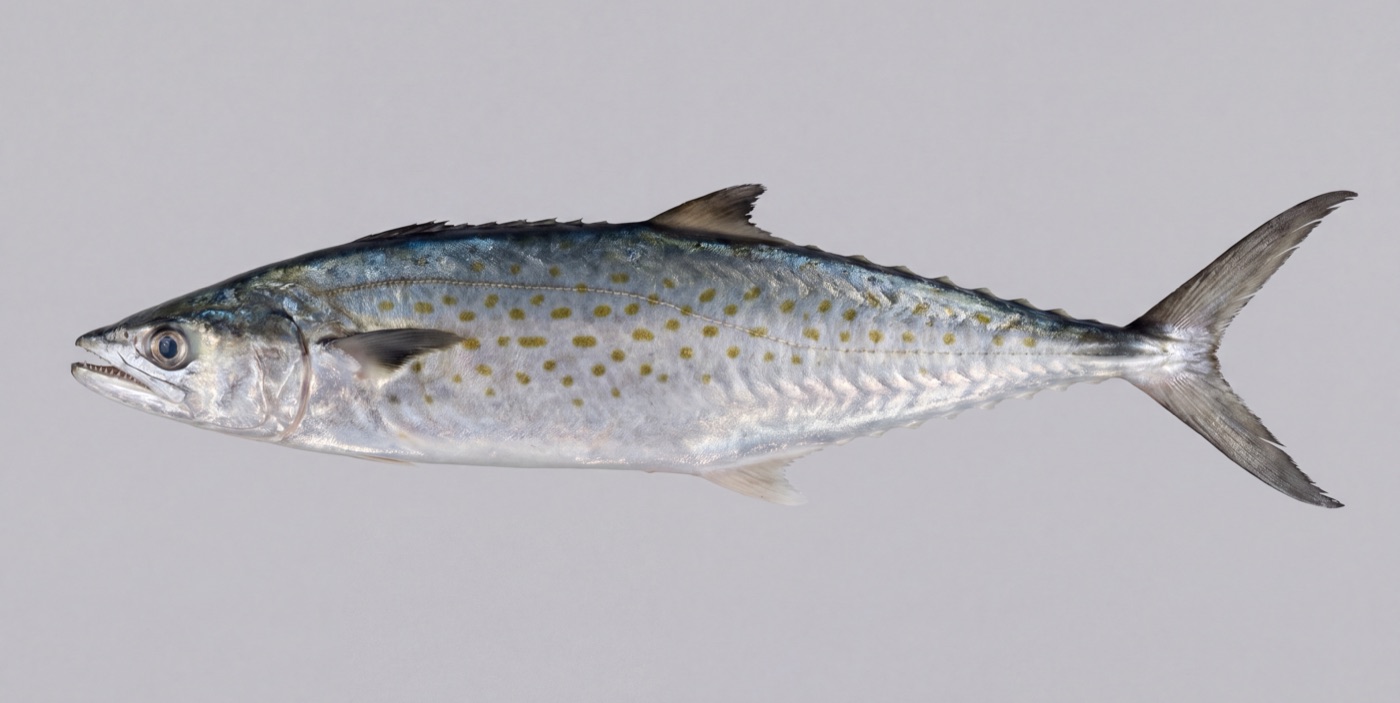
Spanish mackerel is a fast-growing coastal member of the tuna and mackerel family, marked by scattered yellow-olive oval spots on bright silver flanks.
MoreFull Species Details
- Species Name
- Scomberomorus maculatus
- Family
- Scombridae
- Order
- Scombriformes
- Also Known As
- —
Spanish Mackerel (Scomberomorus maculatus) Fish Description
Spanish mackerel is a fast-growing coastal member of the tuna and mackerel family, marked by scattered yellow-olive oval spots on bright silver flanks.
The body is slim, torpedo-shaped and built for speed, with a deeply forked tail and a row of small finlets running to it. The back is olive to dark blue and the sides are bright silver, marked with scattered yellow to olive oval spots. Those spots and one other feature separate the species from the king mackerel it is most often confused with: in Spanish mackerel the lateral line slopes gently from behind the gill cover to the tail, while in king mackerel it drops sharply below the second dorsal fin. Getting that distinction right matters beyond identification, because the two fish sit in different federal mercury advice categories.
Spanish mackerel are coastal pelagic fish, ranging from the Florida Keys to New York and occasionally into New England. They travel in fast-moving schools near the surface, preferring open water but also holding over deep grass beds and reefs and entering shallow estuaries. The species is strongly migratory on a temperature cue, wintering off Florida, reaching North Carolina in early April and New York by June, then retreating south as the water cools. They grow quickly and live only about a decade, which makes them abundant and productive but also tightly tied to seasonal timing.
Interesting Facts About Spanish Mackerel
- They grow fast and live only about 12 years.
- Larvae reach 12 to 15 inches within their first year.
- Growth slows around age 5 in males and age 6 in females.
- The oldest fish sampled were 11 years for females and 10 for males.
- Migration follows temperature: they head south when the water drops below about 70 °F.
Show more facts
- Atlantic fish winter off Florida, reach North Carolina in early April and New York by June.
- Females spawn by age two, releasing between half a million and 1.5 million eggs in a season.
- They spawn in the ocean at night, from May to September.
- Eggs hatch in about 25 hours at 79 °F.
- The federal EPA and FDA chart lists Spanish mackerel as a Good Choice, while king mackerel is in Choices to Avoid.
- A gently sloping lateral line separates them from king mackerel, whose lateral line drops sharply.
- Both Atlantic and Gulf stocks were assessed in 2023 as not overfished and not subject to overfishing.
Average Speed & Size
Spanish mackerel are small, fast and abundant rather than large. North Carolina's marine fisheries division gives the practical figures: the species grows to 37 inches and 12 pounds, but most catches run 14 to 18 inches and 1 to 3 pounds. Florida's state record is 12 pounds. The body is built for speed — torpedo-shaped with a crescent tail and finlets, the standard architecture of a fast pelagic fish — and hooked fish run hard and fast in open water. We have not found a measured swimming speed for this species from a source we can verify, so we do not quote one.
Where to Find Them
Spanish mackerel favour open nearshore water, often in large schools near the surface, and are also found over deep grass beds and reefs and in shallow estuaries. The Florida Museum gives a depth range of about 33 to 115 feet and notes an association with barrier islands and the passes between them. In summer they may push into sounds and river mouths. Because the species is temperature-driven, timing matters more than location for much of its range: it arrives as water warms in spring and leaves once it falls below about 70 °F. Look for surface activity — diving birds and busting bait are the usual giveaway.
Spanish Mackerel Fishing Tips
Spanish mackerel fishing is about speed and finding the school. These are fast, visually hunting fish that chase small baitfish near the surface, so the presentation has to move and the leader has to survive sharp teeth.
Equipment
A light to medium spinning outfit with 10- to 20-pound line suits the size of the fish and lets you cast small lures a long way. A short wire or heavy fluorocarbon leader is the one non-negotiable: the teeth are sharp enough to cut straight through standard monofilament. Keep the leader short so it does not spook fish in clear water.
Chumming
Chumming works well because these are competitive school fish. A steady stream of small cut bait holds a passing school behind the boat long enough to fish it properly, turning a brief encounter into a session.
Bait
Small, fast-moving lures that imitate the baitfish they hunt — narrow spoons and small jigs — are highly effective retrieved quickly. Live small baitfish work when the fish are being selective.
Patience
Less patience, more speed. Retrieve faster than feels right, because a slow lure gets ignored by a fish built to run down prey. When a school surfaces, cast into it immediately and expect it to move; following the birds is usually more productive than waiting.
Conditions that change the bite
- What Barometric Pressure Is Best for Fishing? No research supports a single best barometric pressure for fishing. What pressure really does, how big a weather swing is, and what to watch instead.
- Best Time of Day to Fish: What Evidence Shows Dawn and dusk are measurably better — and the edge is smaller than the folklore says. The 13-year dataset, the light mechanism, and what matters more.
- Dissolved Oxygen: The Condition Anglers Can't See Fish live or die by oxygen you can't see. How temperature, depth, dawn and turnover move it, which species need more, and how to fish around the invisible map.
Guides for fishing this species
- Fishing Line Types: Braid vs Mono vs Fluorocarbon Monofilament, fluorocarbon and braided line compared — stretch, visibility, sink rate and durability, what agencies actually say, and which to spool when.
Related Species
Know when they'll bite.
BiteScore forecasts when spanish mackerel will feed at your spot — from live weather, pressure, and moon data.
Get the App