Cobia
Rachycentron canadum
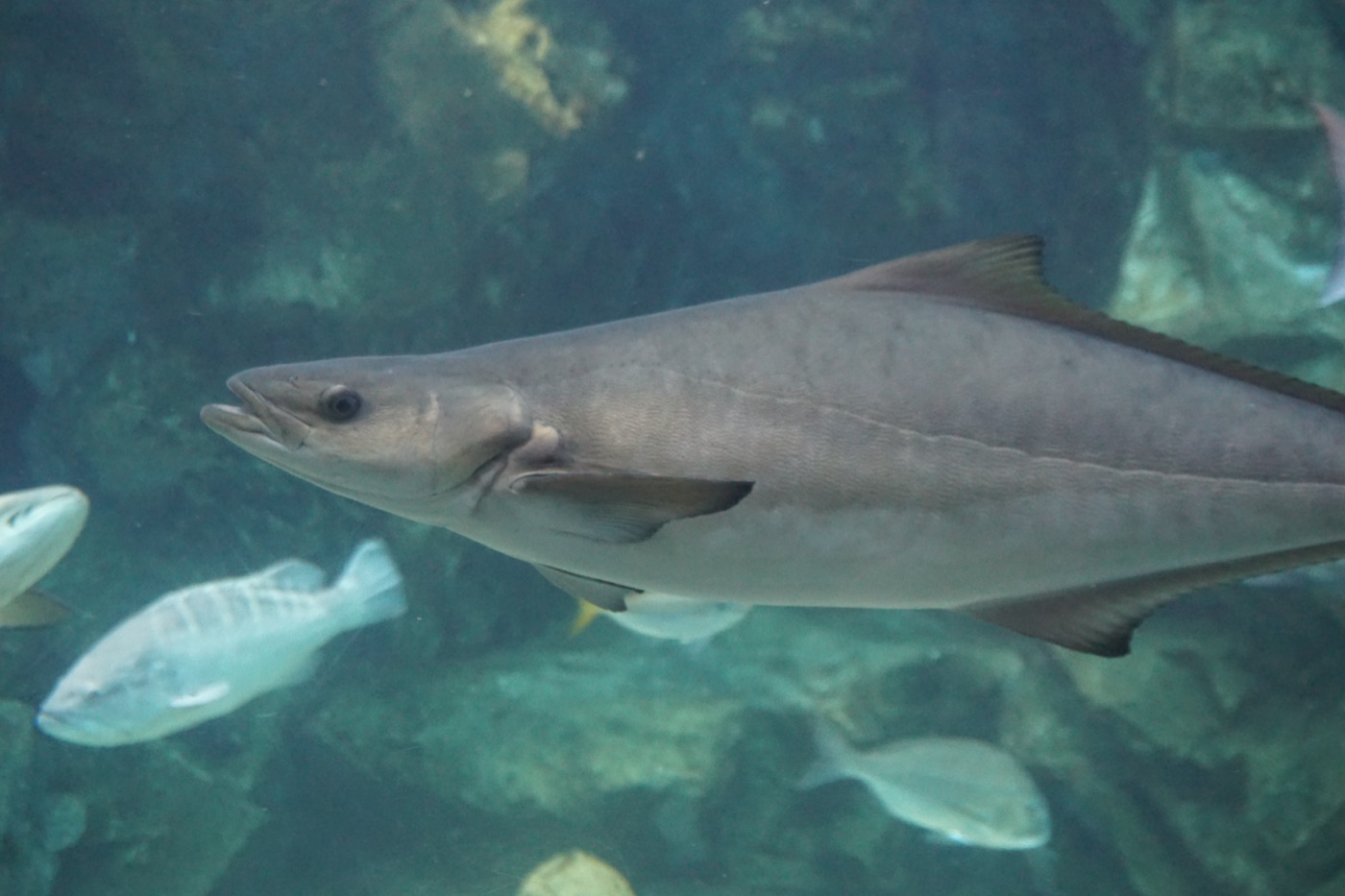
Cobia is a large, solitary coastal gamefish with a broad flat head and dark brown body, often mistaken at a distance for a shark or remora.
MoreFull Species Details
- Species Name
- Rachycentron canadum
- Family
- Rachycentridae
- Order
- Carangiformes
- Also Known As
- Ling, Lemonfish, Black kingfish, Crabeater
Cobia (Rachycentron canadum) Fish Description
Cobia is a large, solitary coastal gamefish with a broad flat head and dark brown body, often mistaken at a distance for a shark or remora.
The body is long and torpedo-shaped, dark chocolate-brown above with a pale belly and a faint darker stripe running along each side. The head is broad, flattened, and low-slung, and the first dorsal fin is reduced to a row of short, stiff spines. This profile gives the cobia a striking resemblance to a shark or a large remora when seen swimming near the surface. The lower jaw projects slightly, and the tail is broad and forked in adults. Young fish show bold black-and-white banding that fades to the uniform brown of the adult.
Cobia is found in warm waters worldwide, ranging across the Atlantic, Indian, and western Pacific oceans, and is common along the US Atlantic and Gulf coasts. The species is largely solitary, often shadowing larger animals such as rays, sharks, and sea turtles, or holding around buoys, wrecks, and floating debris. Cobia migrate seasonally with warming water. Anglers prize the species for its powerful, stubborn fight, its curiosity that brings it to sight-casting range, and its firm, white, excellent flesh, making cobia a favorite of nearshore anglers.
Interesting Facts About Cobia
- The world record cobia weighed 135 pounds 9 ounces, caught off Western Australia in 1985.
- Cobia often swim alongside rays, sharks, and sea turtles for cover and food.
- The species can live up to 15 years in the wild.
- Cobia have a shark-like profile and are frequently mistaken for sharks or remoras.
- The species feeds heavily on crabs, earning the nickname crabeater.
Show more facts
- Cobia migrate seasonally, following warm water along the coast.
- A large female can release several million eggs over a spawning season.
- Young cobia display bold black-and-white bands that fade with age.
- Cobia are curious and often approach boats and floating objects.
- The first dorsal fin is a row of short, stiff, separate spines.
- Cobia grow rapidly and are increasingly raised in aquaculture worldwide.
- The species is highly regarded as table fare for its firm, white flesh.
Average Speed & Size
Cobia is a strong, steady swimmer that typically reaches 24 to 50 inches and 15 to 40 pounds. Trophy fish exceed 60 inches and 70 pounds, with the record near 135 pounds. The species cruises near the surface at an unhurried pace, often shadowing larger animals, then pulls with surprising, bulldogging power once hooked. A cobia's fight is a test of stamina rather than speed, marked by deep, dogged runs and stubborn circling that can wear down both angler and tackle.
Where to Find Them
Cobia is found in warm coastal and nearshore waters along the Atlantic and Gulf coasts, usually near the surface. The species holds around structure and large animals: buoys, wrecks, reefs, channel markers, and rays or sharks it shadows. Cobia favor water above 68 degrees Fahrenheit and migrate along the coast with the warming spring, cruising within sight of the surface. Sight-casting to visible fish is a common tactic. Cobia are absent from cold northern seas, following warm water and the structure and animals that shelter their prey.
Cobia Fishing Tips
Cobia fishing often combines sight-casting to cruising fish with fishing structure and buoys. Success comes from spotting fish near the surface or around markers and presenting a bait or jig quickly and accurately.
Equipment
Use a 7- to 7-foot-6 medium-heavy spinning rod paired with a strong reel spooled with 30- to 50-pound braid and a 40- to 60-pound leader. The heavy tackle is needed to control a large, powerful fish near structure. A rod with enough backbone lets anglers cast a heavy jig accurately to a cruising cobia and then turn the fish away from wrecks and pilings.
Chumming
Chumming with cut bait around a wreck, buoy, or anchored boat draws cobia up from structure and holds them in casting range. A steady scent trail on moving current pulls cruising fish toward the source. Anglers often keep a hooked cobia in the water, since others in the area may follow it to the boat and take a pitched bait.
Bait
Live eels, crabs, and pinfish are the top natural baits, matched to the cobia's crab-heavy diet. Effective lures include large bucktail jigs and soft-plastic eels pitched to sighted fish.
Patience
Cobia are curious but can be finicky, sometimes following a bait without striking, so a well-placed cast and a change of lure often trigger the take. A calm approach to sighted fish keeps them from spooking off the surface.
Conditions that change the bite
- What Barometric Pressure Is Best for Fishing? No research supports a single best barometric pressure for fishing. What pressure really does, how big a weather swing is, and what to watch instead.
- Best Time of Day to Fish: What Evidence Shows Dawn and dusk are measurably better — and the edge is smaller than the folklore says. The 13-year dataset, the light mechanism, and what matters more.
- Dissolved Oxygen: The Condition Anglers Can't See Fish live or die by oxygen you can't see. How temperature, depth, dawn and turnover move it, which species need more, and how to fish around the invisible map.
Guides for fishing this species
- The Fish Finder Rig: Sliding Sinker Bottom Fishing How to build the fish finder rig — sliding sinker, bead, swivel, leader — why fish never feel the weight, and how to pair it with circle hooks.
Related Species
Know when they'll bite.
BiteScore forecasts when cobia will feed at your spot — from live weather, pressure, and moon data.
Get the App