Sockeye Salmon
Oncorhynchus nerka
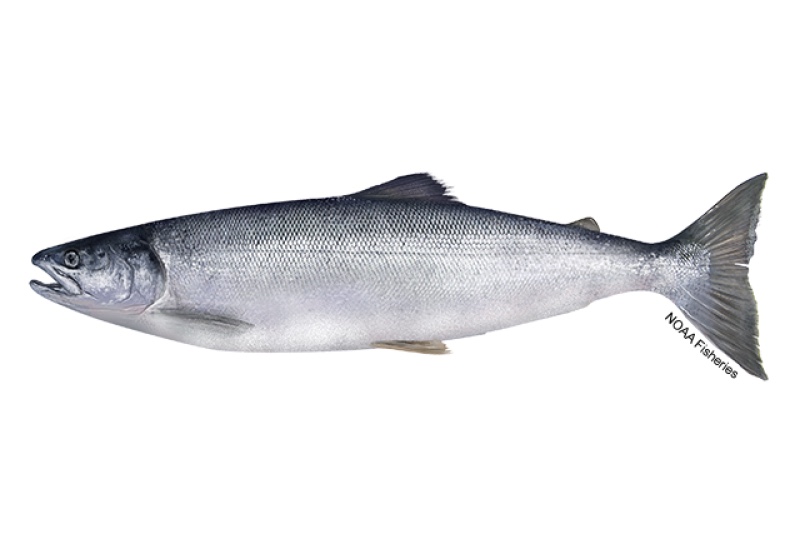
Sockeye salmon is the Pacific salmon of the lakes — a plankton-feeder whose spawning transformation, bright red body under a green head, is the most dramatic in the family.
MoreFull Species Details
- Species Name
- Oncorhynchus nerka
- Family
- Salmonidae
- Order
- Salmoniformes
- Also Known As
- Red salmon, Blueback salmon, Kokanee (landlocked)
Sockeye Salmon (Oncorhynchus nerka) Fish Description
Sockeye salmon is the Pacific salmon of the lakes — a plankton-feeder whose spawning transformation, bright red body under a green head, is the most dramatic in the family.
At sea the sockeye is a clean silver-blue fish, among the smaller Pacific salmon, without the heavy spotting of chinook or coho. The famous version is the spawning dress: NOAA describes heads turning green and bodies turning bright red, the colour that gives the species its other name, red salmon. The biology behind the plainness is diet. Sockeye feed low on the food chain — juveniles on zooplankton, amphipods and insects, lake fish on zooplankton and small crustaceans — a menu that shapes both the deep red flesh and the fishing.
Sockeye are the most lake-dependent of the Pacific salmon. Oregon's wildlife department notes that many populations require a lake for part of the life cycle: juveniles typically rear in a nursery lake for one to three years before smolting, then spend two to three years at sea before returning — and, like their relatives, all sockeye die within a few weeks of spawning. The species also runs a permanent freshwater edition: non-anadromous sockeye, known as kokanee, live out their lives in lakes and rarely top 14 inches. Two population groups carry federal protection — Snake River sockeye are listed as endangered and Ozette Lake sockeye as threatened — while the great Alaska runs remain among the healthiest salmon fisheries anywhere.
Interesting Facts About Sockeye Salmon
- One of the smaller Pacific salmon, typically 4 to 15 pounds.
- Spawning fish turn unmistakable: green head, bright red body.
- Juveniles feed mainly on zooplankton, amphipods and insects.
- Many populations require a nursery lake — the most lake-tied life cycle in the family.
- Juveniles spend one to three years in fresh water, then two to three years at sea.
Show more facts
- All sockeye die within a few weeks of spawning.
- Kokanee are the same species living entirely in fresh water, rarely over 14 inches.
- In lakes they feed on zooplankton and small crustaceans.
- Most Alaska sockeye return to spawn in June and July.
- Columbia River fish migrate upriver in summer toward spawning grounds in Idaho.
- Snake River sockeye are ESA-listed as endangered; Ozette Lake sockeye as threatened.
- Alaska's trophy certificate minimum for sockeye is 12 pounds.
Average Speed & Size
NOAA gives sockeye at 1.5 to 2.5 feet and 4 to 15 pounds, and Oregon's figures agree — 24 to 33 inches, 5 to 15 pounds. Kokanee, the landlocked form, run far smaller at under 14 inches. We have not found a verified hook-and-line record from an agency source, so we do not quote one; Alaska's trophy-certificate minimum of 12 pounds is the sourced benchmark for a big fish. Whatever the size, a sockeye fresh from salt water fights with fast runs and repeated jumps that punch well above its weight.
Where to Find Them
Timing and the lake connection decide everything. Alaska's agency puts most spawning returns in June and July, and Oregon notes Columbia River fish moving upriver in summer toward Idaho — short, intense windows rather than long seasons. Look for river systems attached to nursery lakes, with fish spawning along lake shorelines or in stream gravels. Kokanee open the species to anglers far from the coast, holding in cold deep lakes across the West. As with all salmon, rules differ sharply between healthy runs and the protected Snake River and Ozette Lake populations — check the regulations for your specific water.
Sockeye Salmon Fishing Tips
Sockeye are a plankton-feeder in a family of predators, which changes the fishing: presentations are small, timing is everything, and most fish are caught when a run concentrates them in rivers.
Equipment
A medium rod with 10- to 20-pound line suits river fishing; kokanee anglers go lighter still. In rivers where fish stack in numbers, regulations on hooks and methods are often specific and strict — read the local rules before rigging.
Chumming
Chumming has no place in salmon rivers and is generally prohibited. The concentration comes free: time the run, and the fish arrive in schools that make attraction unnecessary.
Bait
Small and sparse wins for a zooplankton-feeder: small spinners, spoons, beads and sparse flies, per Oregon's own note that sockeye can be caught on small spinners, spoons and fly tackle. Kokanee respond to small trolled lures tipped with corn where legal.
Patience
Fish the run, not the water in general. A river without sockeye today may hold thousands next week — June and July in Alaska, summer in the Columbia. When fish are present but tight-lipped, downsizing the presentation usually beats changing location.
Conditions that change the bite
- What Barometric Pressure Is Best for Fishing? No research supports a single best barometric pressure for fishing. What pressure really does, how big a weather swing is, and what to watch instead.
- Best Time of Day to Fish: What Evidence Shows Dawn and dusk are measurably better — and the edge is smaller than the folklore says. The 13-year dataset, the light mechanism, and what matters more.
- Dissolved Oxygen: The Condition Anglers Can't See Fish live or die by oxygen you can't see. How temperature, depth, dawn and turnover move it, which species need more, and how to fish around the invisible map.
Guides for fishing this species
- Trout vs Salmon: Same Family, Very Different Lives Trout, salmon and char all share one family — the real split is life history. Why Pacific salmon die after spawning, steelhead don't, and where char fit in.
Related Species
Know when they'll bite.
BiteScore forecasts when sockeye salmon will feed at your spot — from live weather, pressure, and moon data.
Get the App