Pink Salmon
Oncorhynchus gorbuscha
Pink salmon is the smallest and most abundant Pacific salmon, locked to a strict two-year life cycle that splits every river's fish into genetically separate odd-year and even-year populations.
MoreFull Species Details
- Species Name
- Oncorhynchus gorbuscha
- Family
- Salmonidae
- Order
- Salmoniformes
- Also Known As
- Humpback salmon, Humpy
Pink Salmon (Oncorhynchus gorbuscha) Fish Description
Pink salmon is the smallest and most abundant Pacific salmon, locked to a strict two-year life cycle that splits every river's fish into genetically separate odd-year and even-year populations.
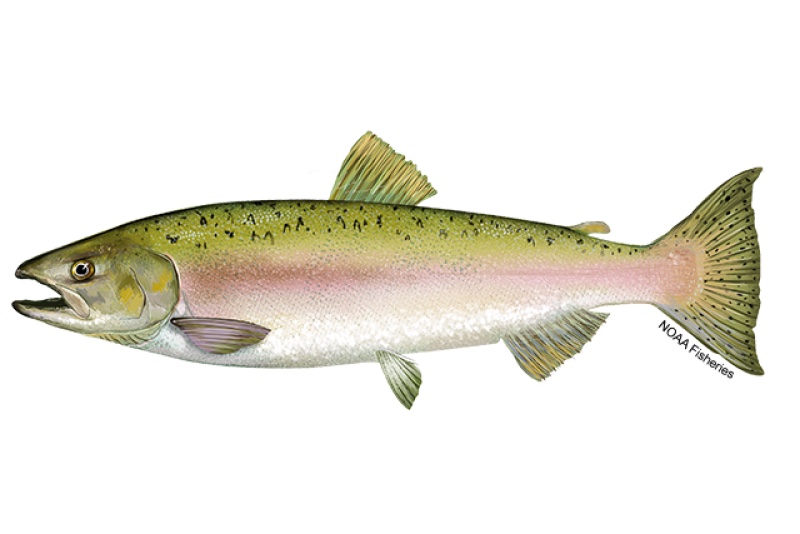
The pink is the compact salmon: silver at sea with large oval blotches on the back and tail, averaging just 3.5 to 5 pounds. Spawning males earn both nicknames at once, developing the very large hump and the hooked jaws — the kype — that make a humpy unmistakable. The species' strangest feature is invisible: an almost perfectly fixed clock. Alaska's agency states it plainly — pinks mature and complete their entire life cycle in two years.
That rigid clock has a remarkable consequence: the predictable two-year cycle has created genetically distinct odd-year and even-year populations, two lineages sharing the same rivers without ever meeting. NOAA notes most systems run pinks in odd years. They are the most abundant Pacific salmon, spawning close to the sea — generally within 30 miles of a river mouth — and, like their relatives, all die after spawning. There is also an unplanned second range: pinks reached Lake Superior by accident in 1956, when about 100 salmon escaped during a hatchery transfer to a seaplane, and by 1979 the species had spread through all the Great Lakes, where it now completes its life cycle entirely in fresh water.
Interesting Facts About Pink Salmon
- The smallest Pacific salmon in North America — and the most abundant.
- The entire life cycle takes two years, almost without exception.
- That fixed clock has created genetically distinct odd-year and even-year populations.
- Most river systems run pinks in odd years.
- Spawning males develop a huge hump and hooked jaws called a kype — hence humpback and humpy.
Show more facts
- They spawn close to the sea, generally within 30 miles of a river mouth.
- All pink salmon die after spawning.
- The diet is small crustaceans, zooplankton, squid and small fish.
- Pinks reached the Great Lakes by accident in 1956, escaping during a hatchery transfer to a seaplane.
- By 1979 they had spread throughout the Great Lakes, living entirely in fresh water.
- USGS gives a preferred temperature range of 5.6 to 14.6 °C, with an optimum of 10.1 °C.
- About 90% of Great Lakes adults mature as two-year-olds — the clock survived the move inland.
Average Speed & Size
Pink salmon average 3.5 to 5 pounds at 20 to 25 inches — NOAA and Alaska's agency give identical figures — with USGS recording a maximum around 76 centimetres, and Great Lakes fish topping out smaller at about 50. Alaska's trophy-certificate minimum of 6 pounds says everything about the scale: a six-pound humpy is certificate-worthy. We have not found a verified hook-and-line record from an agency source, so we do not quote one. What pinks lack in size they return in numbers and willingness — on light tackle, an aggressive fresh-run pink is honest sport.
Where to Find Them
Think short and close to salt. Pinks spawn in the lower reaches of coastal rivers, generally within 30 miles of the mouth, so tidewater stretches fish best. Returns run August to October coastwide, and late June to mid-October in Alaska — but the year matters as much as the month: check whether your river runs odd or even years, because the other lineage simply is not there. In the Great Lakes, the accidental population gives inland anglers a genuine pink run. USGS's temperature preference of roughly 6 to 15 °C explains the cold-water timing.
Pink Salmon Fishing Tips
Pink fishing is timing plus small, bright presentations. When a run is in, the fish are abundant, aggressive and close to the sea — the game is being there in the right year, in the right two months.
Equipment
Light to medium tackle turns pinks into proper sport: a medium-light rod with 8- to 12-pound line is ample. In tidewater a longer rod helps cover water. Single-hook rules are common in salmon rivers — check local regulations before rigging.
Chumming
Not applicable and generally prohibited in salmon waters. The run concentrates the fish for you; the calendar is the attractant.
Bait
Small and pink is the tradition for good reason: small pink jigs, spoons and flies match the crustacean-heavy diet. Retrieve slowly — pinks follow and nip rather than smash.
Patience
Confirm the cycle before the trip: an odd-year river in an even year holds no run at all. Once fish are in, work tidewater on a moving tide and expect numbers rather than size — and bleed and chill fish quickly if keeping, as pink flesh softens faster than other salmon.
Conditions that change the bite
- What Barometric Pressure Is Best for Fishing? No research supports a single best barometric pressure for fishing. What pressure really does, how big a weather swing is, and what to watch instead.
- Best Time of Day to Fish: What Evidence Shows Dawn and dusk are measurably better — and the edge is smaller than the folklore says. The 13-year dataset, the light mechanism, and what matters more.
- Dissolved Oxygen: The Condition Anglers Can't See Fish live or die by oxygen you can't see. How temperature, depth, dawn and turnover move it, which species need more, and how to fish around the invisible map.
Guides for fishing this species
- Trout vs Salmon: Same Family, Very Different Lives Trout, salmon and char all share one family — the real split is life history. Why Pacific salmon die after spawning, steelhead don't, and where char fit in.
- The Slip Float Rig: Bobber Fishing at Any Depth How the slip float rig works — bobber stop, bead, sliding float, weight, hook — why it beats a fixed bobber, and the small-float rule agencies keep repeating.
Related Species
Know when they'll bite.
BiteScore forecasts when pink salmon will feed at your spot — from live weather, pressure, and moon data.
Get the App