Texas Rig vs Carolina Rig
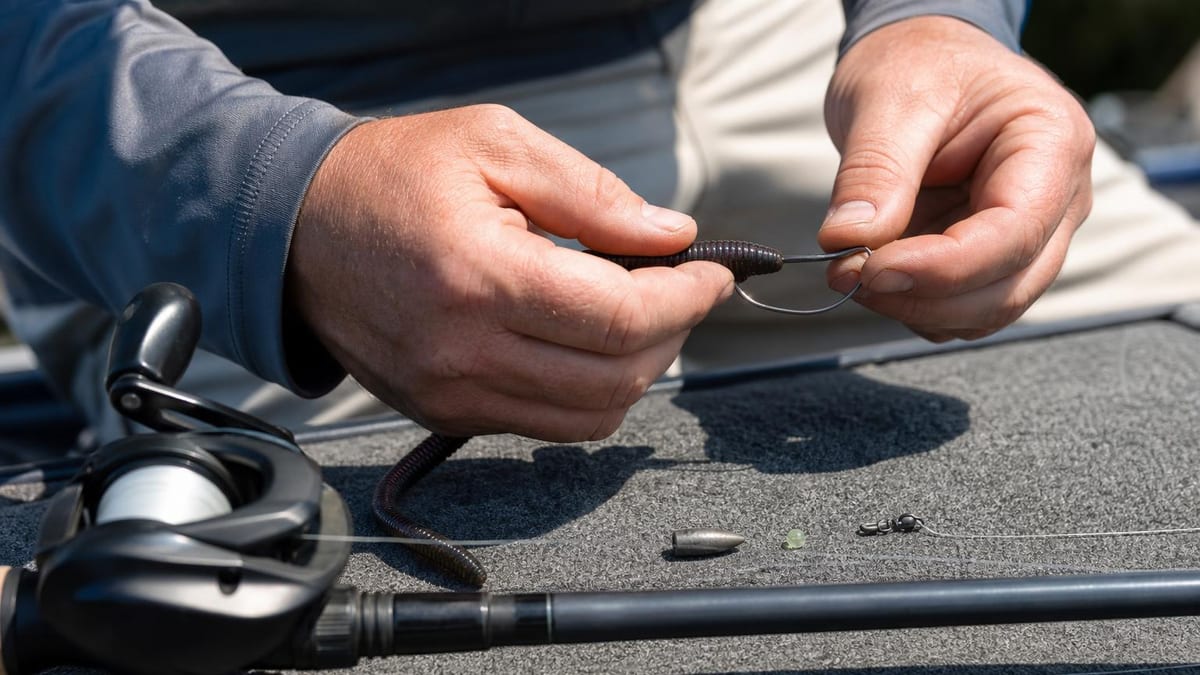
A Texas rig runs a sliding bullet weight straight down onto the bait with the hook point buried in the plastic, which makes it weedless and suits any type of cover from shallow to deep. A Carolina rig separates the weight from the bait with a swivel and a leader, so a fish feels less resistance when it takes the bait and holds on longer.
Key takeaways
- Both rigs use the same hook and the same soft plastic — the weight placement is the only real difference.
- The Texas rig's buried hook point is what makes it weedless; an exposed hook snags on almost everything.
- On a Carolina rig the fish feels less resistance, holds the bait longer, and gives you more time to detect the bite.
- Texas rigs take a forceful hook set; Carolina rigs take a sweeping one.
- Several states and national parks restrict lead weights, and non-lead alternatives are widely available.
Two rigs, one difference
Both rigs use the same soft plastic and the same style of hook, and the only thing that changes is where the weight sits. That is worth stating plainly, because the names suggest two unrelated techniques when in fact one is a variation on the other.
The Texas rig runs a sliding bullet weight down the line to rest against the head of the bait. Texas Parks and Wildlife describes the construction as “running a sliding weight on your line, the line tied to an appropriate hook and the hook point inserted into the worm body in such a way that the barbed point is buried in the plastic.” The reason for burying the point is given just as bluntly: exposed hooks snag on nearly everything they contact.
The Carolina rig takes the same weight and stops it short. A barrel swivel goes on below the weight, a leader runs from the swivel, and the hook and bait go on the end of that leader. The bait is now trailing well behind whatever the weight is doing.
What the separation actually buys you
The advantage is in what the fish feels, not in how the bait moves. This is worth being precise about, because the usual explanation — that the bait glides above the bottom — is not something the agency sources actually claim.
What they do claim is specific and more useful. Texas Parks and Wildlife puts it this way: with a Carolina rig, “when a bass picks up the plastic bait, it feels less resistance. It feels more natural to the bass and it holds the bait longer. At the same time, the angler has more time to detect the bite.”
That is a genuine mechanical advantage. The line slides through the weight, so for the first moment of the take the fish is not dragging half an ounce of metal. It commits rather than dropping the bait, and the extra second is often the difference between a hooked fish and a bite you never registered.
The Texas rig gives that up deliberately in exchange for getting into places the Carolina rig cannot go. A compact rig with the hook point buried in the plastic will come through wood, weed and brush that would leave a trailing leader hopelessly snagged.
Choosing between them
Pick the Texas rig when there is cover to get through, and the Carolina rig when there is water to search. Texas Parks and Wildlife calls the Texas rig “very versatile; it can be used anywhere from shallow to deep and is useful for fishing a soft plastic bait in any type of cover,” and describes it as the rig all bass anglers need to master.
For the Carolina rig the same source is equally direct: it “is generally more effective in deeper water and is a good setup for novice anglers. It also seems to be better for windy conditions.” Missouri’s Department of Conservation extends the depth range further, describing it as effective in shallow water in spring but also catching bass down to 35 feet off secondary and primary points.
Weight selection follows conditions rather than habit. Texas Parks and Wildlife ties it directly to wind and clarity: three-quarter or one-ounce weights when it is really windy, but six-inch worms and eighth-ounce weights when the weather is calm and the water is clear. Missouri’s guidance is to use only enough weight to stay in contact with the bottom, since lighter sinkers hang up less and improve your feel for a strike.
Leader length is the Carolina rig’s main adjustment. Short leaders suit shallow or weedy water and long leaders suit deep water, with 18 inches a reasonable starting compromise. Keep the leader lighter than the main line, so that a snagged hook costs you the hook rather than the weight, swivel and everything else.
The hook set is not the same
Change how you set the hook when you change rigs, because the two demand opposite motions. This catches out anglers who fish one rig for years and then switch.
A Texas rig needs force. The hook point is buried in plastic and has to be driven through the bait and into the fish, and Texas Parks and Wildlife is explicit that most of the time a forceful, powerful hook set is required, warning that without one the fish may be on the line momentarily and then simply come off.
A Carolina rig needs a sweep. The same source says to “sweep the rod to the side and start reeling” — and the reason is the slack. With a leader, a swivel and a sliding weight between you and the fish, a hard upward strike takes up slack rather than moving the hook. Sweeping sideways while reeling loads the rod progressively and drives the hook home.
What the weight is made of
This is the part of rig selection most anglers never think about, and in some waters it decides whether your tackle is legal at all. Both rigs are traditionally built around a lead weight, and lead is increasingly restricted.
Yellowstone National Park permits only lead-free tackle. Its regulations state that “leaded fishing tackle such as leaded split-shot sinkers, weighted jigs (lead molded to a hook), and soft lead-weighted ribbon for nymph fishing are not allowed,” while non-toxic split shot, sinkers and jig heads molded with bismuth-tin, molybdenum or tungsten are permitted. Maine’s Department of Inland Fisheries and Wildlife prohibits the use and sale of lead sinkers and unpainted lead jigs measuring 2.5 inches or less or weighing one ounce or less.
The reason is ingestion by waterbirds. New York’s Department of Environmental Conservation explains the mechanism: “Many lead sinkers and jigs are similar in appearance to the small stones and grit that birds swallow to help digest food in their gizzards.” A bird that swallows one becomes emaciated and dies within two to three weeks. Maine’s agency describes lead tackle as the third leading cause of death for adult common loons in the state, and the Minnesota Pollution Control Agency puts the current national estimate at 25% of adult loon deaths.
Size is why small weights are the problem and heavy ones are not. Yellowstone permits large downrigger weights specifically because they “are too large to be ingested by wildlife.” The bullet weights and split shot used on these two rigs sit squarely in the swallowable range.
One substitution catches people out. Brass is a common weight material and is not a safe alternative — New York’s agency notes that brass contains zinc, which is also toxic to wildlife. The alternatives its brochure lists are bismuth, tin, recycled glass, tungsten and steel. Minnesota adds a practical argument for tungsten beyond the environmental one: it sinks faster, is denser, and is more sensitive than lead, which for a rig that depends on bottom feel is a real advantage. If you are unsure what a weight in your box is made of, Minnesota offers a simple test — lead is grey and dull, and leaves a grey mark if you scratch it on paper.
Limitations and context
Regulations on lead tackle vary by state and by individual water, and they change. Nothing here is a substitute for your own state fish and wildlife agency’s current rules, and the restrictions described above apply to the specific jurisdictions named rather than nationally.
The evidence on lead is also worth characterising honestly. Individual bird deaths from ingested tackle are well documented, and they are the stated basis for the restrictions that exist. Whether lead tackle drives declines at the population level is contested, and we have not seen evidence that settles it either way.
Finally, both rigs are starting points rather than fixed recipes. Texas Parks and Wildlife lists pegged weights, weightless presentations and changes in weight shape as variations on the Texas rig alone. Which soft plastic you hang on either one is a separate question — our guide to fishing soft plastics covers the shapes and what the research does and does not support about them.
Frequently asked questions
What is the difference between a Texas rig and a Carolina rig?
The weight. On a Texas rig a sliding bullet weight sits directly against the bait, keeping the whole rig compact and weedless. On a Carolina rig the weight is stopped by a swivel and the bait trails behind on a separate leader. Texas Parks and Wildlife explains the practical consequence: with the weight held away, a bass 'feels less resistance', holds the bait longer, and the angler gets more time to detect the bite.
Which rig should a beginner start with?
Both have a case, and Texas Parks and Wildlife makes it for each. It calls the Texas rig 'the rig all bass anglers need to master' and describes it as usable anywhere from shallow to deep in any type of cover. It separately calls the Carolina rig 'a good setup for novice anglers' and better in deeper water and wind. If you fish heavy cover, learn the Texas rig first.
How long should a Carolina rig leader be?
Guidance from the Recreational Boating and Fishing Foundation is that short leaders suit shallow or weedy water, long leaders suit deep water, and 18 inches is a reasonable compromise for most fishing. Missouri's Department of Conservation suggests starting at two feet and adjusting, and keeping the leader lighter than the main line so a snag costs you the hook rather than the whole rig.
Do I need to peg the weight on a Texas rig?
Not by default. Texas Parks and Wildlife describes the standard Texas rig as running a sliding weight, and lists pegging it so that it does not slide at all as one variation among several, alongside fishing it weightless. Pegging keeps the rig compact through thick cover; leaving it free lets the bait fall a little more independently.
Are lead fishing weights legal?
It depends entirely on where you fish, and the rules change. Yellowstone National Park allows only lead-free tackle and specifies bismuth-tin, molybdenum or tungsten as acceptable alternatives. Maine prohibits the use and sale of lead sinkers and unpainted lead jigs at or below 2.5 inches or one ounce. Other states differ. Check your own state fish and wildlife agency before you buy weights.
Sources
- Rigging Up, Not Wigging Out (Texas Fishing 2013) — Texas Parks & Wildlife Department. Accessed August 5, 2026.
- What, Where and When — Carolina Rigging — Missouri Department of Conservation. Accessed August 5, 2026.
- Try a Carolina Rig for Minnesota Bass — Take Me Fishing (Recreational Boating & Fishing Foundation). Accessed August 5, 2026.
- 2026 Fishing Regulations — Yellowstone National Park, National Park Service. Accessed August 5, 2026.
- Lead Fishing Tackle — Maine Department of Inland Fisheries & Wildlife. Accessed August 5, 2026.
- Get the Lead Out! — New York State Department of Environmental Conservation. Accessed August 5, 2026.
- Getting the Lead Out of Fishing Tackle — Minnesota Pollution Control Agency. Accessed August 5, 2026.
How we choose sources: sources policy.
More in this series
Know when it's worth going.
Fishing Club AI turns live weather, pressure and moon data into a simple bite forecast for your spot — so the skills you practise get used on the right day.
Get the App