Greater Amberjack
Seriola dumerili
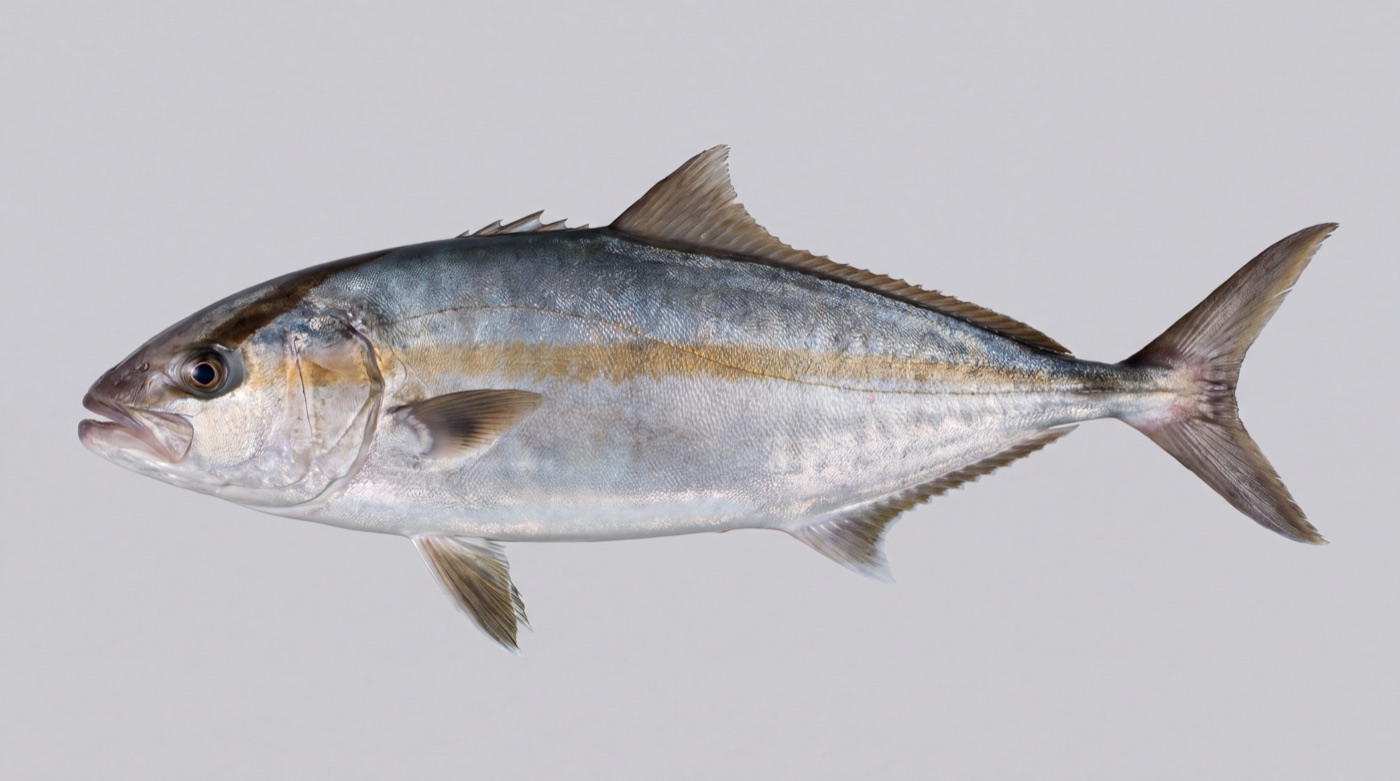
Greater amberjack is a powerful reef-dwelling member of the jack family, identified by the dark diagonal band running from its nose through the eye to the first dorsal fin.
MoreFull Species Details
- Species Name
- Seriola dumerili
- Family
- Carangidae
- Order
- Carangiformes
- Also Known As
- Allied kingfish, Great yellowtail, Kahala, Rock salmon
Greater Amberjack (Seriola dumerili) Fish Description
Greater amberjack is a powerful reef-dwelling member of the jack family, identified by the dark diagonal band running from its nose through the eye to the first dorsal fin.
The body is elongated and muscular, olive-brown to blue-grey above and silver below, with an amber horizontal stripe along the middle of the flank. The identifying feature runs across the head: the Florida Museum calls it a dusky mask stretching from the upper jaw through the eye to the first dorsal fin, while NOAA describes the same mark as a dark amber strip. Florida's wildlife agency adds a detail anglers notice on the water — the stripe 'lights up' when the fish is in feeding mode. The anal fin is about two-thirds the length of the second dorsal, and unlike some relatives the body carries no scutes.
Greater amberjack live over offshore hard structure in subtropical waters, ranging in the western Atlantic from Nova Scotia to Brazil including the Gulf of Mexico and Caribbean, with a separate Indo-West Pacific distribution. They congregate around reefs, rocky outcrops and wrecks in 60 to 240 feet of water, hunting crabs, squid and reef fish. Juveniles are the exception, sometimes appearing in less than 30 feet. The species is a byword among anglers for raw pulling power, and it is one of the more tightly regulated reef fish in US waters — the Gulf stock has been under a rebuilding plan since 2002.
Interesting Facts About Greater Amberjack
- They live up to 17 years and reach six feet.
- The dark stripe through the eye 'lights up' when the fish switches into feeding mode.
- The anal fin is roughly two-thirds the length of the second dorsal — a useful jack identification key.
- There are no scutes on the body, unlike some other jacks.
- Adults eat mostly crab, squid and reef fishes.
Show more facts
- They spawn primarily from March to June over reefs and shipwrecks.
- Sources differ on maturity: NOAA gives three to four years, the Florida Museum four to five.
- Juveniles sometimes turn up in water less than 30 feet deep.
- The Gulf stock has been in a formal rebuilding plan since 2002.
- The Florida state record is 142 pounds, caught near Islamorada.
- The parasites anglers find in the fillet are larval tapeworms, not roundworms.
- Florida's research institute notes that a rich parasite community indicates an intact food web, not a degraded one.
Average Speed & Size
Greater amberjack reach six feet and 200 pounds, but NOAA notes they are most commonly found up to about 40 pounds, and Florida's wildlife agency describes them as common around 40 inches and under 40 pounds. The Florida state record stands at 142 pounds from near Islamorada. Size is not really the point with this species — the fight is. An amberjack hooked over a wreck turns immediately for the structure and pulls with a sustained, low-gear power that punishes tackle and anglers alike, which is why the species is often the hardest-pulling fish an angler has hooked.
Where to Find Them
Look for offshore hard structure in 60 to 240 feet of water — NOAA, Florida's wildlife agency and the Florida Museum all give that same depth band. Sub-adults and adults congregate around reefs, rocky outcrops, wrecks and floating debris, and the fish are strongly structure-associated rather than roaming. Spawning aggregations form over reefs and shipwrecks from March to June, though Florida's agency notes spawning is thought to occur offshore through most of the year. Juveniles use much shallower water, sometimes under 30 feet. We have not found a verified temperature preference for the species, so we do not give one.
Greater Amberjack Fishing Tips
Amberjack fishing is structure fishing with the volume turned up. Find a wreck or a reef in the right depth band, and the challenge shifts immediately from finding fish to keeping one out of the very structure that attracted it.
Equipment
Use heavier tackle than the fish's weight suggests. A stout rod and a reel with a strong drag and 60- to 100-pound line are justified entirely by where the fish lives: an amberjack that reaches the wreck will cut you off within seconds. Heavy abrasion-resistant leader is essential, not optional.
Chumming
Amberjack respond well to being brought up off the structure. A chum stream or a few hooked baits can raise the whole school toward the surface, and a fish fought in open water above the wreck is a far better proposition than one fought down in it.
Bait
Live baitfish are the standard and are hard to beat. Vertical and speed jigs worked fast over structure are highly effective, and the aggressive response to a fast-moving jig is one of the reasons the species is popular.
Patience
Almost none is needed for the bite and a great deal for the fight. The first ten seconds decide the outcome — lock up and lift immediately to turn the fish away from structure, rather than letting it run. Check regulations before you go: bag limits are typically a single fish and seasons are restricted.
Conditions that change the bite
- What Barometric Pressure Is Best for Fishing? No research supports a single best barometric pressure for fishing. What pressure really does, how big a weather swing is, and what to watch instead.
- Best Time of Day to Fish: What Evidence Shows Dawn and dusk are measurably better — and the edge is smaller than the folklore says. The 13-year dataset, the light mechanism, and what matters more.
- Dissolved Oxygen: The Condition Anglers Can't See Fish live or die by oxygen you can't see. How temperature, depth, dawn and turnover move it, which species need more, and how to fish around the invisible map.
Guides for fishing this species
- The High-Low Rig: Two Hooks, One Bottom Rig The high-low (double dropper loop) rig explained — how to build it, why two baits beat one on the bottom, and the hook-limit rules that vary by state.
Related Species
Know when they'll bite.
BiteScore forecasts when greater amberjack will feed at your spot — from live weather, pressure, and moon data.
Get the App