Black Sea Bass
Centropristis striata
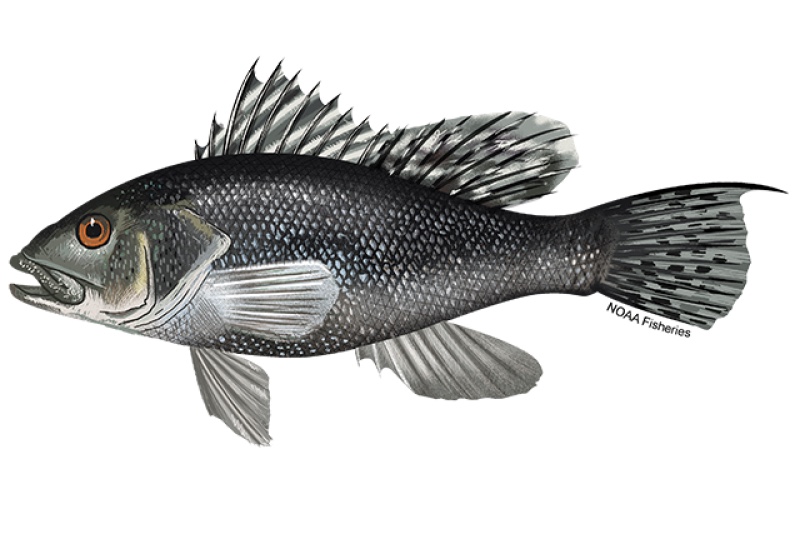
Black sea bass is a structure-loving Atlantic bottom fish with a remarkable biology: most start life as females and become males as they grow, and spawning males develop a bright blue hump on the head.
MoreFull Species Details
- Species Name
- Centropristis striata
- Family
- Serranidae
- Order
- Perciformes
- Also Known As
- Sea bass, Blackfish, Rock bass, Tallywag
Black Sea Bass (Centropristis striata) Fish Description
Black sea bass is a structure-loving Atlantic bottom fish with a remarkable biology: most start life as females and become males as they grow, and spawning males develop a bright blue hump on the head.
The body is stout and dark — smoky grey to black — with each scale carrying a pale blue centre, forming faint horizontal lines along the flank. The extraordinary feature arrives at spawning time: NOAA describes dominant males turning bright blue and developing a blue hump on their heads, the nuchal hump that makes a big spawning male unmistakable. Despite the name, this is no relative of freshwater black bass; it belongs to Serranidae, the true sea basses, a family shared with groupers.
Black sea bass live on structure along the Atlantic coast — NOAA gives a range from Cape Cod to the Gulf, and the interstate commission extends it from the Gulf of Maine to the Florida Keys. They hold on reefs, wrecks, rock bottom, oyster beds, pilings and jetties, hunting crabs, shrimp, worms, small fish and clams by day. The biology is the story: the species is a protogynous hermaphrodite. Most fish begin as females and, somewhere between 9 and 13 inches and two to five years of age, become males — the commission reports that 38% of Mid-Atlantic females reverse sex between August and April, after spawning.
Interesting Facts About Black Sea Bass
- Most black sea bass start life as females and become males as they grow — protogynous hermaphroditism.
- Sex change happens at roughly 9 to 13 inches, between two and five years of age.
- In the Mid-Atlantic, 38% of females reverse sex between August and April, after most spawning.
- Spawning males turn bright blue and grow a blue hump on the head.
- Each scale has a pale blue centre, forming horizontal lines along the body.
Show more facts
- They prefer structured habitat: reefs, wrecks, oyster beds, rock bottom, pilings and jetties.
- They are solitary bottom-dwellers that hunt by day, when they can see prey.
- The diet is crabs, shrimp, worms, small fish and clams.
- Females live up to 8 years; males up to 12.
- Despite the name, they are true sea basses — the grouper family, not freshwater bass relatives.
- The stock was measured at 2.84 times its biomass target in the latest assessment.
- NOAA's status: not overfished, and not subject to overfishing.
Average Speed & Size
Black sea bass are a modest, satisfying size rather than a trophy species. The Chesapeake Bay Program gives an average around 12 inches, and NOAA describes slow growth to a maximum of about 2 feet and 9 pounds. The fish punches above its size on the rod — a sea bass turns side-on and bulldogs for the structure it came from — and it more than compensates at the table, which is much of why the recreational fishery exists. Bigger fish are disproportionately males, which follows directly from the sex-changing biology.
Where to Find Them
Find hard structure and you have found black sea bass. NOAA lists reefs, wrecks and oyster beds as preferred habitat, and the interstate commission adds rock bottoms near pilings, wrecks and jetties. The fish are solitary bottom-dwellers rather than schoolers, but structure concentrates them into what fishes like a school. The range runs along the Atlantic coast from New England to Florida, with the Chesapeake and Mid-Atlantic wreck fields the classic grounds. Day fishing is the rule — the species hunts by sight when light lets it see prey.
Black Sea Bass Fishing Tips
Sea bass fishing is honest bottom fishing over structure: get a bait to the wreck, feel the sharp rap, and lift the fish clear before it turns back in. Position over the structure decides the day.
Equipment
A medium conventional or spinning outfit with 20- to 30-pound braid gives the sensitivity to feel bites in deep water and the backbone to lift fish from wrecks. A two-hook bottom rig with enough sinker to hold vertical is standard. Abrasion-resistant leader saves rigs around rusted steel and shell.
Chumming
Chumming is rarely needed — the structure has already gathered the fish — but a crushed clam or shrimp scent stream can wake up a slow bite. Repositioning the boat a few metres often outperforms any attractant, because sea bass hold tight to specific features.
Bait
Squid strips, clams and cut fish are the standards, matching the natural diet of crabs, shellfish and small fish. Small jigs and bucktails tipped with bait work well on fish holding just above the wreck.
Patience
Precision beats persistence. If five minutes over a spot produces nothing, the boat is off the structure — move rather than wait. Check current regulations before keeping fish: seasons and limits change year to year, and your state agency publishes the current rules.
Conditions that change the bite
- What Barometric Pressure Is Best for Fishing? No research supports a single best barometric pressure for fishing. What pressure really does, how big a weather swing is, and what to watch instead.
- Best Time of Day to Fish: What Evidence Shows Dawn and dusk are measurably better — and the edge is smaller than the folklore says. The 13-year dataset, the light mechanism, and what matters more.
- Dissolved Oxygen: The Condition Anglers Can't See Fish live or die by oxygen you can't see. How temperature, depth, dawn and turnover move it, which species need more, and how to fish around the invisible map.
Guides for fishing this species
- How to Tie a Dropper Loop The dropper loop in four diagrammed steps — a standing loop mid-line for multi-hook rigs, plus the twist count and the pull that forms it correctly.
- The High-Low Rig: Two Hooks, One Bottom Rig The high-low (double dropper loop) rig explained — how to build it, why two baits beat one on the bottom, and the hook-limit rules that vary by state.
Related Species
Know when they'll bite.
BiteScore forecasts when black sea bass will feed at your spot — from live weather, pressure, and moon data.
Get the App